
YOOPAI 2-Pack Cold Build Plate Review: Aggressive Bed Grip
By AValidReview. An AI-assisted summary of customer feedback, not a hands-on test.
The modern 3D printing enthusiast suffers from what can be called the hotbed hangover: the ingrained habit of cranking heated beds to 60 degrees Celsius simply to ensure PLA prints do not lift at the edges. Between chamber heat creep and wasted wattage, heated beds introduce as many complications as they resolve. Cold build surface sheets promise to untangle this friction, and third-party manufacturers have aggressively entered the market with specialized coatings designed to grip filament near ambient room temperature.
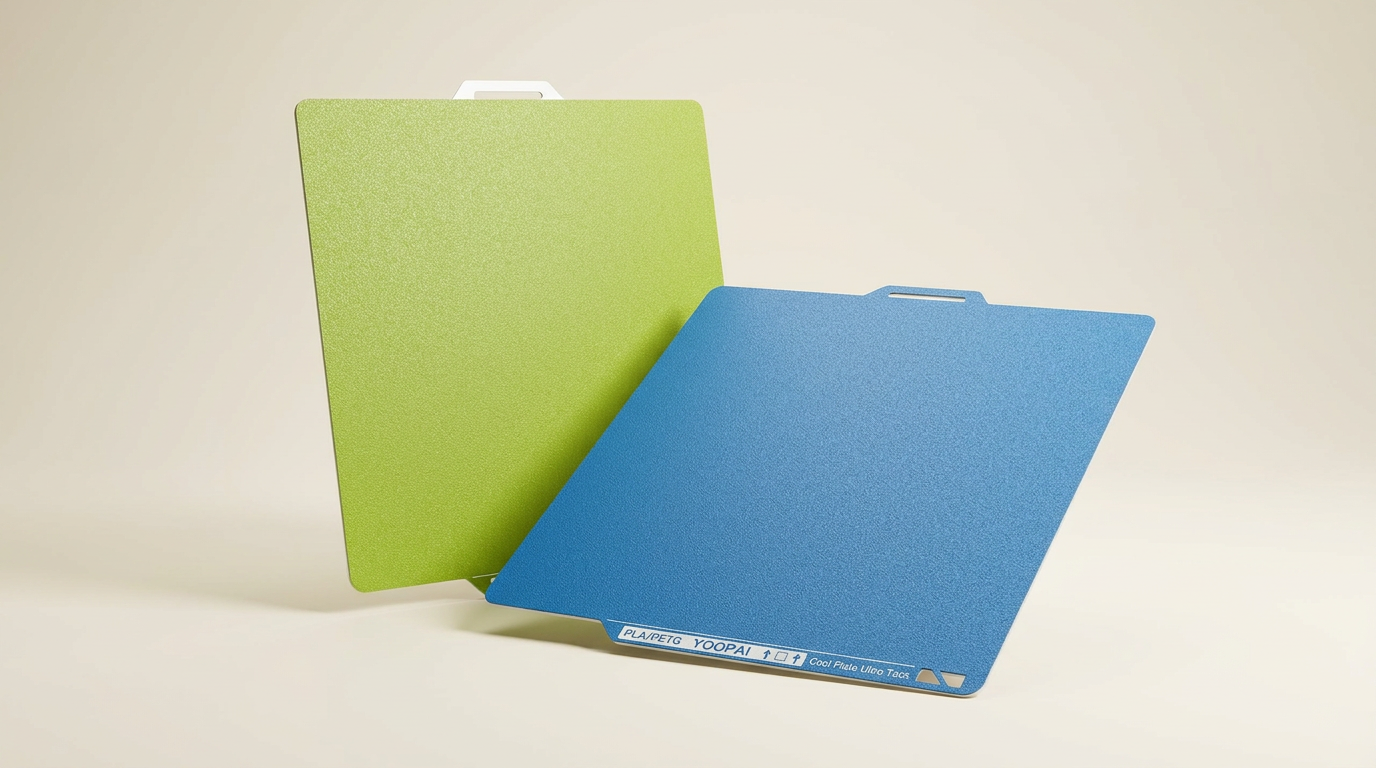
The YOOPAI 2-Pack Cold Build Plate targets Bambu Lab owners with an aggressive pitch: run bed temperatures as low as 25 degrees Celsius, slice power consumption, and swap sheets instantly to keep the nozzle moving. Packed as a two-tone bundle featuring one blue and one green double-sided spring steel sheet, the set offers an alternative to premium cold surfaces like the Biqu CryoGrip at roughly half the typical price point.
Yet hyper-tack surfaces introduce their own engineering trade-offs. While the promise of zero-lifting corners is seductive for printing wide structural models, grip can quickly tip into structural destruction if a plate grabs filament too tightly. Examining hands-on performance reveals whether YOOPAI delivers genuine operational efficiency or simply replaces bed warping with removal anxiety.
What owners love
- + Tenacious room-temperature adhesion eliminates warping on PLA prints
- + Two-pack bundle enables zero-wait continuous swapping
- + Significantly lower heated bed wattage during long prints
- + Machine-readable QR codes register smoothly on compatible models
- + Priced far below established name-brand cold plate competitors
Common complaints
- − Bond strength can be excessive, risking part breakage if removed while warm
- − PETG performance is erratic compared to reliable PLA grip
- − Coating is vulnerable to bubbling or peeling when subjected to high temperatures
- − Sheet margins are fractionally smaller than the factory heated bed
Design & Build
YOOPAI delivers a pair of dual-sided flexible spring steel sheets in distinct blue and green finishes. The core sheet dimensions measure 257 by 257 mm, engineered to fit the bed alignment notches of standard Bambu Lab enclosures. In practice, several owners observe that the plates sit fractionally smaller than the physical aluminum heatbed, leaving a tiny perimeter gap. This tolerance variation does not impact actual printable area, but it highlights the looser production constraints typical of third-party accessory makers. The surface texture itself is notably shallower and finer than the deep peaks found on factory gold textured PEI, resulting in a cleaner bottom layer sheen. However, the proprietary cold-tack coating requires delicate thermal management. Subjecting these sheets to standard high-temperature profiles can cause the surface film to blister and lift away during routine washing.
Setup & Ease of Use
Setting up the plates requires rethinking your default slicing profiles. Instead of defaulting to 55 or 65 degrees Celsius, these sheets thrive between 25 and 35 degrees Celsius. YOOPAI includes printed identification markers near the rear alignment tab. Owners running printers with optical plate scanners report reliable automatic detection, though recognition consistency varies slightly across hardware revisions. Surface cleanliness is paramount: cold adhesives rely entirely on microscopic surface energy rather than thermal plasticization, meaning finger oils will instantly ruin first-layer adherence. A thorough scrub with warm dish soap prior to initial use is mandatory. Because the bundle provides two separate plates, it introduces the continuous swap cycle: rather than waiting for a single plate to chill before clearing a print, you immediately drop the second cold sheet onto the magnetic bed and resume production.
Performance in Real Use
In everyday printing with standard and matte PLA, the grip strength is remarkable. Tall, narrow geometries and sharp diagonal features hold fast without brims or auxiliary adhesives. The energy benefits are tangible; users monitoring smart plugs observe printers drawing roughly 65 to 70 watts during active printing compared to the higher draw required to hold a bed at 60 degrees. However, this extreme grip exposes the hyper-adhesion trap: attempting to pry a model off before the plate drops to ambient temperature frequently leads to delamination or destroyed part layers. The plate must fully cool before flexing, at which point models release cleanly. Filament compatibility is also bifurcated. While PLA grips flawlessly, PETG yields mixed results. Several users report complete failure to adhere under standard profiles unless bed temperatures are manually bumped back up, mirroring the finicky behavior seen on original cool sheets.
Software & Ecosystem
Integrating third-party build surfaces into Bambu Studio requires minor user diligence. Selecting the standard Cool Plate profile in the slicer generally yields the correct baseline, but users must manually enforce low bed temperatures to avoid cooking the delicate top layer. The printed code on the sheet generally passes the start-of-print scan, sparing users annoying surface mismatch errors. That said, the automated printer ecosystem is tuned around PEI and high-temp engineering plates; when you feed it a specialized ultra-tack sheet, the printer firmware assumes standard removal mechanics that can mislead inexperienced users. The hardware relies on your patience rather than the automated release routines designed for standard textured PEI.
Value & Reliability
Value is where YOOPAI stakes its strongest claim. Sourcing two functional, dual-sided cold plates for under $30 undermines the economics of premium specialty sheets, which often charge that much for a single piece of steel. For continuous print farms churning out PLA tokens, decorative goods, or functional brackets, the cost-to-utility ratio is exceptionally favorable. Long-term reliability rests entirely on operator discipline. Run the plate cold, clean it exclusively with detergent, and let prints release naturally, and the sheet will survive hundreds of operational hours. Abuse it with metal scrapers, abrasive cleaners, or high-temperature engineering filaments, and the proprietary coating will deteriorate rapidly. Factory support has proven responsive, quickly replacing sheets for users who suffered early coating delamination.
Verdict
Buy - An inexpensive, highly effective two-sheet package that solves PLA bed warping at room temperature, provided you respect its thermal boundaries.
This two-pack is ideal for Bambu Lab operators running continuous PLA production who want to lower their power draw, eliminate bed warping on wide flat models, and swap build surfaces without downtime. It is distinctly the wrong choice for users seeking a single universal surface for PETG, ABS, and high-temperature technical filaments, as high heat degrades the coating.
The YOOPAI plates expose the dirty secret of modern 3D printing: heated beds are often an inefficient sledgehammer used to crack the simple nut of first-layer grip. By trading thermal brute force for chemical surface tack, this set streamlines everyday PLA fabrication, provided you possess the patience to let your prints fully chill before prying them loose.
FAQ
More 3D Printer Parts & Accessories reviews
Wefuit Bambu Lab Liquid Bed Adhesive Review
Miskis 46-Piece 3D Printer Tool Kit Review: Bench Essentials
Dynta Silk PLA Bundle Review: 6 Colors, 250g Spools
HysiPrui P1S/P1P Integrated Hotend Review: Cheap Spares, Real Trade-Offs
HP OfficeJet Pro 8135 Review: The Cloud-Tethered Workhorse
HzdaDeve Bambu P1S Hotend 3-Pack Review: Value Meets Risk
This review is based on real experiences shared by owners in online communities.