
Uczdru Mini RGB LED Tea Lights for Bambu Lab KC020 Review
By AValidReview. An AI-assisted summary of customer feedback, not a hands-on test.
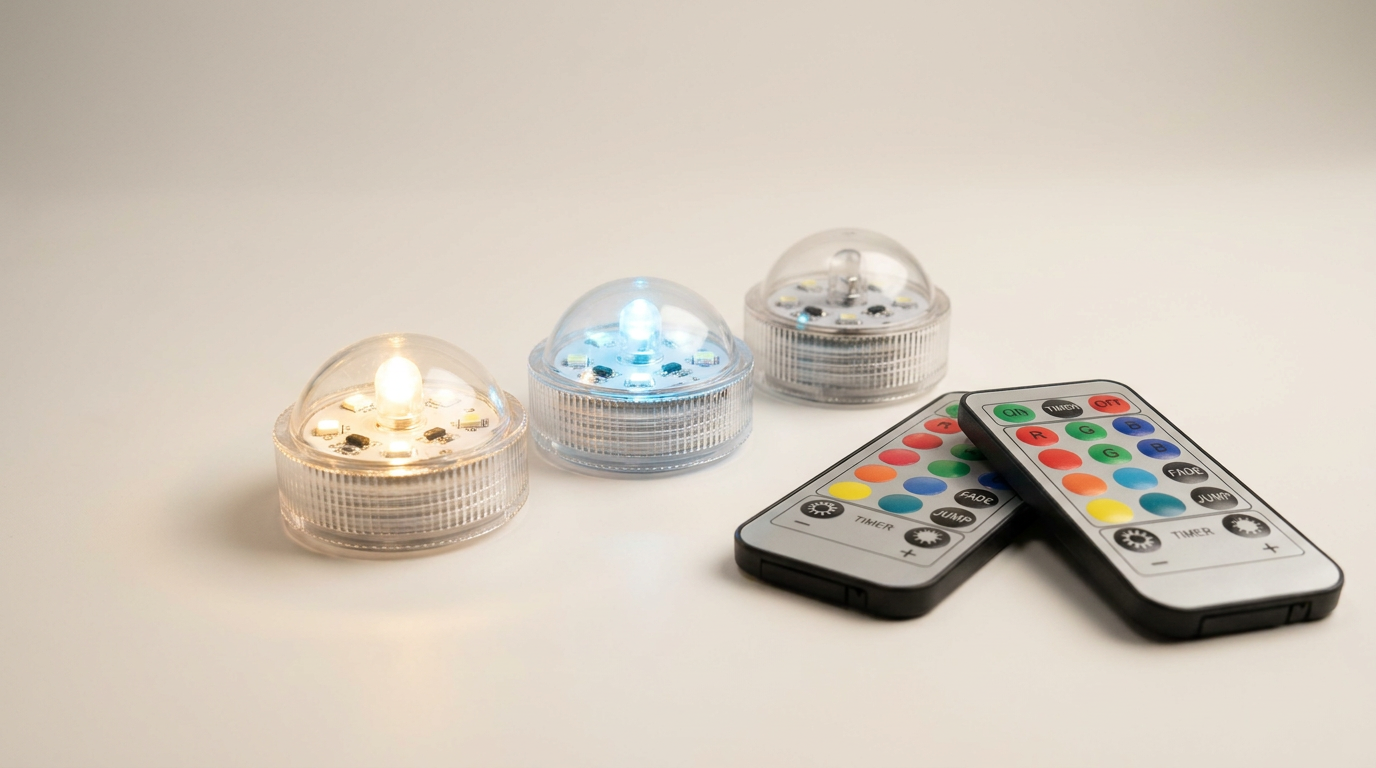
The explosion of maker repositories like MakerWorld has accelerated a shift toward component-first printing, where functional desktop models are designed around cheap, standardized off-the-shelf electronics. The Uczdru 6-pack of waterproof RGB tea lights targets this exact niche, matching the physical dimensions of Bambu Lab's KC020 hardware specification. On paper, it represents an effortless bridge between digital filament designs and functional decorative lamps.
Supplying six pucks alongside six individual infrared remotes is a clear nod to makers who produce multiple prints as separate gifts. Instead of tethering multiple units to a shared remote, each assembly acts as an autonomous module. However, pairing custom additive manufacturing with budget consumer electronics exposes an immediate friction point: what happens when long-term print projects rely on disposable, short-run power sources?
While these pucks offer substantial utility for weekend craft displays and water centerpieces, they also introduce what we call the disposable illumination trap. Buyers expecting continuous, seasonal ambient lighting will quickly run up against the harsh voltage curve of CR2032 coin cells.
What owners love
- + Dedicated infrared remote provided for every single light puck
- + Precise physical fit for Bambu Lab KC020 project specifications
- + Effective IP68 waterproof housing when properly threaded
- + Good color versatility across 13 static presets and brightness steps
Common complaints
- − Internal LED core drops out loosely when unscrewed for battery swaps
- − Jarring or setting down the housing can trigger accidental power activation
- − CR2032 cells exhaust usable remote-control voltage within 12 to 16 hours
- − Zero printed documentation included in the packaging
Design & Build
Each Uczdru puck measures 30 mm in diameter and 24 mm in height, matching the standard KC020 hardware cavity used across popular 3D printing platforms. The construction consists of a translucent polycarbonate twist housing sealed with an internal rubber O-ring. When fully threaded, the casing achieves an airtight IP68 seal that owners confirm holds up submerged in centerpieces and outdoor displays. However, the internal packaging compromises mechanical stability. Unscrewing the housing to access the battery compartment leaves the primary LED board completely unanchored, causing the assembly to drop out unexpectedly in your hand. Furthermore, internal tolerances are delicate: several owners note inadvertent contact triggers, where setting an unlit puck down onto a hard surface causes the internal leads to connect and activate the LED without remote input.
Setup & Ease of Use
The units ship with batteries pre-installed in both the light pucks and the infrared controllers, though Uczdru omits any form of paper documentation. While cycling colors and brightness is intuitive enough to grasp within a minute, troubleshooting requires deduction. The primary user-facing victory here is the one-to-one remote allocation. Packaging six distinct remotes with six individual lights is rare in budget bundles, allowing makers to gift finished 3D prints to family or clients without stranding anyone without a controller. The remotes use line-of-sight infrared, operating reliably up to roughly six feet. While one remote can trigger every puck placed in close proximity, having separate controllers ensures true standalone deployment across multiple rooms.
Performance in Real Use
Optical output is punchy when observed directly, but its real-world efficacy depends heavily on the diffusion layer. Inside thin-walled, translucent lithophanes or white PLA housings, the 13 static colors and 6500K cool white mode cast clean, vibrant hues. Conversely, several users testing the pucks in denser prints, such as seasonal Halloween pumpkins, found the overall lumen output inadequate to pierce thicker walls. The larger operational reality is what we term the disposable illumination trap. Operating these lights continuously at peak brightness drains the two CR2032 coin cells in roughly 12 to 16 hours. Once the cell voltage drops below a specific threshold, the pucks lose the ability to decode infrared signals, often remaining locked on a single static red hue or refusing to fire entirely until fresh batteries are installed.
Software & Ecosystem
Because these lights are hardware primitives rather than connected smart devices, their ecosystem begins and ends with the physical CAD models they inhabit. Bambu Lab popularized the KC020 footprint on MakerWorld to standardize accessory mounting, and Uczdru matches these tolerances accurately. The light capsules twist directly into base cavities without requiring glue, tension clips, or dimensional scaling in the slicer. For creators printing functional items, this mechanical uniformity bypasses the frustration of custom-soldering micro-USB harnesses or designing awkward battery doors. The trade-off is the absence of any automation, timers, or smart platform integration; you are strictly reliant on the physical line-of-sight infrared remote.
Value & Reliability
At a package price in the $20 range, the initial hardware cost per lighted project is exceptionally low, sitting at just a few dollars per illuminated model. That makes the kit a high-value purchase for hobbyists selling or gifting short-run prints. However, quality assurance is imperfect. Verified reports show occasional out-of-the-box dead units caused by depleted factory cells or faulty leads. More importantly, the hidden cost lies in the ongoing replenishment of coin-cell batteries. If an owner intends to run these lights as daily accent lamps, the cost of replacing four CR2032 cells per week will rapidly outstrip the price of the light pucks themselves, making a dedicated wired LED kit a far more economical long-term choice.
Verdict
Consider - Highly useful for modular 3D-printing gifts and short-duration party accents, but fundamentally unsuited for daily ambient home lighting.
This kit is tailor-made for desktop additive manufacturing hobbyists who need turnkey, drop-in hardware for MakerWorld projects without touching a soldering iron. Providing an independent remote for each puck makes it the ideal companion for distributing standalone printed gifts like lithophane boxes, night-light toys, and waterproof holiday ornaments.
Skip this set if your objective is continuous, set-and-forget lighting for a centerpiece or permanent shelf fixture. The coin-cell platform simply cannot support daily multi-hour runtimes without frustrating power drops and recurring battery costs.
The Uczdru pucks expose the inherent ceiling of the KC020 maker standard: while mechanical standardization makes printing seamless, relying on CR2032 cells treats functional prints as temporary novelties rather than permanent home decor.
FAQ
More 3D Printer Parts & Accessories reviews
OilStick 3D Printer Lubricant Brush Review
Eracosy Filament Storage Bags Review: The Seal Lottery
Fungiworks Filament Storage Box 4-Pack Review
Hemulac Hardened Steel Extruder for Bambu P1P and P1S Review
Creality Star-Shaped PTFE Tube Review: Smart Design, Mixed Results
YOOPAI 2-Pack Cold Build Plate Review: Aggressive Bed Grip
This review is based on real experiences shared by owners in online communities.