
Fungiworks Filament Storage Box 4-Pack Review
By AValidReview. An AI-assisted summary of customer feedback, not a hands-on test.
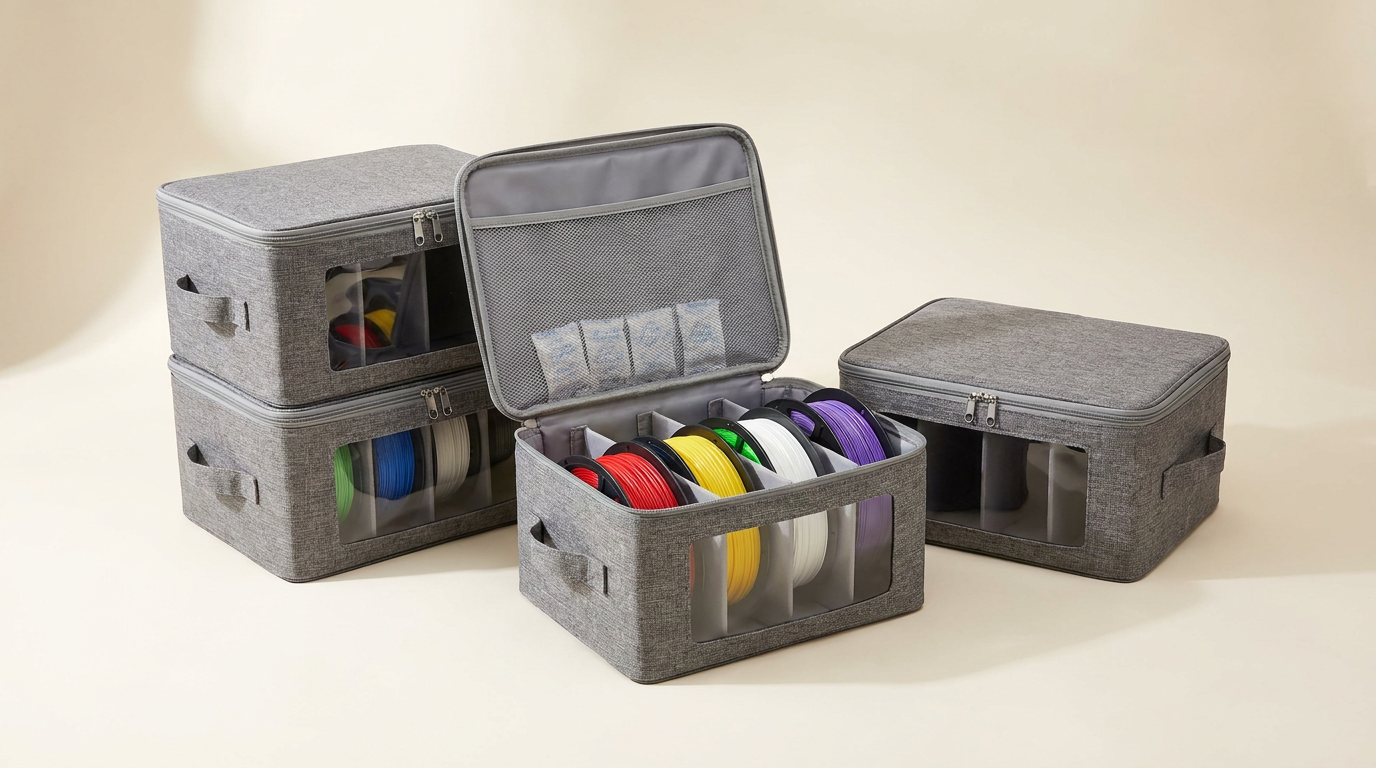
Filament management often falls prey to an airtight orthodoxy: the belief that every spare spool demands an individual gasketed plastic vault or a dedicated heating chamber. In practice, messy workspace friction creates just as many failed prints and abandoned projects as ambient humidity. Stacks of beaten-up cardboard shipping boxes and opaque plastic tubs turn color selection into an exercise in excavation.
Fungiworks targets this specific organizational problem with its four-pack of collapsible Oxford fabric storage boxes. Instead of mimicking laboratory dry cabinets, these cases function as a high-density staging buffer. Each box encloses roughly six standard spools, providing dust protection, basic desiccant slots, and front-facing transparency for around 24 kilograms of material across the entire kit.
The mechanical trade-off is straightforward. A zippered textile container cannot deliver the hermetic seal of a latching polypropylene container. However, for makers drowning in active inventory, this kit offers a tidy, space-efficient filing cabinet for the spools you actually use.
What owners love
- + Stores up to 24 standard spools across four uniform, space-efficient boxes
- + Clear viewing windows eliminate the need to unzip cases to check spool colors
- + Folds completely flat when empty to preserve shop storage space
- + Adjustable hook-and-loop dividers keep partial loads upright
- + Significantly neater aesthetic than shipping boxes or mismatched totes
Common complaints
- − Fabric and standard zippers cannot provide a truly airtight hermetic seal
- − Included desiccant packets are too small for high-humidity environments
- − Structural rigidity limits safe vertical stacking to two units high
- − Advertised seven-spool capacity is unrealistic for standard 1kg spools
Design & Build
The Fungiworks storage box relies on water-repellent Oxford fabric stretched over semi-rigid internal panels, supported by a drop-in bottom baseplate. Dual zippers secure the perimeter of the lid, while a wide clear vinyl window spans the front face. Inside, fabric hook-and-loop dividers allow you to section off compartments to stop half-empty rows from toppling over. At 16.5 by 8.3 by 8.1 inches, each box is sized specifically to match the diameter of standard 1kg filament rolls.
The textile construction represents an intentional design pivot away from heavy injection-molded totes. It feels durable, resists casual scuffs, and sheds incidental water splashes without soaking through. However, structural limits exist. Owners who try to stack these boxes more than two units high encounter what we call the stack sag limit: because the top lid relies on fabric tension rather than a hard structural rim, a heavy third box causes the underlying units to bow inward. The side carry handles are adequate for shifting a loaded box across a desk, but frequent transport at maximum weight puts noticeable strain on the perimeter stitching.
Setup & Ease of Use
Setting up the four-pack takes under five minutes. You unfold each flat-packed shell, push the stiffened baseboard into the bottom to lock out the rectangle, and press the hook-and-loop dividers into position. Fungiworks includes blank identification cards, a black marker, and a handful of small desiccant sachets in the box. Dedicated clear label slots on the side let you categorize boxes by polymer type, which streamlines picking when you manage mixed inventories of PLA, PETG, ABS, and TPU.
Capacity claims require a dose of realism. While promotional materials suggest room for up to seven 1kg spools, real-world loading reliably caps out at six standard rolls per container. You might squeeze a seventh unit inside if you run narrow cardboard spools, compact 250g sample rolls, or spoolless master-spool refills, but six is the working limit for standard 200mm plastic reels. The front window proves its worth immediately, allowing you to confirm remaining spool volume and material color without unzipping the closure.
Performance in Real Use
Moisture control is where buyers must calibrate their expectations against the physics of zippered fabric. The internal mesh pocket holds desiccant to draw moisture out of the air volume inside the box, and in moderate environments or finished basements, owners report that indicator silica remains dry for extended stretches. However, the enclosure breathes through its zipper teeth and seams. It is dust-proof and splash-resistant, but it is not moisture-proof in the industrial sense.
For low-maintenance polymers like standard PLA and ABS, running a healthy scoop of bulk desiccant inside the box provides more than enough passive protection to prevent brittleness. For hygroscopic materials like PETG, TPU, or nylon, these boxes work best as a secondary outer layer over individually sealed vacuum bags. The primary practical upside is workflow speed: instead of foraging through an opaque tub like a raccoon, your active queue sits indexed on a shelf, ready to feed into a heated dryer or an automatic material station.
Workflow & Print Station Integration
In a modern workshop setup, these boxes serve as an intermediate queue rather than a terminal archive. Dedicated multi-material systems like the Bambu Lab AMS or automated dryers hold active print spools, but they leave secondary colors stranded on open wire racks. The Fungiworks cases act as a staging buffer between bulk warehouse delivery and immediate printer loading.
Because the boxes fold flat, they solve the dead-space penalty common to rigid plastic tubs. When a print run depletes several spools, you can collapse the empty container and tuck it behind a desk instead of dedicating shelf space to empty volume. The dimensions also sit flush on standard utility shelving units, turning what is normally a chaotic pile of half-torn cardboard packaging into a clean, uniform print station inventory.
Value & Reliability
Priced under $50 for the four-pack, the Fungiworks set lands at roughly $10 to $12 per enclosure. Sourcing four rigid, airtight plastic storage containers with equivalent spool capacity typically costs more than double that sum, and plastic totes rarely match the exact profile of standard spools without wasting significant interior volume.
The weak point in the bundle is the included desiccant supply. Fungiworks bundles small pouches that total only a fraction of what is required to condition a multi-spool enclosure over months of storage. Buyers should treat the supplied silica as a starter pack and budget for a jar of rechargeable desiccant beads or larger 50-gram packets. As long as you respect the load limits of the carry handles and avoid aggressive vertical stacking, the Oxford fabric and zippers demonstrate solid long-term resilience.
Verdict
Buy - An affordable, high-density filing system that organizes messy spool collections, provided you do not expect lab-grade hermetic sealing.
This kit is ideal for makers with 10 to 30 spools of PLA, PETG, and ABS who want to eliminate cardboard box clutter, protect their stock from ambient workshop dust, and locate colors quickly via clear viewing windows. It is also an excellent secondary staging solution for owners of AMS and multi-material units who need a clean shelf footprint.
Skip this set if you work primarily with moisture-sensitive engineering filaments like nylon or water-soluble support materials in high-humidity garages without vacuum bagging them first. If your setup demands true submersion-grade airtightness, you must spend more on rigid gasketed containers.
The Fungiworks 4-Pack succeeds by rejecting the category obsession with extreme hermetic sealing in favor of basic ergonomic utility. It acknowledges that visual indexing and dust defense solve 90 percent of everyday filament storage headaches at a fraction of the cost and bulk of heavy plastic tubs.
FAQ
More 3D Printer Parts & Accessories reviews
Hemulac Hardened Steel Extruder for Bambu P1P and P1S Review
Creality Star-Shaped PTFE Tube Review: Smart Design, Mixed Results
YOOPAI 2-Pack Cold Build Plate Review: Aggressive Bed Grip

Wefuit Bambu Lab Liquid Bed Adhesive Review
Miskis 46-Piece 3D Printer Tool Kit Review: Bench Essentials
Dynta Silk PLA Bundle Review: 6 Colors, 250g Spools
This review is based on real experiences shared by owners in online communities.