
Eracosy Filament Storage Bags Review: The Seal Lottery
By AValidReview. An AI-assisted summary of customer feedback, not a hands-on test.
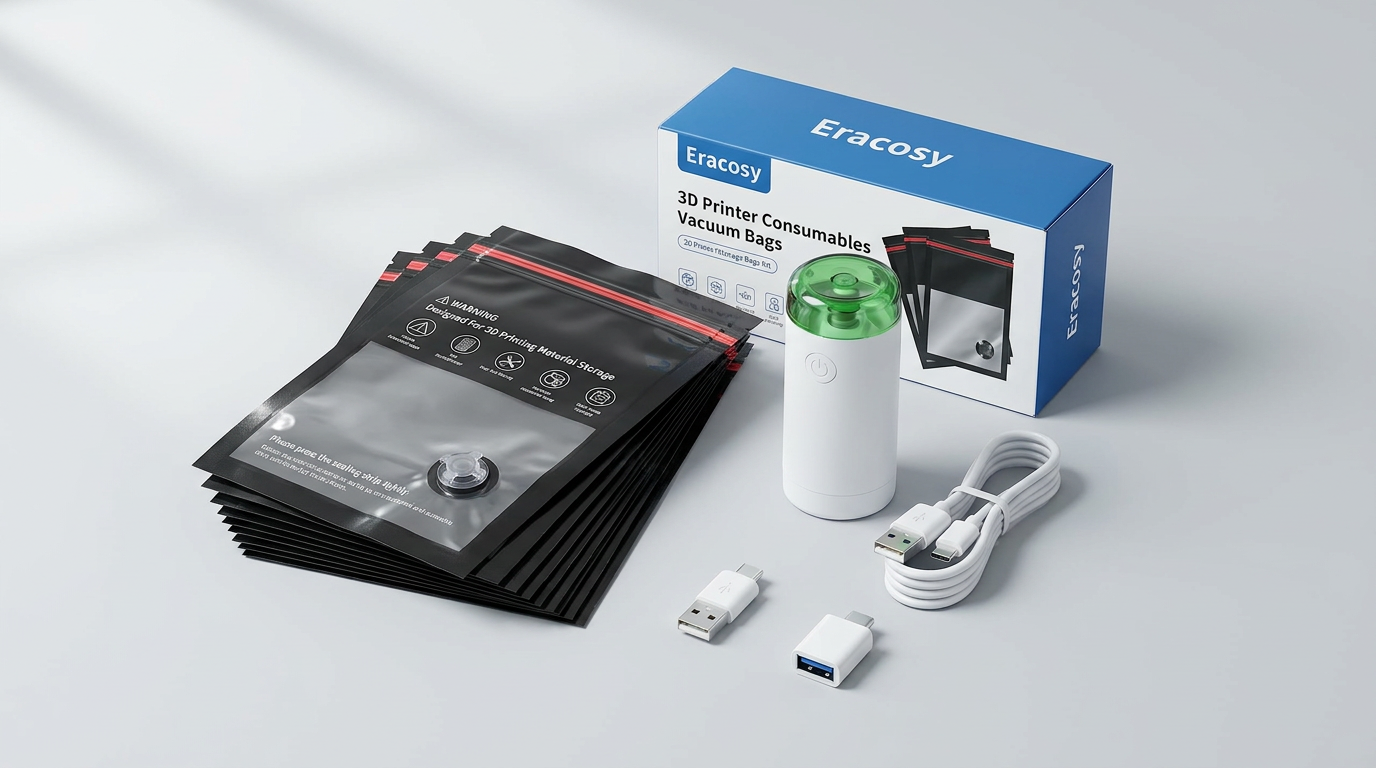
Makers frequently treat moisture control as an engineering problem at the hotend, only to delegate spool storage to bargain-bin plastic packaging. The Eracosy 30-Pack Filament Storage Kit promises to solve hygroscopic filament decay with an all-in-one bundle: thirty reusable bags, sealing clips, and a USB-powered electric vacuum pump for under $40. It positions itself as a neat bypass to bulky plastic cereal containers and heated dryboxes.
Yet flexible vacuum storage introduces what we call the seal lottery. When a kit cuts manufacturing costs to deliver high bag counts alongside motorized hardware, tolerances inevitably slide. Instead of set-and-forget moisture defense, users often find themselves babysitting check valves and managing slow leaks that defeat the entire purpose of sealed preservation.
What owners love
- + Generous 30-bag package volume for large spool collections
- + Dual-sided design with opaque black backing to reduce light exposure
- + USB-powered electric pump eliminates tedious hand pumping
- + Includes dedicated sliding clips to assist with zipper sealing
Common complaints
- − Frequent vacuum loss within 24 to 48 hours across multiple bags
- − Electric pump face frequently fails to mate flush with bag valves
- − Pump motor runs warm and can emit an acrid burning odor
- − Center valve placement shrivels into spool hubs, breaking the seal
Design & Build
The Eracosy bags use a composite PA and PE plastic construction that feels reasonably thick to the touch. One functional high point is the split-panel presentation: a clear front face allows instant spool identification, while the black rear panel offers modest defense against ambient light exposure. Sized at roughly 12.4 by 13.3 inches, the bags easily swallow standard 1kg spools with room to spare around the edges.
The mechanical layout, however, reveals immediate ergonomic flaws. The one-way suction valve sits dead center on the bag face. When you place a standard 1kg spool inside, that valve aligns directly over the hollow center spindle of the spool. As negative pressure builds, the plastic film shrivels downward into the empty center void, warping the valve seat and pulling the sealing membrane out of flat alignment. It is a recurring engineering oversight common to generic vacuum bags that directly threatens long-term seal integrity.
Setup & Ease of Use
Sealing a spool requires inserting the filament, running one of the five included plastic clips firmly across the dual-track zipper, flattening the valve sticker, and applying the motorized pump. In theory, the USB pump makes manual hand-plungers obsolete. It connects to any standard 5V charging brick or power bank and evacuates air with a single button press.
In practice, mating the pump to the valve is notoriously finicky. Multiple owners report that the pump suction head does not seat flush against the bag valve ring. Without an airtight physical seal between the pump cup and the valve perimeter, the pump simply moves ambient air rather than pulling a vacuum from the spool chamber. Getting it to draw down often demands sustained, forceful downward pressure that flexes the bag and stresses the valve membrane.
Performance in Real Use
Vacuum performance is where the Eracosy kit runs into severe practical limitations. A vacuum bag has one job: sustain negative pressure to prevent ambient humidity from degrading sensitive polymers like PETG, TPU, and nylon. A significant portion of owners report that these bags repressurize within 6 to 24 hours of evacuation. When half or more of your stored spools reinflate by the following morning, the system fails its core mandate.
This behavior represents the vacuum decay tax, a hidden maintenance overhead where you must routinely inspect your storage rack and re-pump leaking units. While a handful of bags maintain a tight, brick-like hold over weeks, the inconsistency across the 30-pack suggests loose quality control on the check-valve membranes. When humidity can seep back in unnoticed, hygroscopic filaments quietly absorb ambient water, ruining print runs via steam pops and stringing during later extrusion.
Software & Ecosystem
As a purely mechanical accessory kit, there is no accompanying software or moisture-logging app. The kit relies entirely on physical indicators. However, Eracosy leaves out humidity indicator cards, which should be standard issue for any long-term filament containment system. Without an internal humidity strip visible through the clear front face, you are forced to judge moisture control purely by whether the plastic appears drawn down against the spool.
The reliance on standard USB power for the pump is broadly convenient around a 3D printing workstation, allowing you to run it off a nearby power strip or printer hub. However, the pump motor lacks advanced thermal regulation or pressure sensing. It continues drawing current until switched off, and sustained operation on multiple spools can quickly lead to thermal throttling and motor stress.
Value & Reliability
On paper, the value proposition looks compelling: getting 30 large bags alongside an electric extraction pump in the $35 to $40 range yields an attractive per-unit cost. If every bag held a seal, it would handily outperform rigid desiccant tubs on both price and shelf space. But real-world reliability radically alters the math.
Between bags that leak immediately at the seam and reports of the pump motor emitting a burnt electrical smell during extended sealing sessions, the kit exhibits high failure rates out of the box. Contacting customer support yields inconsistent results, leaving buyers to treat defective bags as disposable packaging rather than multi-year workshop infrastructure.
Verdict
Stay Away - Inconsistent check valves and an underpowered, unreliable USB pump undermine what should be an effortless bulk storage kit.
FAQ
More 3D Printer Parts & Accessories reviews
Fungiworks Filament Storage Box 4-Pack Review
Hemulac Hardened Steel Extruder for Bambu P1P and P1S Review
Creality Star-Shaped PTFE Tube Review: Smart Design, Mixed Results

YOOPAI 2-Pack Cold Build Plate Review: Aggressive Bed Grip

Wefuit Bambu Lab Liquid Bed Adhesive Review
Miskis 46-Piece 3D Printer Tool Kit Review: Bench Essentials
This review is based on real experiences shared by owners in online communities.