
Wefuit Holographic PEI Plate Review: Aesthetic Upgrade for Bambu Lab
This review is based on real experiences shared by owners in online communities.
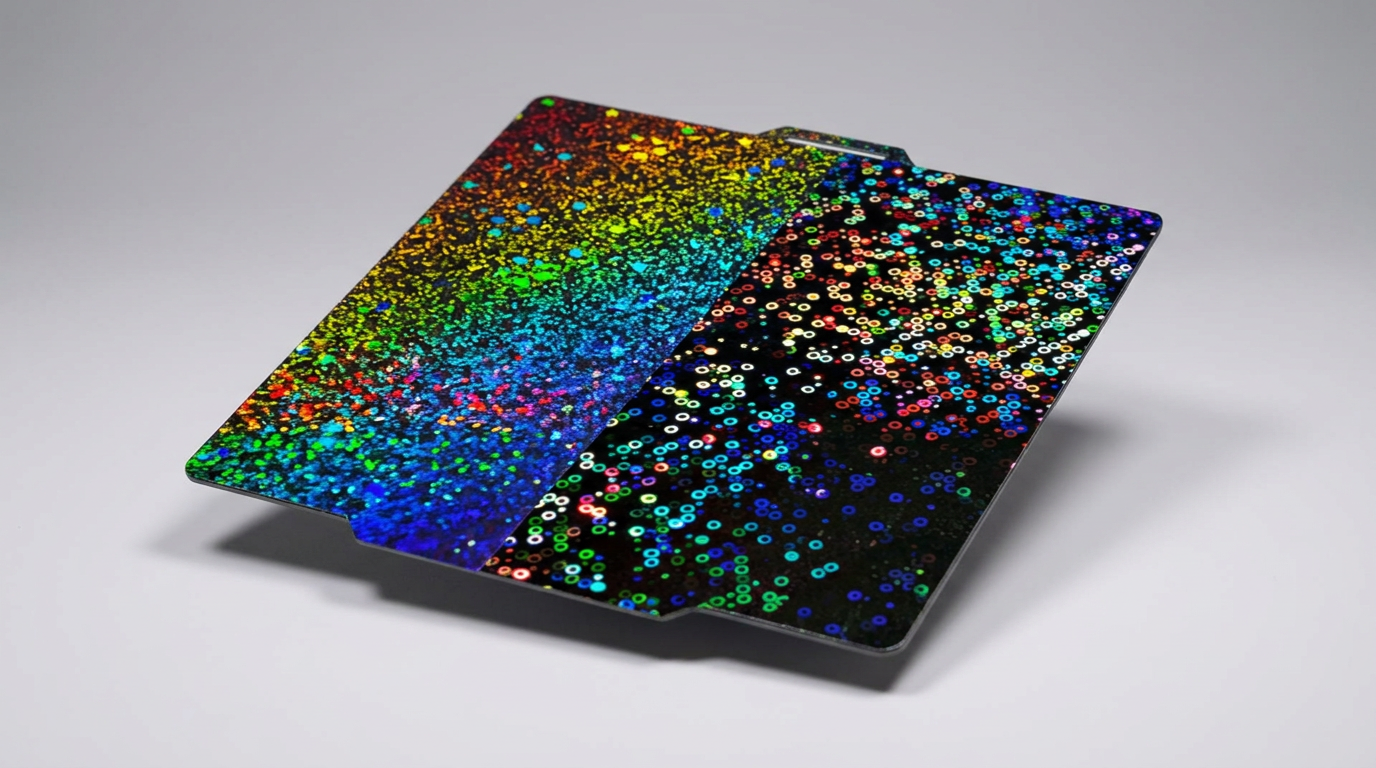
The modern 3D printing landscape, particularly with Bambu Lab's rapid acceleration, has shifted user expectations from mere functionality to refined output. Build plates, once a utilitarian component, are now central to print aesthetics and first-layer quality. The Wefuit Holographic PEI plate enters this arena, promising not just adhesion but also a distinctive visual flair, challenging the notion that aftermarket plates must compromise performance for style.
This plate targets users who value the cosmetic outcome of their prints, transforming the often-overlooked first layer into a deliberate design element. It represents a subtle but significant trend where the printer's output moves beyond dimensional accuracy to incorporate surface finish as a primary characteristic. For many, the bottom of a print is simply the bottom; for this plate's audience, it's a canvas.
Our assessment focuses on how effectively this dual-purpose design balances its aesthetic ambition with the fundamental requirement of reliable print adhesion, a balance often difficult to strike in third-party accessories. We examine whether its unique surface offers a genuine enhancement or merely introduces an additional variable to an already complex printing process.
What owners love
- + Delivers distinctive holographic or textured patterns on print first layers
- + Offers strong adhesion for PLA and many other filaments with dialed settings
- + Spring steel construction facilitates easy print removal post-cooling
- + Competitive pricing compared to first-party Bambu Lab options
- + Generally good compatibility with various Bambu Lab printer models
- + Durable and maintains flatness through repeated use
Common complaints
- − PETG adhesion can be inconsistent, requiring specific parameter adjustments
- − May require bed temperature increases for optimal adhesion, especially with certain filaments
- − Printer firmware may flag it as an unrecognized plate, requiring manual override
- − Some initial user effort needed to fine-tune settings for best results
- − The unique pattern can only be applied to one side or layer of a print
Design & Build
The Wefuit Holographic PEI plate features a flexible spring steel core, ensuring durability and consistent flatness across its surface. Owners consistently report that the plate holds its shape even after numerous print cycles, which is critical for maintaining first-layer integrity. The dual-sided design, with distinct holographic patterns on each face- Circle and Star, allows users to choose their preferred aesthetic. This design choice speaks to an emerging market demand for 'aesthetic utility' - where a component performs its primary function while also contributing to the visual output. The material composition handles temperatures up to 200°C, indicating a robust construction suitable for common filament types. This emphasis on surface pattern represents a departure from purely functional build surfaces, adding a layer of cosmetic customization that stock plates typically lack.
Setup & Ease of Use
Initial setup involves simply swapping out the existing build plate, a process streamlined by Bambu Lab's magnetic bed design. However, the 'first-layer aesthetics curve' is apparent here: while the physical swap is simple, achieving optimal results often requires minor adjustments. Owners frequently report needing to increase bed temperatures, sometimes by 5 to 10 degrees, beyond stock profiles to secure consistent adhesion. For Bambu Lab X1 series users, the printer may display warnings regarding an unrecognized plate; ignoring this prompt allows printing to proceed without issue. Many users successfully leverage the "Smooth PEI Plate/High Temp" setting within their slicer as a starting point. This initial calibration period, though minor, is a trade-off for the unique finish the plate provides.
Performance in Real Use
In day-to-day operation, the plate largely delivers on its promises. Adhesion for PLA is widely lauded, with prints sticking reliably and releasing cleanly once the plate cools. The hallmark feature- the holographic or textured pattern- consistently transfers to the first layer, producing aesthetically pleasing results. This 'signature surface effect' transforms the print's bottom into a visually engaging element, particularly with silk PLA filaments. While PLA performs admirably, PETG presents a recurring challenge; several owners note difficulty achieving reliable PETG adhesion without extensive parameter tuning. This suggests a filament-specific performance ceiling, where the unique surface geometry, while great for some plastics, introduces variables for others. The ability to easily flex the spring steel plate to remove prints is a significant usability advantage, minimizing part damage and expediting workflow.
Software & Ecosystem
As an aftermarket accessory, the Wefuit plate operates outside Bambu Lab's integrated ecosystem. This necessitates user intervention at times. The most common feedback relates to the printer's inability to automatically identify the plate. This is a characteristic of most third-party plates and generally resolved by selecting a generic smooth PEI profile in the slicer and potentially disabling build plate detection. This minor friction point is a manifestation of the 'closed ecosystem compatibility tax,' where users gain functionality and cost savings but forfeit some of the seamless automation expected from a fully integrated system. The reliance on existing smooth PEI profiles within the slicer indicates that while the physical plate is distinct, its software interaction mimics established, generic smooth surfaces rather than requiring unique, custom profiles. The expectation is on the user to adapt printer settings, not on the plate to integrate digitally.
Value & Reliability
Positioned at a price point well below Bambu Lab's official plates, the Wefuit Holographic PEI plate offers considerable value. Owners repeatedly highlight its affordability as a key factor in their satisfaction. The spring steel construction contributes to its perceived longevity, with users reporting many successful prints without degradation of the surface or its unique patterns. This 'cost-per-print aesthetic dividend' means users are getting a distinctive finish for a comparatively low initial investment. While the long-term wear of the holographic coating specifically is less documented due to its relatively recent market presence, the underlying spring steel plate is robust. The primary factor affecting its reliability for some users is the initial learning curve for optimal bed temperature and filament settings, particularly for PETG, rather than inherent flaws in the plate itself.
Verdict
Buy - This plate offers a unique aesthetic upgrade at an accessible price point for Bambu Lab users.
The Wefuit Holographic PEI plate is an excellent choice for Bambu Lab owners who prioritize unique visual effects on the bottom of their prints and are willing to perform minor bed temperature adjustments. It is particularly well-suited for printing PLA, transforming mundane surfaces into captivating designs. Those frequently printing with PETG might find the initial adhesion dialing-in frustrating and should consider if the aesthetic trade-off is worth the effort. It's a strong proposition for hobbyists seeking to add a personalized touch to their creations without spending well north of $50 on an official plate.
This plate embodies the 'post-functional accessory' trend in 3D printing: components that move beyond baseline utility to offer experiential or aesthetic enhancements. It quietly serves the growing segment of makers for whom print quality now encompasses the 'first-layer flex' a subtle but impactful detail that distinguishes a generic print from a personalized creation, pushing the boundary of what a 3D print can express.
FAQ
More 3D Printer Parts & Accessories reviews
YUNHAN Air Filter for Bambu Lab 3D Printers Review

HYHJMISTY 91PCS 3D Printer Tools Kit Review: A Focused Starter Set
Black Magic 3D Printer Adhesion Kit Review: The Applicator Advantage
Fuitnerd 184-Piece 3D Printer Tool Kit Review: Value-Focused Utility
CreatryLab A1/A1 Mini Hotend Review: Budget Reliability for Bambu Labs
Fuitnerd 142Pcs 3D Printer Tools Kit Review: A Maker's Essential?
This review is based on real experiences shared by owners in online communities.