
TOSUKKI 1.5mm Adhesive 3D Scanner Targets: A Precision Underperformer
This review is based on real experiences shared by owners in online communities.
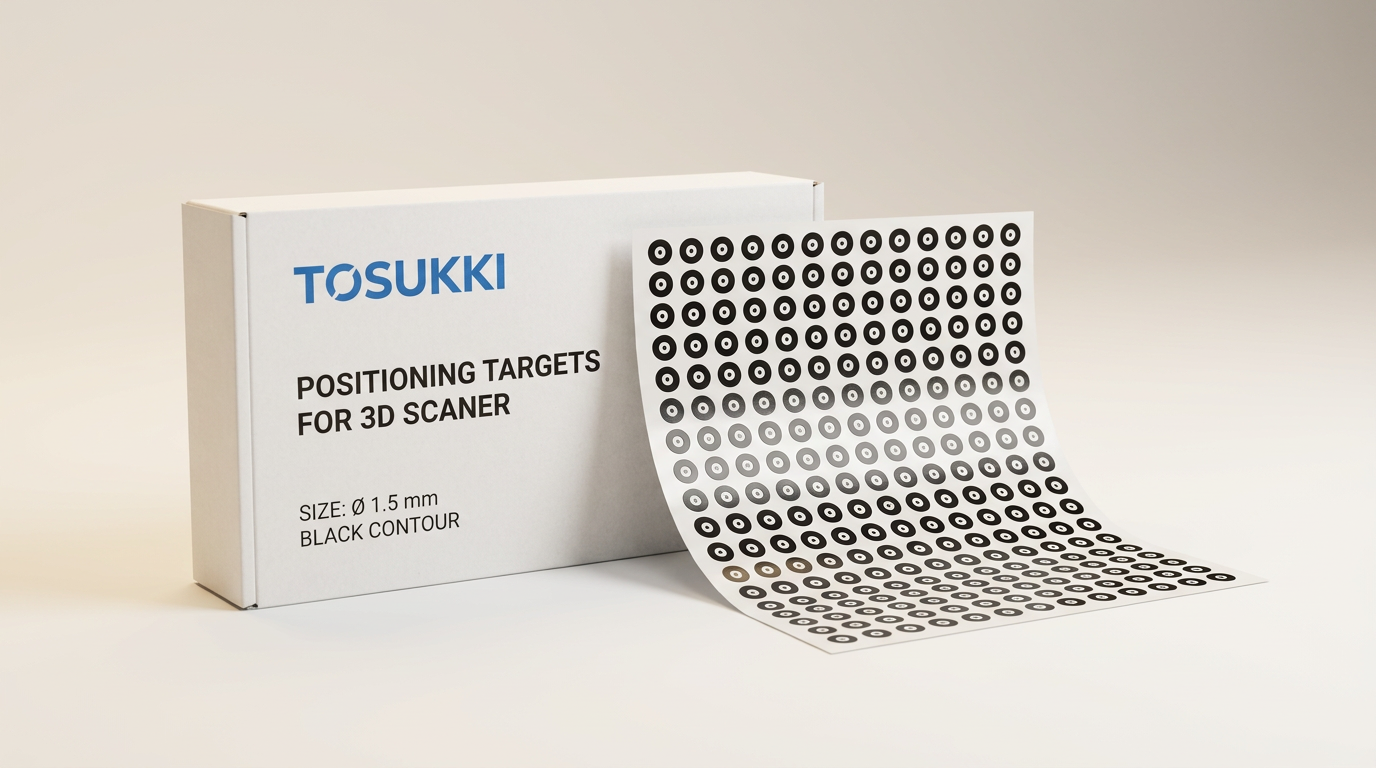
The pursuit of high-fidelity 3D scanning relies on meticulous precision, a standard that extends to even the most unassuming components like positioning targets. Many assume that a simple adhesive dot is a commodity, interchangeable and reliably accurate across manufacturers. This assumption often overlooks a critical detail: these targets are not just passive markers, but active participants in the triangulation process, where minute discrepancies can cascade into significant data errors.
TOSUKKI offers a box of 3,000 1.5mm adhesive targets, positioning them as a cost-effective solution for industrial scanning applications. However, owner experiences reveal a product that struggles with fundamental inconsistencies, challenging its utility in environments demanding high accuracy. The true cost of these targets extends beyond their purchase price, manifesting in calibration headaches and compromised scan integrity.
This review unpacks whether TOSUKKI's offering can genuinely support professional-grade 3D scanning, or if its apparent value is undermined by a "tolerance tax" where the cost savings are offset by increased labor and reduced data reliability.
What owners love
- + Targets are provided in bulk, offering a large quantity per box.
Common complaints
- − Advertised diameter often does not match actual measurement.
- − Targets frequently lack retro-reflectivity, hindering scanner detection.
- − Product page layout creates confusion regarding size selection.
- − Not suitable for handheld 3D scanning applications.
- − Inconsistent quality compromises scanning accuracy.
Design & Build
The TOSUKKI adhesive targets are designed as simple, self-adhesive circles intended to provide reference points for stationary 3D scanners. The manufacturer specifies multiple sizes, with this particular variant listed as 1.5mm inner diameter. However, owners frequently report discrepancies between the stated and actual dimensions. One user ordering 3mm targets received dots closer to 3.6mm, indicating a significant quality control issue that undermines the product's primary function of providing a known, precise reference point. This variation introduces a "tolerance tax," where buyers pay not just in dollar cost but also in the time and effort required to confirm the actual size and adjust scanner settings, or worse, to rescan entire parts due to positional errors. These targets are not retro-reflective, a characteristic the manufacturer notes, but several users interpret this as a lack of effective reflectivity altogether, highlighting a potential communication gap or expectation mismatch regarding their performance.
Setup & Ease of Use
These targets are straightforward to apply, functioning as simple peel-and-stick dots. The bulk packaging suggests a design intent for high-volume application in industrial settings. However, the user experience is hampered before application due to confusion on the product's ordering page. Several potential buyers express frustration over the perceived lack of clarity, believing they are purchasing an assortment of sizes rather than a single, specific diameter. This creates an initial hurdle, requiring careful reading to ensure the correct size selection, which should be a frictionless process for a commodity item. Once applied, their usability is directly tied to their performance, which is where further issues arise, negating any initial ease of application.
Performance in Real Use
In operation, the TOSUKKI targets fall short of expectations for precision 3D scanning. A primary complaint revolves around their retro-reflectivity-or lack thereof. Despite the manufacturer stating they are "not highly reflective targets," multiple users report these dots are "not reflective at all," leading to wasted time and failed scans. This is a critical deficiency for any 3D scanning target, as the scanner relies on detecting these reflective points for accurate triangulation. The inconsistent sizing further compounds performance issues; a target that is larger or smaller than expected can skew the calibration and introduce measurement errors into the final scan data. This effectively creates a "hidden cost of validation," forcing users to manually verify target dimensions and reflectivity before deployment, a step that negates the intended efficiency of using pre-made targets.
Software & Ecosystem
These adhesive targets are passive components and do not interact directly with software beyond serving as physical reference points for a scanner's detection algorithms. The manufacturer lists compatibility with high-end industrial scanners like GOM ATOS, Hexagon, and ZEISS (COMET), while explicitly stating their unsuitability for handheld 3D scanners, particularly those employing laser or white light technologies. This distinction is crucial, underscoring that these targets are designed for fixed, high-precision scanning setups that may employ different detection methods than their handheld counterparts. The issues owners report-particularly concerning inconsistent sizing and insufficient reflectivity-suggest a fundamental incompatibility with the very precision requirements of the listed compatible industrial systems. For these systems, reliable target detection is paramount; if the targets are not consistently read, no amount of sophisticated software can compensate for the compromised input data.
Value & Reliability
Priced around $20 for 3,000 targets, the TOSUKKI offering appears cost-effective on the surface. However, the recurring issues with dimensional inaccuracy and poor reflectivity severely impact their reliability and, consequently, their true value. A product intended for precision measurement that consistently fails to meet its own specifications forces users into additional labor-intensive steps: verifying target sizes, troubleshooting scan failures, and potentially reprinting or rescanning entire projects. This translates into a significant "rework multiplier," where the initial savings are quickly dwarfed by increased operational costs, project delays, and compromised data quality. The low overall rating and multiple one-star reviews directly reflect this failure in reliability. For professional applications where accuracy is non-negotiable, these targets introduce more problems than they solve, making them a false economy.
Verdict
Stay Away - These targets exhibit fundamental quality control issues that undermine their utility in precision 3D scanning workflows.
Professionals and hobbyists requiring consistent, reliable positioning targets for their 3D scanning projects should avoid this product. The recurring problems with dimensional inaccuracy and insufficient reflectivity render them unsuitable for applications demanding even moderate precision. Investing slightly more in known, reputable brands will prevent the significant time and data integrity issues these targets introduce. Those using high-end industrial scanners that rely heavily on accurate target detection will find these targets a liability.
The TOSUKKI targets exemplify the "false economy trap" in technical consumables. Their low price per unit is quickly overshadowed by the hidden costs of calibration failures, compromised data, and wasted operational time. This product highlights a critical gap between marketing claims and real-world performance, reminding us that even the simplest components can introduce profound friction into complex workflows if their quality is not rigorously maintained.
FAQ
More 3D Scanners reviews
Revopoint INSPIRE 2 3D Scanner Review: Unpacking the Accessory Echo Chamber
Creality 6mm 3D Scanning Markers Review: Essential Tracking Aid
TOSUKKI 6mm Positioning Targets Review: The Refined Generic Choice

AESUB 3DTOOLS 3D Scanner Spray Review: The 'Evaporative Enabler'
Creality 8-inch Rotating Turntable: A Solid Scanner Accessory

Generic 12 Piece Multi-Angle Markers Review: Essential 3D Scanning Dots
This review is based on real experiences shared by owners in online communities.