
AESUB Violet 3D Scanning Spray Review
By AValidReview. An AI-assisted summary of customer feedback, not a hands-on test.
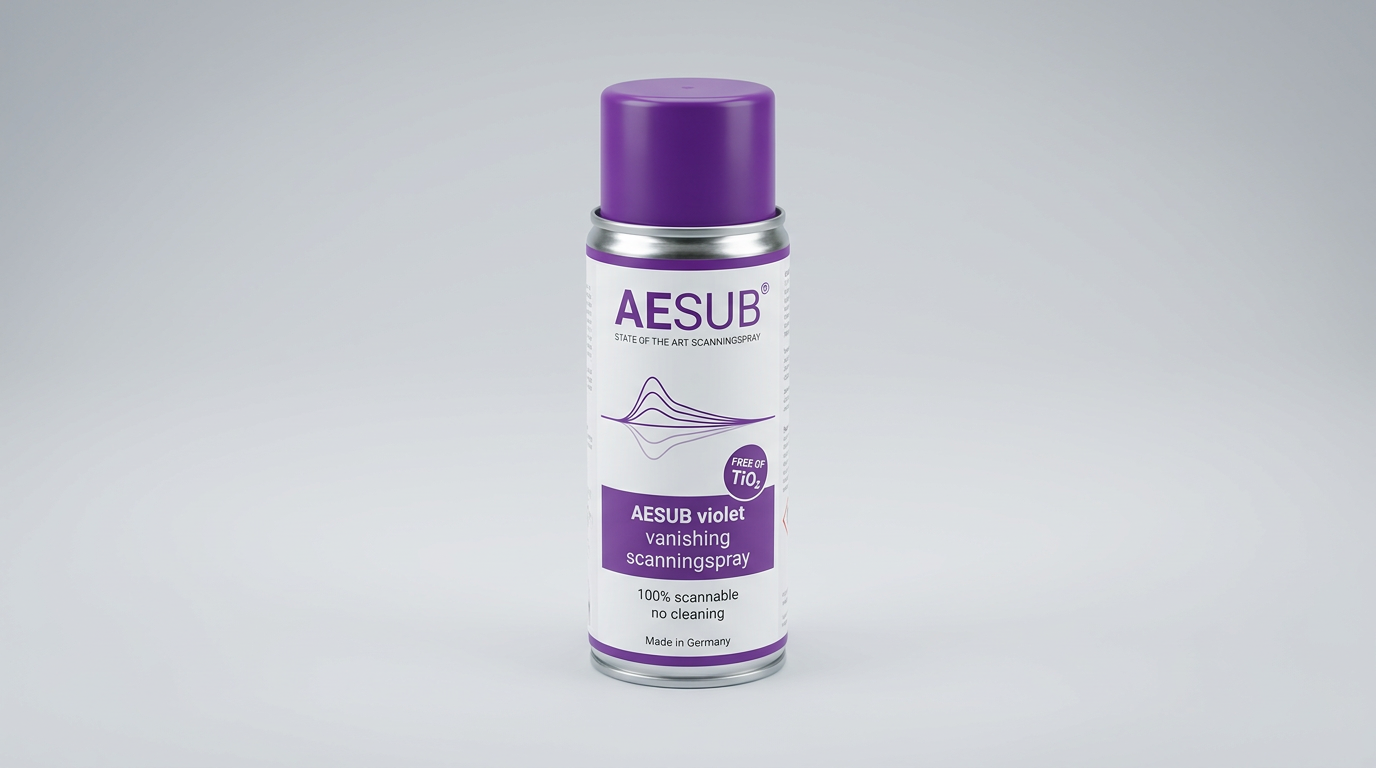
Consumer 3D scanner marketing routinely promises friction-free reality capture, but optical hardware remains subordinate to basic physics. Structured light and photogrammetry rigs choke on specular reflection, high-transparency glass, and photon-absorbing black surfaces. Enthusiasts historically countered this optical friction with messy workarounds like talcum powder, dry shampoo, or chalk-based developer sprays that risked clogging delicate electronics and demanded tedious post-scan scrubbing. AESUB Violet represents an industrial-grade chemical pivot: a self-sublimating aerosol that provides a uniform matte target, then vanishes into thin air.
Branded here in collaboration with 3DMakerpro, the Violet formulation addresses the working window paradox that plagues fast-evaporating sublimation sprays. While standard evaporating sprays often dissipate before complex, multi-angle alignment sweeps finish, Violet holds its ground for 12 to 24 hours. The spray essentially acts as a hardware subsidy, transforming finicky mid-tier scanners into capable digitizers for automotive parts, laboratory glassware, and dark consumer plastics.
What owners love
- + Evaporates completely within 12 to 24 hours with zero cleanup
- + Eliminates tracking loss on clear, glossy, and pitch-black surfaces
- + Pigment-free formulation protects sensitive mechanical components
- + Generous sublimation window accommodates extended multi-angle scans
- + Lays down an ultra-thin, uniform matte coating without pooling
Common complaints
- − Recurring consumable expense in the $40 to $50 range per can
- − Aerosol requires disciplined, steady sweep technique to avoid waste
- − Sublimation requires adequate workspace ventilation
Design & Build
The AESUB Violet delivery mechanism consists of a standard 400ml pressurized aerosol canister fitted with a fine-mist fan nozzle. Unlike hardware purchases, the build quality here is judged strictly on nozzle atomization and chemical stability. Cheaper industrial chalk sprays spit agglomerated droplets that degrade mesh tolerance, but the Violet nozzle dispenses a coherent, micro-fine vapor cloud when depressed evenly. The active chemistry relies on sublimating active substances without solid pigments, meaning there is zero titanium dioxide grit to lodge in rotary stages, ball bearings, or scanner cooling fans. The 400ml volume offers sufficient volume for multiple medium-to-large automotive assemblies, provided the user does not saturate the workpiece.
Setup & Ease of Use
Application requires a deliberate, disciplined technique rather than passive spraying. Owners find that holding the can roughly 15 to 20 centimeters from the target and moving in steady, overlapping passes yields optimal coverage. The liquid flashes off within seconds, turning from a wet sheen into a chalk-white, non-reflective matte finish. Because the spray contains no physical carrier pigment, over-application is primarily a waste of product rather than a mesh-distorting error, though heavy puddling will marginally alter dimensional accuracy. The key operational advantage over traditional developer sprays is the total absence of a decommissioning phase: once the scan captures, the part simply sits on a rack until the coating clears on its own.
Performance in Real Use
In real-world capture scenarios, AESUB Violet neutralizes the specific surface conditions that break triangulation algorithms. Users scanning polished automotive chrome, bare machined steel, and deep black plastics report immediate tracking stability where their sensors previously dropped frames or registered empty voids. On transparent targets like eyewear and laboratory beakers, the spray deposits an opaque surface that structured light can compute without phase distortion. The Violet designation stands out specifically for its sublimation window. Where faster formulations disappear in two to four hours, Violet remains optically stable through full duty cycles, giving operators ample time to reposition parts, recalibrate, and execute high-resolution texture passes without the coating degrading mid-capture.
Software & Ecosystem
While co-packaged under the 3DMakerpro banner, AESUB Violet is hardware-agnostic. Owners pair it successfully across diverse ecosystems, ranging from 3DMakerpro units like the Moose to Revopoint and industrial desktop rigs. The spray bypasses the need for aggressive algorithmic smoothing or software noise reduction filters, which typically destroy crisp edge geometry in an attempt to clean up specular artifacts. By correcting the optical data at the physical level, scanner acquisition software maintains reliable feature tracking, builds denser point clouds, and minimizes raw mesh registration errors. Users spend significantly less time in post-processing tools manually stitching broken frames or patching tracking holes.
Value & Reliability
Priced in the $40 to $50 band per canister, AESUB Violet represents a noticeable recurring operating cost for hobbyist setups. However, calculating value purely against the purchase price misses the broader trade-off. For field technicians and small machine shops, the cost of the can is immediately offset by the recovery of labor hours previously spent scrubbing talc or chalk out of intake manifolds and screw threads. The chemical reliability is consistent: verified users experience clean evaporation within the 12 to 24-hour mark without residual stickiness or discoloration. It serves as an insurance policy against rescans, making it a pragmatic expense for any workflow where downtime exceeds material cost.
Verdict
Buy - An indispensable chemical consumable that upgrades consumer scanner tracking on optical problem surfaces without adding clean-up labor.
AESUB Violet is an essential purchase for reverse-engineers, mechanics, and 3D printing enthusiasts who regularly capture polished metals, dark synthetic plastics, and glass. If your scanning queue involves non-porous components with difficult geometry, the time saved in post-capture cleaning easily justifies the recurring cost. Conversely, casual users scanning matte PLA prototypes or light-toned plaster casts can skip this chemical altogether, as their standard hardware already tracks those textures without intervention.
The broader truth about consumer 3D scanning is that software innovation cannot compensate for broken optical physics. Rather than spending thousands to upgrade sensor hardware in search of better edge tracking, spraying difficult targets with a temporary sublimation layer remains the most cost-effective path to clean dimensional accuracy.
FAQ
More 3D Scanners reviews
3DMakerpro Moose Review: Precision Scanning Meets a Real Learning Curve

Creality Otter Lite Basic 3D Scanner Review: Reality Capture
Creality Pika 3D Scanner Review: Precision Meets The Compute Cliff
Revopoint POP 4 Magnetic Outdoor Filter Review
3DMakerpro Moose Lite Premium 3D Scanner Review
3DMakerpro Seal Lite Review: Precision at a Strict Distance
This review is based on real experiences shared by owners in online communities.