
SUNLU S4 3D Filament Dryer Review: A Multi-Spool Powerhouse
This review is based on real experiences shared by owners in online communities.
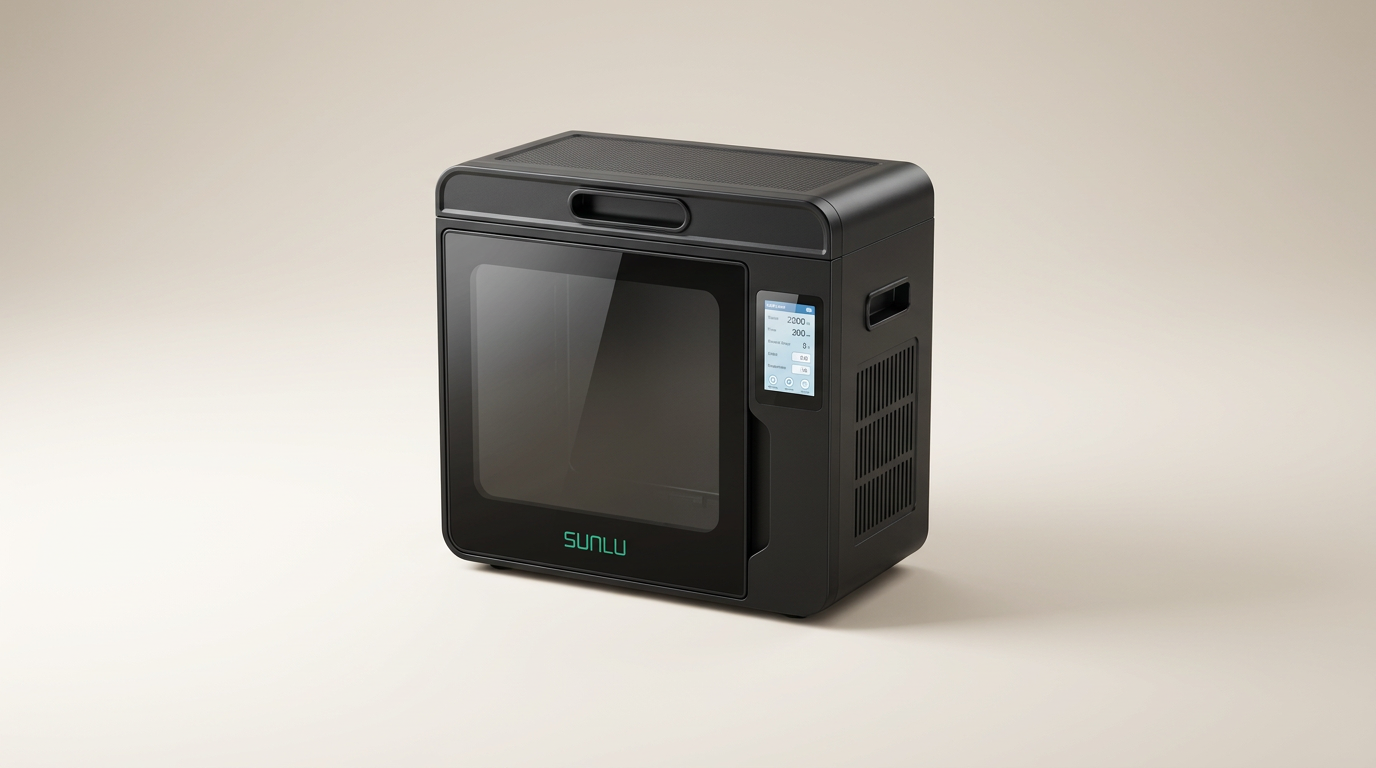
In the evolving landscape of 3D printing, filament management often remains a silent bottleneck, especially for users moving beyond casual printing or working with hygroscopic materials. While single-spool dryers address individual needs, the SUNLU S4 signals a shift towards multi-spool, active drying as a foundational element for consistent print quality in a home or small print farm environment. This device implicitly understands that the drying process is no longer a preparatory step but an integrated, continuous function.
The S4 positions itself not merely as an accessory but as a critical infrastructure component, particularly for multi-color or multi-material setups. Its design and operational capabilities reflect an understanding that ambient humidity is a persistent challenge, and proactive, sustained drying is the most effective countermeasure. This review examines how the S4 delivers on that promise, assessing its efficacy and identifying the user profile it best serves.
What owners love
- + Dries up to four spools simultaneously, increasing efficiency
- + Effective at improving print quality, reducing stringing and bubbling
- + Active humidity control with automatic on/off function (Mode 2)
- + Robust internal bearings allow smooth filament feeding while printing
- + Wide material compatibility and adjustable temperature range (35-70C)
- + Can feed directly into printers, including AMS systems
Common complaints
- − Instruction manual lacks clarity on advanced features
- − Physical size is substantial, requiring dedicated space
- − Touchscreen quality is reported as basic
- − Handles for the top lids are small and occasionally awkward
- − Internal heat distribution can create hotspots without rotation
Design & Build
The SUNLU S4 presents a substantial footprint, designed to accommodate four 1kg filament spools. This capacity, while beneficial for multi-printer setups or batch drying, dictates its considerable physical dimensions. Owners frequently describe it as well-built, with a robust feel. A notable design element is the integration of smooth bearings for each spool, which facilitates printing directly from the dryer. This feature eliminates friction points that can stress extruders, an essential consideration for maintaining consistent filament tension. The inclusion of eight filament exit holes offers flexibility for diverse printer configurations. However, a common observation points to the basic quality of the touchscreen interface and the small, somewhat awkward handles for opening the top lids, suggesting areas where the external user experience could be refined. The plastic construction is darker than some marketing images, occasionally obscuring visibility of the spools inside.
Setup & Ease of Use
Initial setup of the S4 is straightforward, largely involving connecting power and loading filament. The unit includes PTFE tubes and silicone plugs for comprehensive setup. Where the S4 introduces a 'control curve' is in its operational modes and settings. Owners report that while basic drying functions are intuitive, understanding the nuances of Mode 2 (humidity-based control) and specific parameter adjustments (like PV) requires some independent research or experimentation beyond the provided instructions. The preset profiles for common filament types are a convenience, but the ability to override and customize these settings is critical for advanced users. The active fan system ensures quicker temperature attainment compared to passive dryers, contributing to a more efficient drying cycle. Despite minor interface quirks, users find the day-to-day operation practical once the initial learning phase is complete.
Performance in Real Use
The S4's core performance, drying filament, consistently garners positive feedback. Users report significant improvements in print quality, citing reduced stringing, bubbling, and overall improved layer adhesion, particularly with moisture-sensitive materials like PETG, TPU, and Nylon. The 350W PTC heater and three circulation fans contribute to rapid and efficient drying. A key differentiator is its 'active storage' capability, where the unit monitors internal humidity and cycles on to maintain a dry environment, preventing re-absorption of moisture. This feature is particularly valued in humid climates. However, a pattern emerges where some users find it beneficial to periodically rotate spools, suggesting that while the air circulation is effective, the bulk of the heat source at the bottom can lead to uneven drying without manual intervention, a 'thermal gradient' that most automated dryers face. The ability to print directly from the dryer, even with multi-material systems like Bambu Lab's AMS or Prusa's MMU, is a frequently lauded benefit, transforming drying from a pre-print chore into a continuous, integrated process.
Software & Ecosystem
The S4's 'software' in this context refers to its internal control system and user interface, rather than external applications. The unit offers preset profiles for various filament types and allows for user-defined adjustments to temperature (35-70C) and timer (0-99 hours). The critical feature is Mode 2, which enables humidity-based control; the dryer turns on automatically when internal humidity exceeds a user-set threshold and turns off once it drops to the desired level. This 'set and forget' functionality is highly valued for long-term filament storage and active drying during prints. While the display and touch response are functional, they do not offer the premium experience found in higher-end consumer electronics. Owners note that the built-in hygrometer is generally accurate. The lack of detailed instructions for advanced modes is a recurring point, suggesting a gap between the device's capabilities and its onboarding experience. The S4's ecosystem integration extends to its physical compatibility, allowing direct feeding into various printer types, a testament to its design for continuous operational workflow.
Value & Reliability
Priced around $100 to $150, the SUNLU S4 positions itself as a strong value proposition, especially given its four-spool capacity and active drying features. Many owners previously used smaller, single-spool dryers and view the S4 as a significant upgrade, capable of handling the demands of multiple printers or a print farm. The reliability appears solid, with reports of consistent performance over several months of use. The ability to dry multiple rolls simultaneously translates into tangible time savings and improved print consistency, which can offset its purchase cost through reduced material waste and failed prints. While the unit is large, its ability to integrate into an active printing workflow, reducing the 'wet filament tax' on print quality, makes it a worthwhile investment for serious hobbyists and small businesses. Owners generally feel the S4 delivers on its promises, offering substantial functionality for its price point.
Verdict
Buy - The SUNLU S4 delivers exceptional multi-spool drying capacity and active humidity control, effectively mitigating common print quality issues.
This dryer is ideal for any 3D printer owner who consistently uses multiple filament types, prints large parts, or lives in a humid environment. It particularly benefits users running multiple printers or those integrating their dryer into an AMS system, providing a continuous supply of dry material. Users who only print occasionally with one material, or who have limited space, might find its size and capacity overkill.
The S4 represents a critical shift towards the normalization of active, multi-spool filament management within the 3D printing workflow. It embodies the concept of 'proactive print hygiene,' recognizing that for consistent, high-quality output, filament drying must move beyond episodic treatment to continuous environmental control, especially as multi-material printing becomes more accessible.
FAQ
More 3D Printer Parts & Accessories reviews
YUNHAN Air Filter for Bambu Lab 3D Printers Review

HYHJMISTY 91PCS 3D Printer Tools Kit Review: A Focused Starter Set
Black Magic 3D Printer Adhesion Kit Review: The Applicator Advantage
Fuitnerd 184-Piece 3D Printer Tool Kit Review: Value-Focused Utility
CreatryLab A1/A1 Mini Hotend Review: Budget Reliability for Bambu Labs
Fuitnerd 142Pcs 3D Printer Tools Kit Review: A Maker's Essential?
This review is based on real experiences shared by owners in online communities.