
Sovol SV08 Max Review: A Colossal CoreXY Printer for the Committed
This review is based on real experiences shared by owners in online communities.
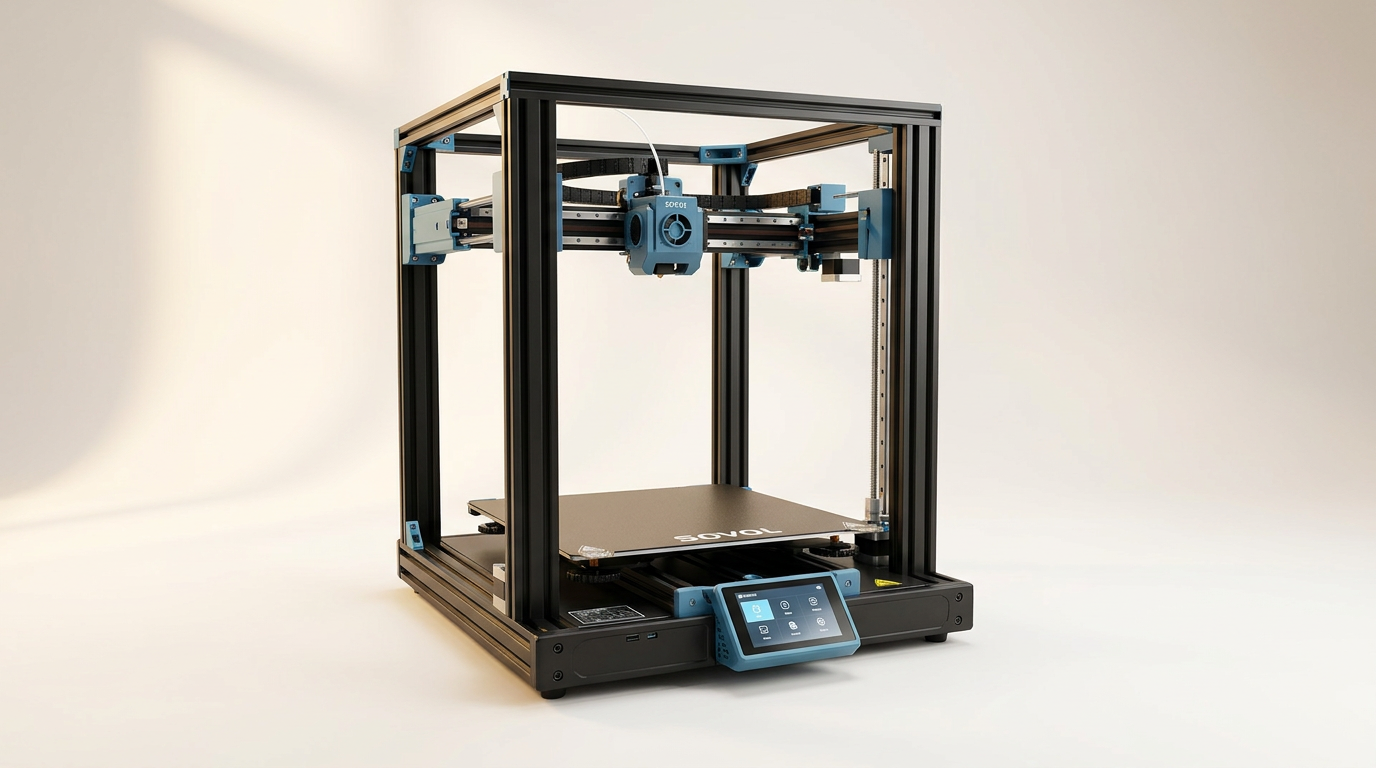
The 3D printing landscape has largely bifurcated: accessible, smaller desktop units and specialized, high-cost industrial machines. The Sovol SV08 Max carves out a distinct niche, aiming to deliver industrial-scale capabilities to the prosumer segment without a corresponding industrial price tag. It represents a fascinating market experiment: can a consumer-priced printer truly bridge the gap to large-format, high-speed production, or is it merely a scaled-up version of its smaller siblings with inherited limitations?
This printer promises a colossal 500x500x500mm build volume and speeds up to 700mm/s, positioning it as a direct challenge to more expensive, or self-built, large-format CoreXY machines. However, as owner feedback reveals, scaling up a design brings inherent complexities, often manifesting as what we call the "Proportionate Price of Scale" where larger dimensions amplify even minor inconsistencies in assembly or calibration. While the SV08 Max provides a compelling value proposition on paper, its true utility hinges on a user's willingness to engage with its nuances.
What owners love
- + Delivers exceptional build volume for large format prints.
- + Achieves high print speeds, competing with premium machines.
- + Utilizes open-source Klipper and Orca Slicer for flexibility.
- + Features robust CoreXY kinematics with metal linear rails.
- + Handles a wide range of advanced and high-temperature filaments.
Common complaints
- − Initial setup and calibration can be challenging for some users.
- − The printer generates significant operational noise.
- − Wifi module performance is consistently described as poor.
- − Quality control issues, like gantry alignment, appear occasionally.
- − Requires user-driven tuning and potential upgrades for optimal performance.
Design & Build
The Sovol SV08 Max employs a CoreXY kinematic system, a design choice often associated with higher speed and precision due to reduced moving mass and balanced forces. Owners frequently commend the decision to include metal linear rails, a component several users specifically highlight as a superior alternative to rubber wheels found in competitor designs, ensuring better long-term precision and durability. The printer's sheer scale, offering a 500x500x500mm build volume, is its most defining physical attribute, enabling projects that would be impossible on smaller machines. While the core frame is robust, some owners report quality control inconsistencies, such as misaligned X-gantries upon arrival, suggesting that while the design is sound, manufacturing execution can vary. This introduces what we term the "Unboxing Lottery" where initial user experience is heavily dependent on the factory alignment and calibration, requiring some users to invest immediate effort into correction.
Setup & Ease of Use
Initial setup for the SV08 Max generally receives positive remarks, with many users reporting assembly completion within an hour, often citing clear instructions and pre-sorted hardware. The included eddy current sensor for bed leveling and pressure-sensing touch points contribute to an advertised "effortless" first layer. However, user experiences reveal a nuanced reality. While some achieve successful prints within minutes, others report a significant "dialing-in journey," necessitating extensive calibration, including X-axis tramming, Z-offset adjustment, and flow calibration. This discrepancy indicates that while the physical assembly is straightforward, achieving optimal print quality requires a deeper understanding of 3D printing principles, pushing it beyond a truly plug-and-play experience for beginners. The machine's large scale also means that calibration issues, if present, are often magnified across the expansive print bed.
Performance in Real Use
The SV08 Max delivers on its promise of speed and large-format printing. Owners consistently praise its ability to produce high-quality prints at speeds competitive with, or even exceeding, established premium machines. The 300°C hotend and direct drive extruder enable successful printing with a wide array of filaments, from common PLA to more demanding ABS, ASA, and carbon fiber composites. However, this performance often comes with trade-offs. The printer's operational noise is a recurring concern for many, a direct consequence of pushing such a large system to high speeds, suggesting a "Performance Acoustics Tax" for those seeking its speed and volume capabilities. Some users actively modify fan configurations to mitigate this. Bed adhesion is generally strong, and the large build volume proves invaluable for industrial parts, prototypes, and oversized props, validating its core purpose.
Software & Ecosystem
Sovol has strategically positioned the SV08 Max within an open-source ecosystem, running tweaked Klipper firmware and utilizing Orca Slicer. This choice is overwhelmingly positive for experienced users, offering deep customization, network control, and preventing vendor lock-in. Owners appreciate the availability of 3D files for printing replacement or modified parts. The open nature also means a vibrant community often provides solutions and guides for optimization. However, the integrated WiFi module consistently emerges as a significant weakness. Owners describe it as outdated and prone to issues, with some resorting to workarounds like external Raspberry Pi setups for reliable connectivity. This disparity between the powerful Klipper base and the underperforming network hardware creates a friction point, forcing users into the "Klipper Cavalry" to optimize their network access.
Value & Reliability
The Sovol SV08 Max presents a compelling value proposition, offering a massive CoreXY machine at a price point significantly lower than custom-built Voron systems or high-end industrial alternatives. Several owners specifically chose it for its price-to-size ratio. Many describe it as a workhorse, performing reliably over extended periods once initial calibration and potential minor issues are addressed. Support is generally viewed positively, with Sovol customer service assisting with troubleshooting and part replacement when needed. However, the occasional need for user-driven upgrades, such as hotend modifications or fan replacements, suggests that while the initial cost is attractive, some users may incur a "Tinker Tax" a subsequent investment of time and potentially money to achieve their ideal operational state. This makes it an excellent choice for users willing to engage with the machine's full potential through minor enhancements.
Verdict
Buy - The Sovol SV08 Max offers unparalleled large-format, high-speed printing capabilities at a highly competitive price point for users willing to engage with its nuances.
This printer is an excellent fit for hobbyists, small businesses, or educational institutions seeking to produce very large prints or multiple items quickly, without the significant financial investment of industrial machines. Users comfortable with Klipper firmware, accustomed to calibration, and open to minor modifications will find immense value. However, individuals expecting a perfectly refined, silent, and effortlessly networked experience straight out of the box, especially those new to 3D printing, may find its initial demands challenging. Those who prioritize absolute silence or seamless, out-of-the-box wireless connectivity should consider alternatives, or be prepared for aftermarket solutions.
The SV08 Max reveals a growing segment of the 3D printing market: the "Prosumer Power Niche." It's not a beginner's printer, nor is it truly industrial. Instead, it’s a robust, open-source platform that democratizes large-scale manufacturing for skilled enthusiasts. It demands engagement, rewarding those who treat it as a project to optimize, rather than a mere appliance. Its inherent challenges are not flaws, but rather the distributed cost of its ambitious feature set at an accessible price.
FAQ
More 3D Printers reviews
Refresh Sports Boomerang for Kids Review: Fun Returns, But at What Cost?
ANYCUBIC Photon Mono 4 & Wash & Cure 3.0 Review
3D Central DNA Double Helix: A Desk Ornament with a Scale Problem
ELEGOO Centauri Carbon 2 Combo Review: Bridging the Speed Gap
Creality Ender 3 V3 SE Review: A Gateway to 3D Printing
Creality Ender 5 Max Review: A High-Volume CoreXY for Production
This review is based on real experiences shared by owners in online communities.