
QIDI Plus5 Combo 3D Printer Review: High Temp Powerhouse
By AValidReview. An AI-assisted summary of customer feedback, not a hands-on test.
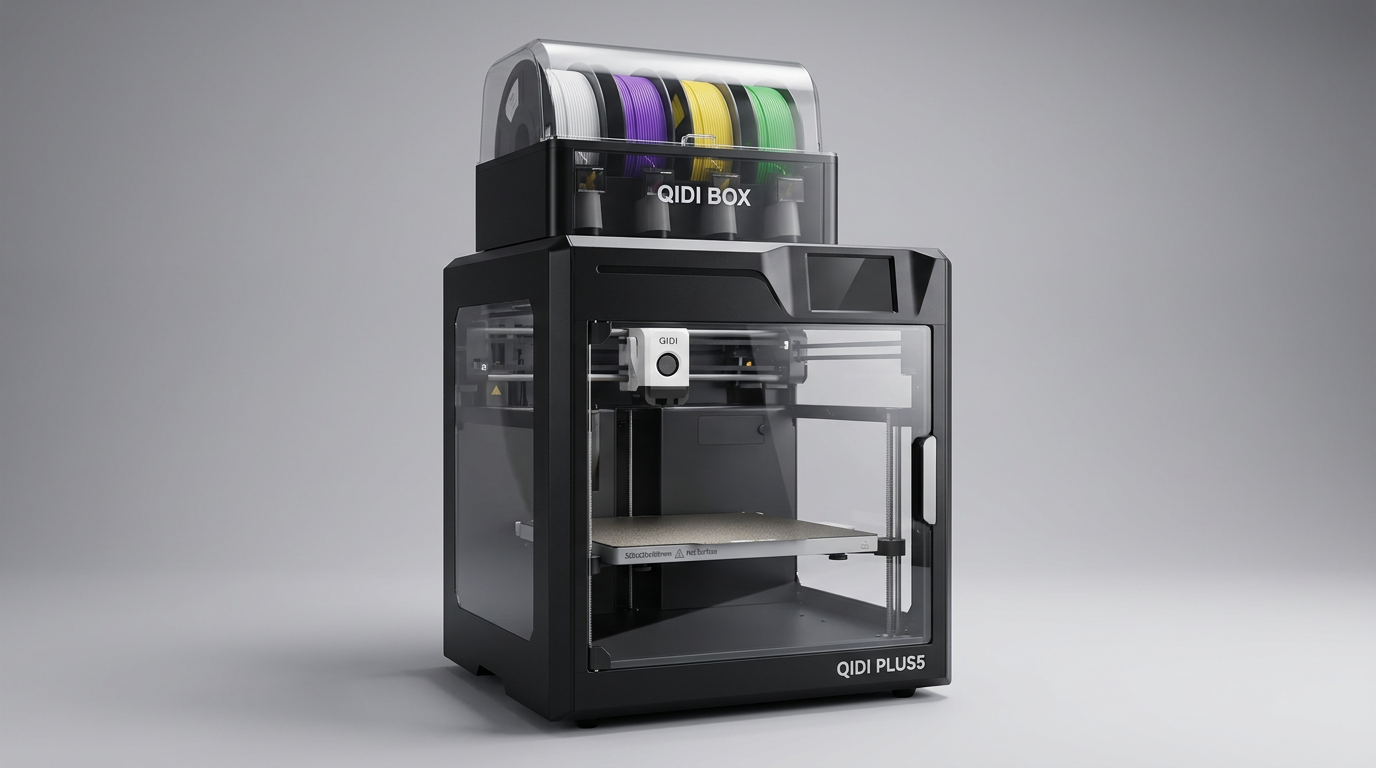
The modern 3D printing market is currently obsessed with multi-color convenience, often prioritizing rainbow trinkets over structural utility. The QIDI Plus5 Combo attempts to straddle both worlds, offering an expansive 320x320x300mm build envelope, a blistering 370-degree hotend, and a genuinely heated chamber alongside an automated material changer known as the QIDI Box. On paper, it represents an aggressive assault on the high-temperature industrial space at a fraction of traditional enterprise costs.
Yet this machine exposes what we call the Dual-Identity Divide: the reality that pairing an industrial-grade thermal motion system with a delicate consumer multi-material feeder creates conflicting engineering priorities. The core machine is an unapologetic, heavy-duty production tool built for engineering plastics. The included filament switching accessory, by contrast, feels like a fragile afterthought rushed out to match consumer trends.
For buyers hunting for a cost-effective way to melt carbon-fiber nylon, polycarbonate, and high-temp composites at scale, the Plus5 offers rare mechanical capability in the sub-$1000 tier. However, relying on the full combo setup out of the box will test your patience if you expect seamless multi-color automation.
What owners love
- + Actively heated chamber reliably maintains target temperatures above 65C
- + Generous 320x320x300mm build volume accommodates large engineering prototypes
- + Exceptional hotend capability handling high-temperature composite filaments
- + Intuitive touchscreen interface with automatic filament retraction upon damage
- + Responsive manufacturer technical support during early hardware troubleshooting
Common complaints
- − QIDI Box filament manifold is fragile and prone to cracking during jam clearing
- − Cardboard spools consistently jam the material feeder without printed adapters
- − Firmware updates have degraded multi-spool recognition and print resume reliability
- − Bowden feed tubes can detach under pressure mid-print
Design & Build
The Plus5 is a physically imposing machine with serious mass. Multiple owners report needing assistance simply unboxing and setting the unit onto a workbench. This heft translates into structural rigidity for its CoreXY motion system, which is crucial for maintaining print consistency across the 320x320x300mm build volume. The enclosure is designed for serious thermal retention, and real-world thermal testing confirms the active chamber heater reaches between 65C and 72C when set to 65C. That level of ambient heat eliminates warp on demanding polymers, placing the core chassis far ahead of passive enclosures. Conversely, the QIDI Box accessory suffers from an immediate material mismatch. Its filament manifold utilizes brittle plastic components, with users reporting snapped fittings on day one while attempting to clear basic filament snags.
Setup & Ease of Use
Despite its industrial scope, the out-of-box software guidance and touchscreen navigation are approachable enough that first-time users can produce successful test prints quickly. The toolhead features automatic filament detection that safely retracts damaged or imperfect strands before they cause catastrophic hotend blockages. However, multi-material prep introduces what we call the Spool Friction Tax. The internal rollers inside the QIDI Box cannot tolerate raw cardboard spools, which cause immediate feed failures. Owners must print specialized spool adapter rings to run common cardboard-wound materials. Additionally, early batch units have arrived with misaligned or loose screws in the feeder module, requiring direct customer service intervention before the unit can load filament reliably.
Performance in Real Use
When operating as a standalone, high-temperature workhorse, the Plus5 delivers pristine surface finishes and remarkable layer cohesion on parts made from nylon, polycarbonate, and carbon-reinforced blends. The active chamber heating is not marketing fluff; it provides the structural stability needed for dimensionally accurate functional prototypes. The breakdown occurs almost entirely in the material delivery pathway of the combo system. Long-term owners running multi-part plates report repeated failures where feed tubes pop loose mid-print, causing the extruder to run dry. When feed interruptions occur, the firmware resume function frequently stalls or loses toolpath coordinates, turning what should have been a hands-off batch run into wasted engineering material.
Software & Ecosystem
While single-material job submission is straightforward via network slicing, the software stack managing the QIDI Box remains a pain point. Firmware revisions intended to patch earlier bugs have actively worsened synchronization between the printer and the feeder. Operators report instances where the system attempts to pull from completely empty spool slots, ignores designated backup spools when one runs out, or refuses to push past sensor checkpoints. Slicing integration does not yet possess the bulletproof maturity found in competitor ecosystems, forcing owners to spend valuable shop time micromanaging material assignment rather than trusting the automated workflow.
Value & Reliability
Priced in the $800 to $900 range, the Plus5 Combo occupies a distinct economic tier. You cannot buy an actively heated 320mm chamber capable of running 370C nozzles from the consumer market leaders at this price point. In that narrow operational context, the raw hardware value is tremendous. Support technicians, frequently cited by name in owner reports, are quick to dispatch troubleshooting steps and replacement hardware. Even so, reliability over consecutive months is uneven for users who depend on the multi-material box. The machine functions reliably when treated as an industrial mono-extruder, but falters when treated as an automated multi-color production hub.
Verdict
Consider - Excellent high-temperature chamber hardware undermined by a fragile multi-color feeding system.
The QIDI Plus5 Combo is built for the Functional Fabricator: engineers, product designers, and advanced makers who require high-temperature plastics, warp-free polycarbonate parts, and a massive build envelope without stepping into five-figure industrial machinery. If you evaluate this machine strictly on its ability to bake, extrude, and fuse structural polymers, the value proposition is formidable.
Buyers seeking an effortless multi-color experience for decorative models or hassle-free PLA prints should look elsewhere. The QIDI Box feeder is plagued by brittle manifolds, cardboard spool rejections, and erratic firmware behavior that will frustrate anyone looking for simple push-button automation.
The Plus5 exposes an uncomfortable reality in consumer additive manufacturing: trying to bolt budget multi-color novelty onto an industrial thermal platform creates a compromised hybrid. Treated as a dedicated, high-temp single-material workhorse that happens to come with a filament drying box, this printer is a powerhouse; treated as a seamless multi-color appliance, it will disappoint you.
FAQ
More 3D Printers reviews
Bambu Lab A1 Combo Renewed Review: Fast Multicolor Printing
Hephi3d TINA2S Review: Compact, Accessible 3D Printing
Davercop 3D Printed Latte Art Camera Review
Anycubic Kobra S1 Max Combo Review: Industrial Scale for Less
ugee Funbox 3D Printer Review: Safe Household Making
Original Prusa CORE One+ Kit Review: The Maker's CoreXY
This review is based on real experiences shared by owners in online communities.