
Bambu Lab A1 Combo Renewed Review: Fast Multicolor Printing
By AValidReview. An AI-assisted summary of customer feedback, not a hands-on test.
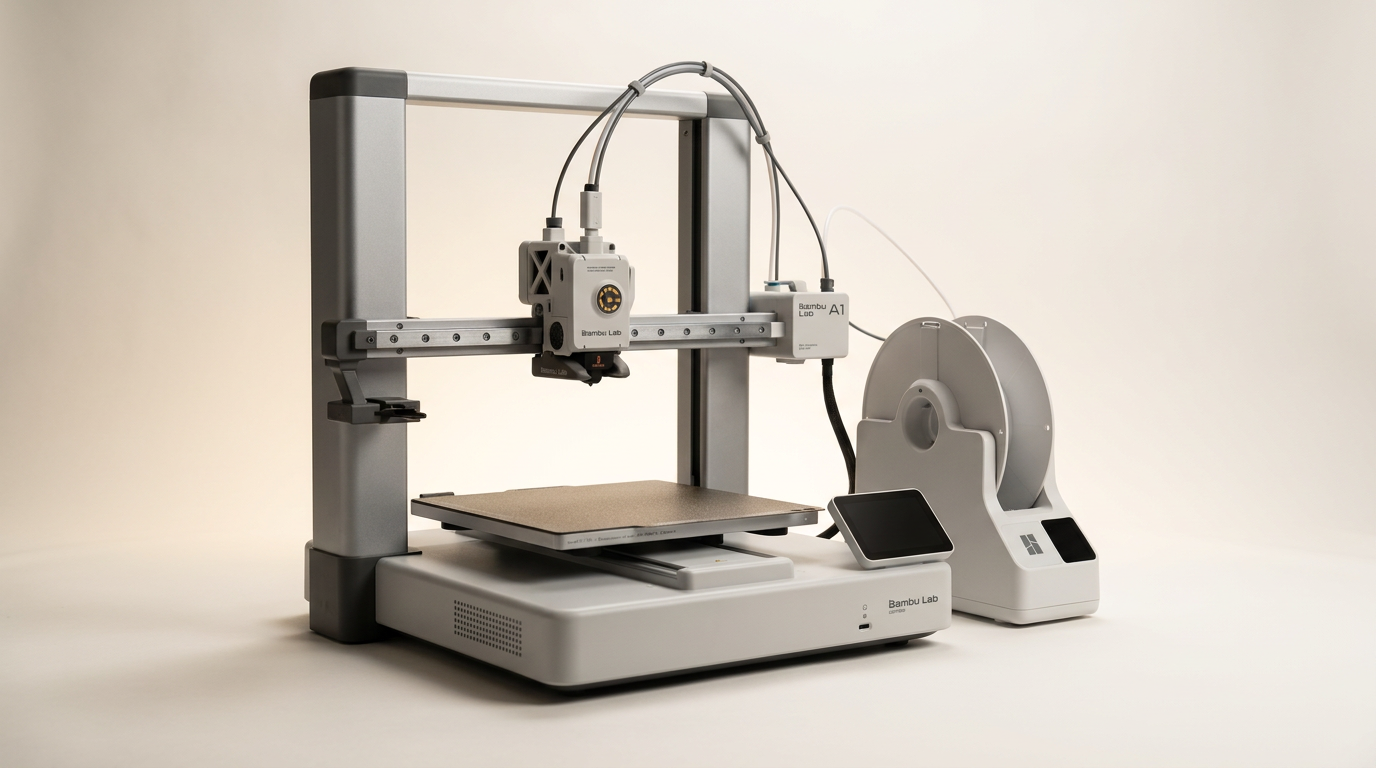
The refurbished 3D printer market has historically operated as a clearance bin for broken hobbyist dreams. Buyers typically accepted loose belts, scratched beds, and missing hardware in exchange for a modest discount. The Bambu Lab A1 Combo (Renewed) challenges that expectation by packaging modern bed-slinger speeds and four-spool multi-material printing into an officially restored package in the $350 to $400 range. On paper, it represents the most cost-effective path to automated multicolor printing available.
Yet buying complex electromechanics second-hand creates what we call the early-hours gauntlet. A brand-new Bambu machine succeeds because tightly controlled factory calibration hides the underlying mechanical tolerances. When a machine undergoes factory refurbishment, that precision balance faces real-world variance. While many units arrive indistinguishable from new hardware, others expose latent stress points within their first two days of operation.
For makers weighing this renewed bundle against a factory-sealed alternative, the decision hinges on tolerance for troubleshooting. The hardware delivers flagship-grade speed and calibration convenience, but buyers must be prepared to thoroughly stress-test their hardware before their return window lapses.
What owners love
- + Factory-refurbished cosmetic condition often mirrors brand-new hardware
- + AMS lite enables automated four-spool multicolor printing out of the box
- + Full automatic calibration eliminates manual bed leveling and Z-offset tuning
- + Quick-swap nozzle system simplifies maintenance and nozzle changes
- + Substantially lower entry cost for high-speed multi-material printing
Common complaints
- − Subsystem failures on arrival can impact AMS lite filament feeding
- − Short-term infant mortality reported within the first 48 hours of use
- − Returning single defective modules like the AMS lite creates logistical friction
Design & Build
The A1 embraces a traditional bed-slinger architecture, moving the build plate along the Y-axis while the toolhead travels on an overhead gantry. What separates it from legacy machines is structural stiffness and refinement. Linear rails and active motor noise cancellation make the motion system quiet and smooth. The quick-swap nozzle design ditches traditional threaded heat breaks for a single clip system, eliminating one of the most frustrating maintenance chores in desktop printing. Across verified refurbished units, cosmetic standards are high. Owners frequently note that machines arrive looking brand-new, with minor blemishes such as tiny surface smudges being the only telltale signs of previous ownership. The hardware feels deliberate, solid, and modern.
Setup & Ease of Use
Bambu Lab built its reputation on eliminating the calibration rituals that once defined entry-level printing. The A1 handles resonance frequency sweeps, automatic bed leveling, and dynamic flow calibration without user intervention. First-time setup usually takes under an hour, guided by a responsive color touchscreen. However, the renewed experience introduces what we call the subsystem decoupling dilemma. When a peripheral component falters, such as the AMS lite failing to push filament into the toolhead extruder on first print, diagnosing the root cause becomes frustrating. Users run into ambiguity over whether to return the whole bundle or pursue replacement for just the faulty feeder module, dampening an otherwise streamlined unboxing experience.
Performance in Real Use
When operating correctly, the A1 Combo delivers output that rivals printers costing twice as much. Accelerations up to 10,000 mm/s squared allow common decorative and functional models to finish in a fraction of traditional print times. Detail retention remains sharp, with clean layer stacking and virtually no ghosting thanks to active input shaping. The AMS lite switches between four filaments with repeatable consistency, making multi-color signage, miniature painting prep, and structural support interfaces straightforward. Long-term users report running the printer nearly continuously for weeks without mechanical drift, underscoring that a properly restored unit yields first-rate performance.
Software & Ecosystem
The software stack acts as the invisible backbone of the A1 experience. Bambu Studio and the mobile companion app provide tight integration, automatic slicing profiles, and remote monitoring. Unlike fragmented open-source toolchains, sending a print from your phone or desktop involves zero network configuration hurdles. The trade-off is reliance on a closed ecosystem. When an error occurs within the AMS feed path, the system relies heavily on proprietary telemetry that can sometimes leave users guessing if the snag is physical, firmware-related, or a sensor defect. For mainstream operators, the cohesive workflow outweighs the walled-garden constraints.
Value & Reliability
Priced well below standard retail, the renewed A1 Combo provides massive hardware value per dollar. The risk lies entirely in quality variance. While many owners receive flawless units that perform without a hiccup, multiple reports document immediate failure modes: filament feed rejections on print number one, or printers that shut down completely after two days of regular use. In the refurbished market, this bifurcation is standard. You either receive a machine that functions identically to factory-fresh stock, or you encounter an infant mortality failure that should have been caught during re-certification. Testing the unit immediately with rigorous, multi-hour jobs is mandatory to confirm system stability.
Verdict
Consider - Outstanding multi-color capability at a bargain price, tempered by a noticeable risk of out-of-the-box hardware snags.
The renewed Bambu Lab A1 Combo is right for resourceful hobbyists, educators, and makers who want flagship-tier multicolor printing without paying full retail. If you are comfortable inspecting mechanical feeds and promptly processing a return if a defect surfaces, the savings in the $350 to $400 range make it one of the strongest values in desktop manufacturing today.
Skip this renewed model if you are buying a gift for an absolute beginner, or if you lack the patience to troubleshoot potential infant mortality defects within your exchange window. In those scenarios, spending the extra money for a factory-sealed unit with direct, unbundled warranty support remains the safer investment.
The renewed A1 exposes the central paradox of modern consumer 3D printing: software and automated calibration can hide mechanical complexity from the user, but they cannot eliminate physical wear. When you buy refurbished, you are not gambling on print quality, you are gambling on whether the automated feeder sensors survived their previous life intact.
FAQ
More 3D Printers reviews
Hephi3d TINA2S Review: Compact, Accessible 3D Printing
Davercop 3D Printed Latte Art Camera Review
Anycubic Kobra S1 Max Combo Review: Industrial Scale for Less
ugee Funbox 3D Printer Review: Safe Household Making
Original Prusa CORE One+ Kit Review: The Maker's CoreXY
ANYCUBIC Photon P1 Max Review: Scale Meets Detail
This review is based on real experiences shared by owners in online communities.