
SAHVAIM Thick Textured PEI Plate for Bambu Lab Printers Review
This review is based on real experiences shared by owners in online communities.
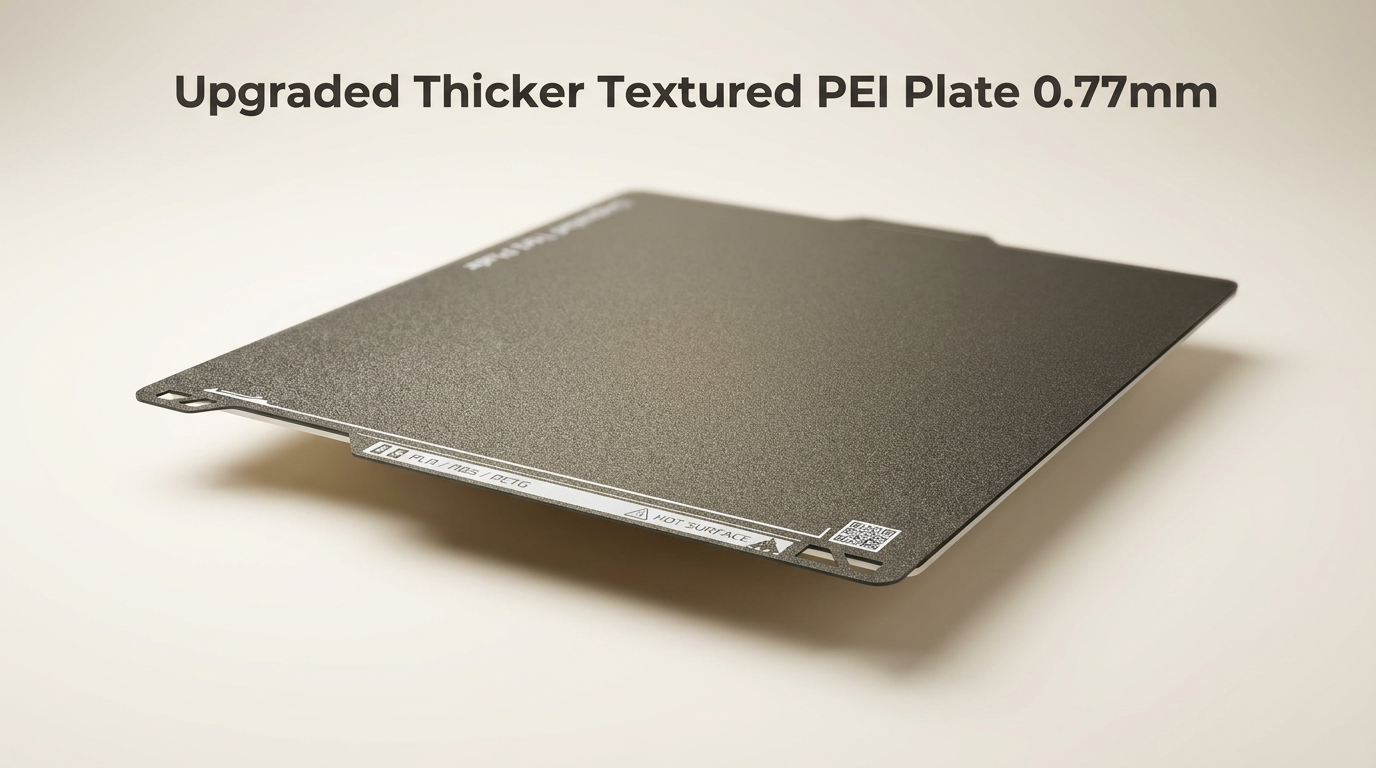
The market for 3D printer build plates has rapidly expanded, mirroring the growth in consumer 3D printing itself. While most focus remains on the printers, the build surface often dictates success, particularly for high-speed systems like Bambu Lab machines. The SAHVAIM 0.77mm Thick Textured PEI Plate enters this segment not as a novel innovation, but as a direct challenge to the OEM offering, aiming to deliver comparable performance without the premium.
Historically, third-party accessories in this space often compromise on material quality or thickness, leading to adhesion inconsistencies or premature wear. SAHVAIM's approach with a 0.77mm thick spring steel core, dual-textured PEI, and Bambu Lab compatibility positions it as a direct substitute. The critical question for discerning users is whether it truly achieves parity where it matters most: print adhesion and durability, or if its lower price point comes with hidden trade-offs.
This review evaluates the SAHVAIM plate through the lens of real-world use, examining its capacity to meet the demands of popular filaments like PLA and PETG, its recognition by Bambu Lab printers, and its longevity compared to stock plates. The goal is to determine if this aftermarket option represents a genuine upgrade path or merely a cost-saving measure with an inevitable performance asterisk.
What owners love
- + Superior or comparable adhesion to OEM plates for PLA and PETG
- + Enhanced durability and longevity compared to some stock plates
- + Automatic recognition by Bambu Lab P1S/P2S/A1/X1 series printers
- + Significant cost savings over manufacturer-branded alternatives
- + Thick, robust spring steel construction prevents warping
- + Easy print removal once the plate cools to room temperature
Common complaints
- − PETG adhesion can be excessively strong, requiring caution during removal
- − Texture may be slightly rougher than some OEM plates, affecting print bottom finish
- − Requires careful cleaning and maintenance, avoiding acetone specifically
- − Availability tied to third-party retailers, not directly from printer manufacturer
Design & Build
The SAHVAIM Textured PEI Plate distinguishes itself with a substantial 0.77mm thickness, a dimension frequently cited by owners as lending a premium, robust feel comparable to original equipment. This thickness, combined with flexible spring steel, provides a solid foundation that resists deformation over time, a common failure point for thinner or lower-quality plates. The dual-textured PEI surface is applied via powder spraying, yielding a consistent finish across both sides, which are equally usable. This design choice speaks to durability and offers a doubled lifespan for the printing surface. Owners consistently report the plate arrives well-packaged and feels substantial in hand, an indicator of its underlying material quality.
Setup & Ease of Use
Integrating the SAHVAIM plate into a Bambu Lab ecosystem proves straightforward. The 257x257mm dimensions ensure a precise fit, and crucially, Bambu Lab printers across the P1S, P2S, A1, and X1 series recognize the plate without issue. This 'plug and print' compatibility, including barcode scanning on models like the P2S, eliminates common aftermarket frustrations, allowing users to swap plates and resume printing quickly. The plate's design supports a workflow where a freshly printed object can cool on one plate while a new print commences on a second, a significant advantage for users with high print volumes. The only user-reported setup nuance involves remembering to remove a clear protective backing upon first use, a minor point quickly resolved.
Performance in Real Use
Adhesion emerges as the SAHVAIM plate's core strength. Users frequently highlight its superior grip for common filaments like PLA and PETG, often outperforming the stock plates that accompanied their printers, particularly after extended use. Prints reliably adhere without additional adhesives, a key convenience. However, this strong adhesion presents a nuanced trade-off, especially with PETG. Owners report that PETG can bond *too* well, necessitating thorough cooling of the plate to room temperature before parts can be safely removed, preventing potential damage to the print or the plate. This adherence characteristic defines what we might call the 'thermal release curve': parts requiring a significant temperature drop to detach cleanly. The deep texture translates into an aesthetically pleasing bottom surface for prints, a consistent positive remark from users.
Software & Ecosystem
The SAHVAIM plate operates within the Bambu Lab ecosystem as a direct replacement part, rather than introducing its own software or requiring specific settings. Its seamless recognition by the printer's firmware, including the QR code detection on compatible models, is a critical success factor. This integration means users can swap plates without modifying printer profiles or software settings, maintaining the streamlined experience that Bambu Lab printers are known for. The plate's function is entirely hardware-based, simplifying its adoption for users accustomed to the proprietary accessories of their printer. This positions it as a 'transparent upgrade' that requires no digital adaptation from the user.
Value & Reliability
Reliability is a recurring theme. Numerous users note the plate's ability to endure hundreds of prints without degradation in adhesion, a stark contrast to some OEM plates that exhibit issues after fewer cycles. The long-term performance suggests a robust PEI coating and spring steel base. The value proposition is compelling; owners consistently describe it as an 'excellent alternative' to OEM plates, which can cost more than double the price. For a consumable item essential to consistent printing, this cost efficiency represents a significant 'operational overhead reduction,' making multiple plates a practical investment for increased print throughput. Its sustained performance over months of use reinforces its reliability and value in the context of ongoing 3D printing operations.
Verdict
Buy - This plate consistently delivers performance equal to, or exceeding, OEM options at a substantially lower price point.
This build plate is an excellent choice for any Bambu Lab P1S, P2S, A1, or X1 series owner seeking a reliable, high-performance, and cost-effective alternative to manufacturer-branded plates. It particularly suits those who print frequently with PLA and PETG and value strong adhesion and durability. Users managing multiple prints will also appreciate the ability to swap plates to maintain workflow. Those sensitive to price, who find OEM plates in the mid to high double-digit range prohibitive, will find this plate, typically priced under $25, an easy recommendation.
Conversely, users who prioritize an absolutely identical surface finish to the smoothest OEM plates, or those who find excessive PETG adhesion a workflow hindrance rather than a feature, might consider other options. The underlying editorial take here is that this product exemplifies the 'post-OEM sweet spot' in the 3D printing accessory market. It identifies a primary pain point, the consumable nature and cost of build plates, and delivers a third-party solution that, through thoughtful material choice and validated compatibility, bypasses the expected compromises of aftermarket products. It's a clear signal that the ecosystem for high-performance printers is maturing, offering more choice without necessarily sacrificing quality.
FAQ
More 3D Printer Parts & Accessories reviews
BambooSegD RGB LED Lamp Kit: The 3D Printer Accessory Standard
Creality TPU 95A: A Flexible Filament for Patient Printers
UniTak3D Quick-Swap Hotend 0.4mm Review: A Solid Bambu A1 Alternative
3DZWMAN LED Lamp Kit Review: The Smart Alternative for 3D Print Lighting
XZN Silk PLA Filament Review: Visual Impact and Printing Consistency
ANKHOH Hard Case for 3Doodler Start+ Review: Essential Organization
This review is based on real experiences shared by owners in online communities.