
SAHVAIM Hotends for Bambu Lab: A Value Proposition with Caveats
This review is based on real experiences shared by owners in online communities.
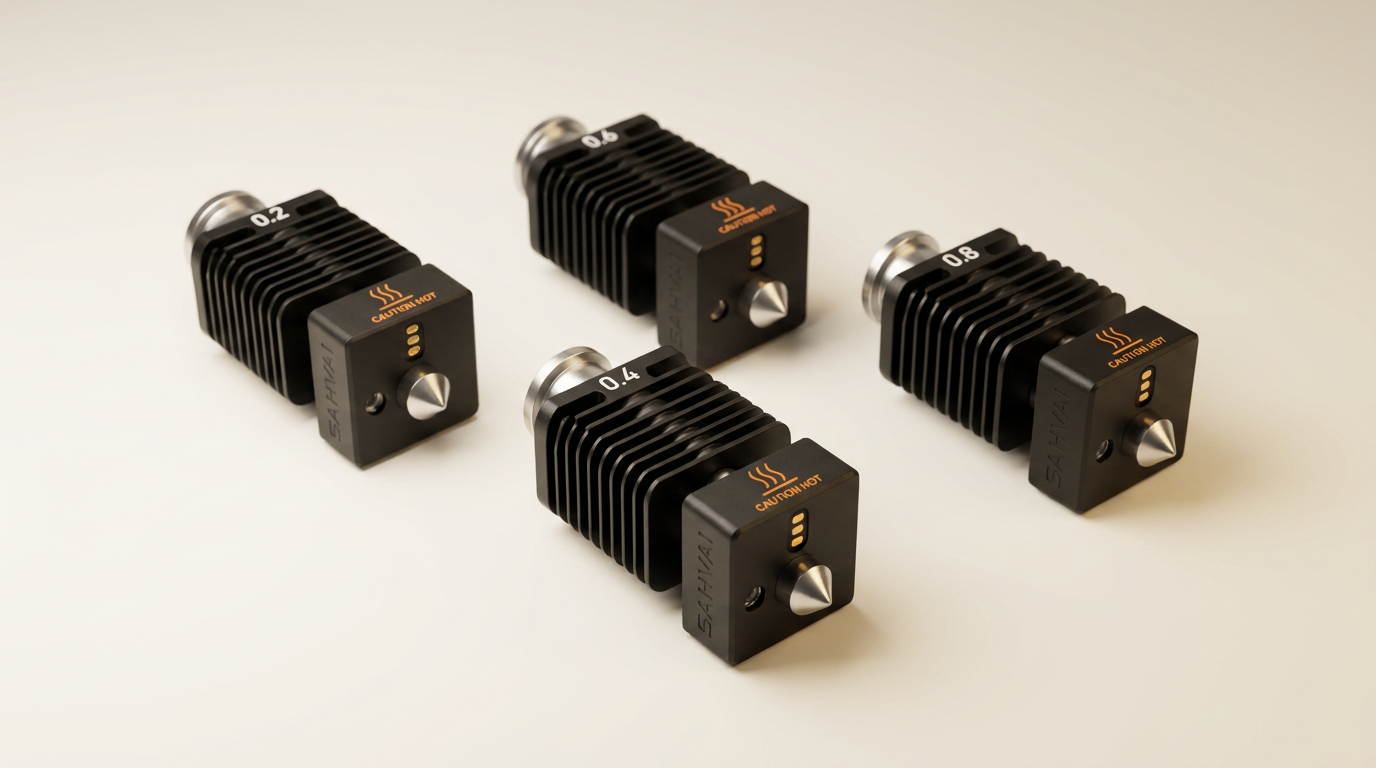
The aftermarket for Bambu Lab accessories has grown rapidly, driven by users seeking cost-effective alternatives to proprietary parts. SAHVAIM's 4-pack of hardened steel hotends, targeting the H2, X2D, and P2S series, enters this space as a direct challenge to the OEM pricing model. While promising significant savings and broader nozzle selection, the real-world experience reveals a nuanced trade-off: a clear economic advantage often paired with a subtle, but persistent, 'reliability lottery' for the discerning user.
Unlike many third-party components that prioritize raw compatibility, these SAHVAIM hotends aim for functional parity across a range of filament types. The set provides a spectrum of nozzle sizes, from fine detail 0.2mm to fast-printing 0.8mm, allowing for versatility in projects. However, the recurring theme among owners is that while the core printing function often performs adequately, consistency in manufacturing and peripheral compatibility can introduce unexpected challenges, echoing a common friction point in the third-party ecosystem.
This review unpacks the SAHVAIM offering, assessing its claims against the direct experiences of 3D printer owners. We evaluate whether the cost savings outweigh the potential for troubleshooting, providing insight into where these hotends truly stand as a viable option for Bambu Lab users seeking expanded capabilities without the full OEM premium.
What owners love
- + Significantly lower cost than official Bambu Lab hotends
- + Includes a versatile range of four nozzle sizes (0.2, 0.4, 0.6, 0.8mm)
- + Generally performs well with common filaments like PLA, PETG, TPU
- + Owners report comparable print quality to original parts on working units
- + Quick and easy installation, matching the original quick-swap design
- + Seller offers responsive customer service for defective units
Common complaints
- − Inconsistent manufacturing quality leading to functional errors or leakage
- − Silicone socks are often incompatible, causing errors or fitment issues
- − Some units exhibit poor print quality or frequent clogging, especially the 0.2mm nozzle
- − Potential for fan speed errors or print failures, particularly on P2S models
- − Specific compatibility issues with bed leveling on some printer models
Design & Build
The SAHVAIM hotends mimic the aesthetic and quick-swap mechanism of the original Bambu Lab components. Owners note the visual similarity, often commenting that they look identical to factory originals. The set includes a range of hardened steel nozzle sizes, suggesting an intent for durability and versatility across various filament types, including those with abrasive particles. However, the claim of 'hardened materials' for fiber reinforced prints draws skepticism from some users, who question the actual composition of the nozzle orifices compared to official parts. A recurring minor but notable observation is the reverse polarity of the magnets compared to Bambu's own, a detail that does not impact function but points to subtle manufacturing differences. The core design aims for a 'plug-and-play' experience, though execution in terms of fit and finish sometimes falls short, as evidenced by issues such as nozzles separating from the body or incorrect lengths affecting bed leveling.
Setup & Ease of Use
Installation of these SAHVAIM hotends largely follows the familiar quick-swap procedure established by Bambu Lab, with several owners reporting a straightforward experience. The hotends are designed for tool-less swapping, aligning with the brand's '30-second replacement' claim. However, the ease of setup is frequently hampered by peripheral compatibility issues. A prominent 'silicone sleeve disconnect' is noted, where the included silicone sock often triggers errors on printers like the P2S or simply does not fit correctly. This forces users to either reuse their original socks or operate without them, compromising thermal stability and potentially leading to fan speed errors. Furthermore, a few owners mentioned the absence of necessary tightening hardware, a minor but critical oversight that disrupts the out-of-box experience and highlights a gap in providing a complete user solution.
Performance in Real Use
When functional, these hotends generally deliver satisfactory printing results for common filaments. Many users report performance indistinguishable from original Bambu Lab nozzles, especially with PLA and PETG, making them a compelling alternative. The inclusion of multiple nozzle diameters allows for flexible project demands, from fine detail to rapid prototyping. However, the 'consistency paradox' emerges clearly in performance. While some units produce flawless prints, others suffer from persistent issues like poor print quality, frequent clogging, or outright print failures. The 0.2mm nozzle, while offering fine detail, is particularly susceptible to being 'finicky' or clogging. Critically, several owners encountered fan speed errors, particularly on the P2S, which point to subtle deviations in manufacturing tolerances that affect sensor readings or airflow, suggesting that direct physical fit does not always translate to seamless electronic compatibility.
Software & Ecosystem
As third-party hotends, these SAHVAIM units operate within the existing Bambu Lab software and firmware ecosystem without specific SAHVAIM-branded integration. The expectation is that they function as direct OEM replacements. However, this is where the 'silent incompatibility' manifests. Printers like the P2S report errors related to fan speeds or non-recognition of the silicone sleeve, indicating that while the physical hotend fits, its interaction with the printer's sensors or protective mechanisms is not always perfect. This necessitates troubleshooting by the user, often involving swapping back to an original nozzle to confirm the issue. The printer's diagnostic systems, designed to ensure optimal operation with OEM parts, effectively flag deviations in these third-party components. This is not a failure of the software itself, but rather an indicator of the fine tolerances and proprietary integration within the Bambu Lab ecosystem that aftermarket parts must contend with.
Value & Reliability
The primary appeal of these SAHVAIM hotends is their value proposition, offering a set of four nozzles for a fraction of the cost of official Bambu Lab equivalents. For many, this price point makes them an attractive option for expanding their nozzle arsenal or simply having spares. When they work, the cost savings are substantial. However, reliability remains a significant concern, creating a 'quality lottery' for buyers. A notable number of owners report critical failures, such as nozzles separating, constant clogging, or severe print quality degradation, often requiring a return to the original Bambu Lab hotend to resolve. While the seller has shown responsiveness in offering refunds, the frequency of these issues underscores a fundamental trade-off: significant cost savings come with an elevated risk of receiving a suboptimal or defective unit. This suggests that while the initial outlay is low, the potential for lost print time and troubleshooting effort adds an unseen cost.
Verdict
Consider - For users needing diverse nozzle sizes at an aggressive price point, these offer potential value.
These hotends are best suited for experienced Bambu Lab owners comfortable with troubleshooting and willing to accept a degree of inconsistency in exchange for substantial cost savings, particularly those printing primarily with common, non-abrasive filaments. If your workflow demands absolute reliability or you are new to 3D printing, investing in OEM parts, even at a higher price, remains the more prudent choice. These are not for those who expect flawless, out-of-the-box performance without potential intervention.
The SAHVAIM hotends reveal a core tension in the 3D printing aftermarket: the pursuit of affordability versus the inherent integration of a sophisticated ecosystem. While offering a tantalizing 'component arbitrage' opportunity, the real cost extends beyond the sticker price, demanding users account for potential downtime and diagnostic effort. The hotends function not as true OEM replacements, but as a gateway product that requires users to invest time alongside their money.
FAQ
More 3D Printer Parts & Accessories reviews
YUNHAN Air Filter for Bambu Lab 3D Printers Review

HYHJMISTY 91PCS 3D Printer Tools Kit Review: A Focused Starter Set
Black Magic 3D Printer Adhesion Kit Review: The Applicator Advantage
Fuitnerd 184-Piece 3D Printer Tool Kit Review: Value-Focused Utility
CreatryLab A1/A1 Mini Hotend Review: Budget Reliability for Bambu Labs
Fuitnerd 142Pcs 3D Printer Tools Kit Review: A Maker's Essential?
This review is based on real experiences shared by owners in online communities.