
Original Prusa CORE One+ Kit Review: The Maker's CoreXY
By AValidReview. An AI-assisted summary of customer feedback, not a hands-on test.
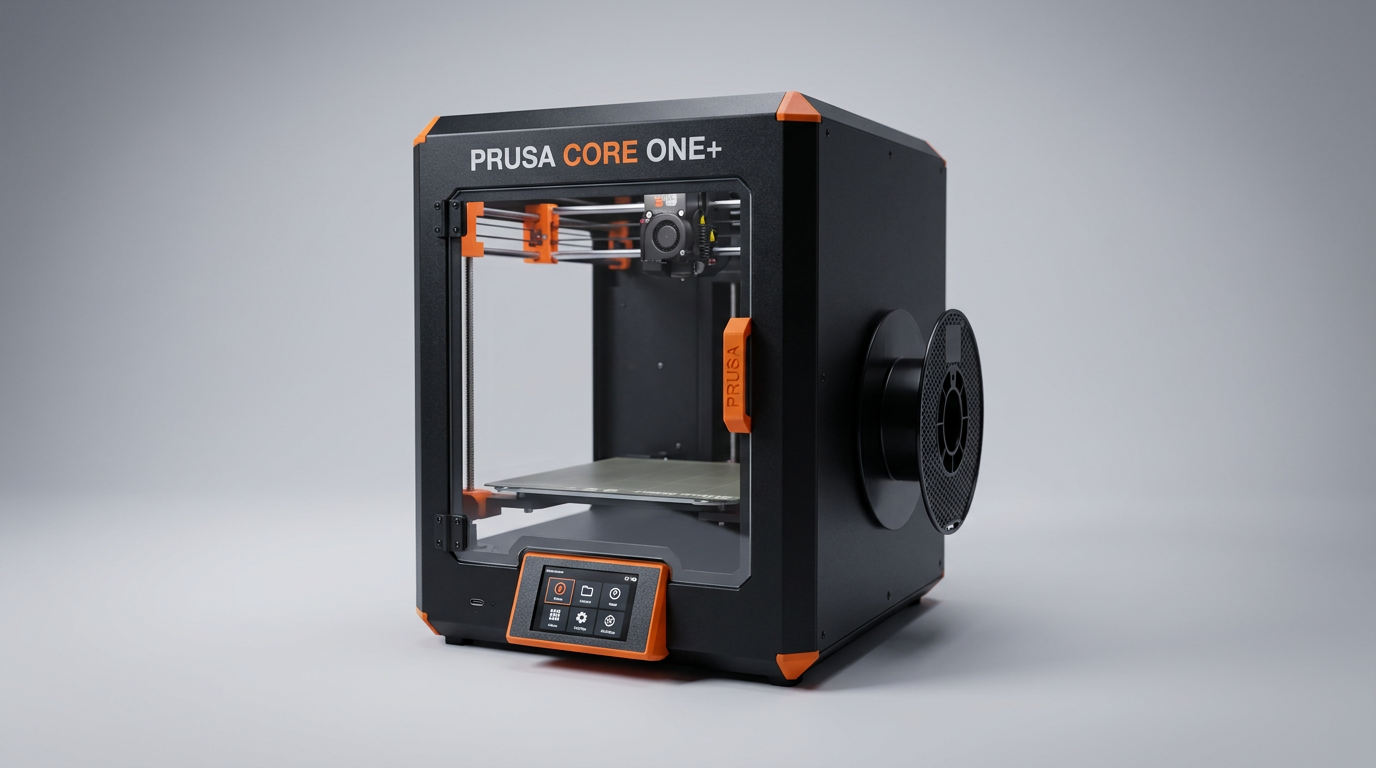
While desktop 3D printing rushes toward appliance-like black boxes that treat the user as a passive consumer, Prusa makes an unapologetic demand: build it with your own hands. The CORE One+ kit commands an investment well north of $1,000, yet it arrives as hundreds of fasteners, steel plates, wiring looms, and printed brackets. It is a deliberate counter-philosophy to the sealed-box ecosystem, betting that true production reliability comes from total mechanical comprehension rather than proprietary automation.
What most prospective buyers miss is that this build is not a cost-saving compromise; it is an architectural contract. The 15 to 20 hours required to assemble this machine pay out what we call the maintenance dividend. When a thermal clog, belt tension imbalance, or bearing bind inevitably strikes six months down the line, owners who built their toolpath from bare steel do not submit an RMA ticket and wait. They fix it in fifteen minutes because they know every nut and bolt by name.
Yet that contract cuts both ways. The CORE One+ offers zero forgiveness for careless assembly, and buyers expecting modern consumer convenience will hit a wall. We evaluated owner experiences, hardware design choices, and real-world performance to determine whether Prusa's flagship CoreXY kit justifies its steep investment of both cash and labor.
What owners love
- + Unmatched mechanical intimacy makes long-term maintenance fast and painless
- + Rigid steel CoreXY architecture delivers exceptional print quality at high speeds
- + Completely offline operation protects proprietary intellectual property
- + Comprehensive online photographic documentation and organized hardware packs
- + Active thermal enclosure reliably handles engineering filaments like ASA and nylon
Common complaints
- − Demanding 15 to 20 hour assembly leaves zero room for careless mistakes
- − Missing hardware or warranty replacements can trigger multi-day shipping delays
- − Extensive use of 3D-printed structural parts raises durability concerns for some
- − Severe risk of print failure if calibration or assembly steps are rushed
Design & Build
The CORE One+ departs from Prusa's traditional open-bed slingers by adopting a fully enclosed CoreXY motion system wrapped in an all-steel exoskeleton. The frame provides the structural rigidity necessary to handle high acceleration without ringing or resonance artifacts. Inside the box, however, buyers encounter Prusa's hallmark engineering compromise: a mix of precision-machined motion components and PETG 3D-printed functional parts. Several owners express skepticism about seeing plastic brackets and mounts on a machine in the $1,300 to $1,400 range, arguing that CNC-milled aluminum would inspire greater confidence against long-term fatigue. Prusa's counter-argument remains practical reparability: if an enclosed mount cracks two years from now, you can simply print its replacement rather than ordering proprietary cast metal. The chamber incorporates an active thermal management system designed to sustain 55 degrees Celsius, using an automated top vent to regulate internal temperatures across volatile engineering filaments like polycarbonate and nylon while avoiding heat creep during long PLA runs.
Setup & Ease of Use
Assembling the CORE One+ is a full-weekend commitment, typically demanding 15 to 20 hours of concentrated focus. Prusa's web-based, step-by-step photographic guides remain the gold standard of hardware documentation, supplemented by 1:1 hardware templates and user-submitted comments that flag tricky alignment tolerances. The process is completely solder-free, but it tests mechanical patience. A recurring theme in user feedback is that your final print quality is a direct reflection of your assembly diligence; take shortcuts with belt alignment or squareness, and the machine will punish you. There are logistical vulnerabilities in this kit model as well. When a hardware pack arrives short-shipped, as one owner experienced with a missing motion component, the entire project grinds to an immediate halt while waiting over a week for international replacement shipments. This is not a plug-and-print tool; it requires workshop maturity and meticulous care from the moment the box is unsealed.
Performance in Real Use
Once dialed in, the CORE One+ operates as an industrial workhorse. Long-term users describe it as a beast of a printer that routinely turns out the cleanest layers they have ever produced, outclassing budget platforms like the Ender series by orders of magnitude. The CoreXY kinematics handle rapid toolhead transitions without introducing surface artifacts, and the enclosed chamber prevents the edge-curling and layer delamination that plague high-temp polymers on open beds. However, the machine does not insulate users from fundamental additive manufacturing physics. When users bypass proper thermal calibration or misuse slicer settings, catastrophic failures follow. One owner reported total failure with filament emerging as melted, spider-webbed strands, illustrating the appliance trap: buyers expecting hands-off automation can easily misdiagnose thermal bottlenecks or extruder tension issues if they treat the machine like a consumer microwave rather than a precision industrial instrument.
Software & Ecosystem
PrusaSlicer anchors the operational experience, providing battle-tested profiles that eliminate the guesswork from filament tuning. The software pairs with Printables, Prusa's thriving model repository, enabling clean workflow handoffs. Crucially, the CORE One+ addresses an escalating concern in professional and academic settings: data sovereignty. Unlike competitors that funnel print jobs through remote cloud infrastructure and mandate telemetry tracking, the CORE One+ is built for strict local control. It features a removable Wi-Fi module and complete offline processing capabilities. For businesses, defense contractors, and educational labs handling proprietary CAD data, this cloud-free architecture is not a retro design choice; it is an enterprise requirement. Your intellectual property stays confined to local memory cards and internal networks.
Value & Reliability
Priced well north of $1,000, the CORE One+ kit occupies an unusual market position. Rivals offer pre-assembled, fully enclosed CoreXY machines at lower price points with flashy touchscreens and LiDAR sensors. Prusa asks you to pay a premium and build the machine yourself. The value proposition only makes sense when viewed through the lens of machine lifespan and operational autonomy. You are paying for an open ecosystem, fully documented schematics, and an engineering team that refines motion systems without locking replacement parts behind gated serial numbers. Reliability hinges almost entirely on user build quality. Those who take the time to square the frame and torque every screw report months of zero-failure uptime. Those who rush the process or expect the printer to compensate for user error find themselves holding an expensive collection of troubleshooting tickets.
Verdict
Buy - The Original Prusa CORE One+ kit trades instant convenience for lifetime reparability, rock-solid CoreXY stability, and complete offline data control.
This kit is ideal for engineering workshops, makerspaces, and serious hobbyists who view tool ownership as a craft. If you want a machine capable of producing high-temp functional parts without phoning home to remote cloud servers, and you are eager to spend a weekend understanding every gear and belt, nothing in this price tier matches it. Conversely, if you want a turnkey consumer appliance that prints ten minutes out of the box, or if the thought of torquing belts and routing wire harnesses fills you with dread, skip this kit and buy a pre-assembled alternative.
The CORE One+ reveals the central divide in modern additive manufacturing: convenience versus agency. By forcing you to assemble its spine and calibrate its joints, Prusa protects you from the black-box obsolescence creeping into consumer tech, creating an industrial machine that you never have to throw away.
FAQ
More 3D Printers reviews
ANYCUBIC Photon P1 Max Review: Scale Meets Detail
Anycubic Kobra S1 ACE 2 Pro Combo 3D Printer Review
Toybox Alpha Two 3D Printer Review: The Zero-Fuss Toy Factory
Creality K2 SE 4C Review: Budget Multicolor CoreXY
Anycubic Kobra S1 Max Combo Review: High-Volume Ambition
Anycubic ACE 2 Pro Review: Heated Multi-Material Feeding
This review is based on real experiences shared by owners in online communities.