
Miskis 46-Piece 3D Printer Tool Kit Review: Bench Essentials
By AValidReview. An AI-assisted summary of customer feedback, not a hands-on test.
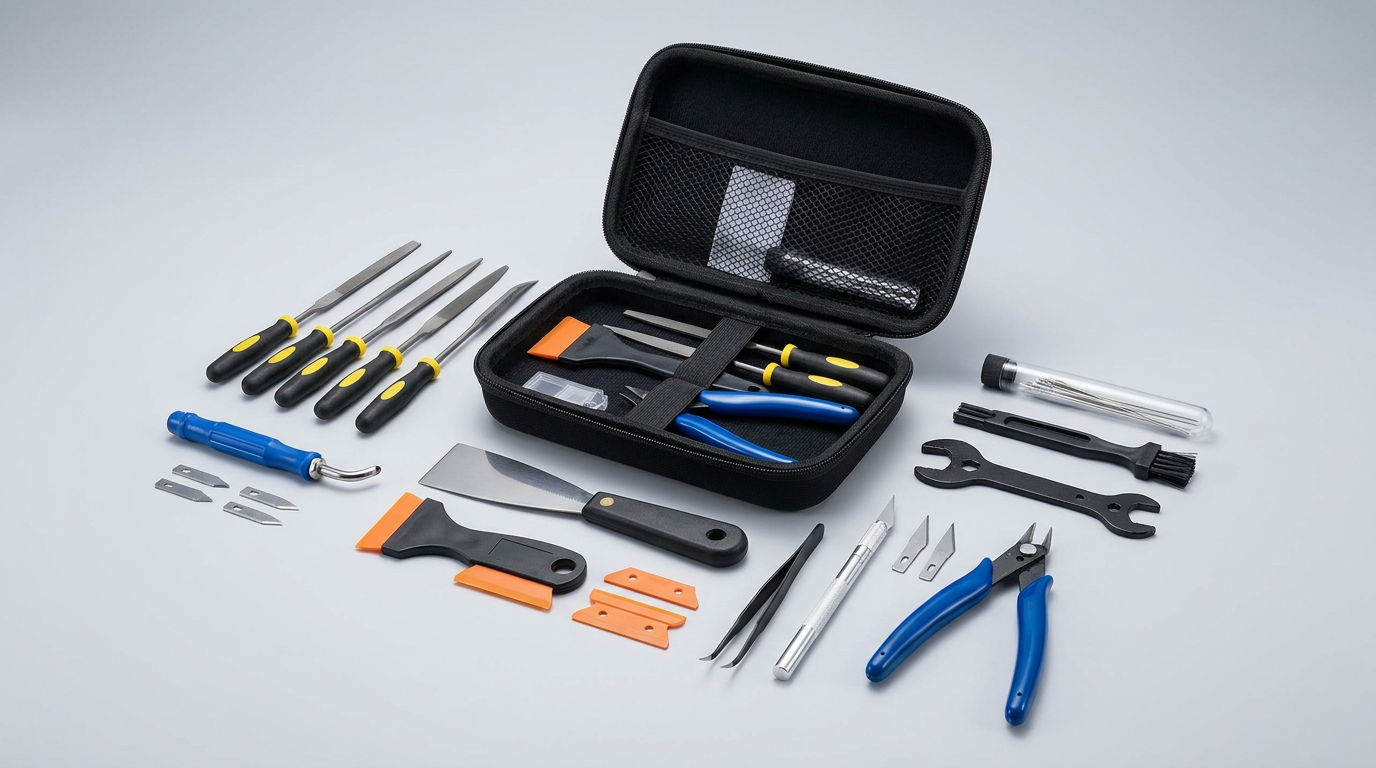
Consumer 3D printing often sells the illusion of push-button manufacturing, yet every completed print immediately introduces what can be called the post-processing gap. Slicers generate parts, but raw plastic comes off the bed with brim flash, support scars, and stringing that software cannot fix. Most owners spend months building an ad-hoc collection of dull kitchen knives, mislaid pliers, and random dental picks to manage this benchwork.
The Miskis 46-Piece 3D Printer Tool Kit targets that disarray directly. Sold in the under-$20 band, typically landing between $10 and $15, the package bundles print removal scrapers, deburring blades, needle files, hotend cleaning wires, and a hobby knife into a single zip-around EVA case. Rather than offering industrial metallurgy, it provides immediate workshop consolidation.
This collection operates on a clear principle of starter-pack attrition. It equips an owner with every mechanical implement needed to triage bed adhesion, clogged nozzles, and edge cleanup, functioning as an entry-level test bench. You get a functional baseline immediately, deferring expensive, specialized tool purchases until your workload genuinely demands them.
What owners love
- + Comprehensive 46-piece assortment covers print removal, nozzle care, and model finishing
- + Included deburring tool and five needle files make quick work of brim seams and tight joints
- + Dual scraper setup includes a plastic blade safe for delicate textured PEI sheets
- + Compact zippered EVA case prevents small maintenance tools from scattering across the bench
- + Exceptional value for hobbyists outfitting a first additive manufacturing station
Common complaints
- − Flush cutters feature limited jaw clearance and basic hobby-grade steel
- − Generic interior case straps lack dedicated, form-fitted slots for every piece
- − Tweezers have needle-sharp tips that require cautious handling around prints
- − Stamped metal nozzle wrench offers minimal mechanical leverage for tight heat blocks
Design & Build
The Miskis kit gathers 46 discrete components inside a semi-rigid EVA travel case. The bundle includes a broad metal spatula, a double-ended plastic scraper with replacement blades, five needle files, a craft knife with spare blades, needle-point tweezers, a rotating deburring tool, wire cleaning brushes, a stamped hotend wrench, flush cutters, and a vial of ten stainless steel clearing needles. The overall build quality reflects utility-grade manufacturing rather than high-end German hand tools, but context matters. Because these tools manipulate soft thermoplastics like PLA, PETG, and ABS rather than billet aluminum, hardened tool steel is unnecessary for standard model cleanup.
The inclusion of both metal and plastic scrapers represents a smart design choice that addresses changing print bed materials. Older glass beds tolerated stiff metal putty knives, but modern textured PEI sheets scratch easily under aggressive steel edges. The plastic scraper acts as a paint-safe razor, lifting stubborn skirt lines without ruining plate coatings. The deburring tool features an interchangeable curved swivel blade, while the needle files provide varied profiles (flat, round, triangular) for tailoring model joints.
Setup & Ease of Use
There is no formal setup required beyond unzipping the case, but the organizational scheme demands modest patience. The interior layout uses elastic retention bands and a netted divider pocket. While this condenses a massive tool count into a footprint barely larger than a paperback book, it relies on a generic pouch system rather than custom molded EVA recesses. Tools shift during transit, and smaller accessories, like the vial of clearing needles or extra hobby blades, inevitably settle to the bottom of the mesh sleeve.
In daily practice, having a dedicated post-processing kit sitting beside the printer eliminates workshop sprawl. Print removal is straightforward: the thin leading edge of the plastic scraper slips under thin first-layer brims, while the wide metal scraper breaks vacuum on larger flat-bottomed prints. The craft knife handle holds standard hobby blades securely via a knurled collar, and the deburring tool rotates freely on its internal bearing, allowing one-handed chamfer cleanup around model bases without chattering.
Performance in Real Use
Across routine printing tasks, the kit punches well above its modest cost. The deburring tool is a standout performer, shaving down elephant foot expansion along bottom perimeters with a single smooth sweep. Owners who print mechanical enclosures or dovetail joints consistently highlight the five miniature files, which make quick work of slight dimensional variances in tight-tolerance assemblies. The included brass brush cleans accumulated plastic deposits off brass nozzles during heating cycles without gouging the softer heater block metal.
The limitations of the kit surface primarily in the cutting tools. The flush cutters work fine for snipping 1.75 mm filament and small support interfaces, but the jaws do not open as wide as professional electronics cutters, requiring multiple passes on dense tree supports. The tweezers feature exceptionally fine, needle-like tips that are ideal for extracting filament drool from hot nozzles, though they can bend under heavy lateral prying. The stamped steel nozzle wrench works for basic maintenance, but stubborn, heat-fused nozzles still benefit from a proper six-point socket wrench to prevent rounding the brass hex.
Software & Ecosystem
While this is a purely mechanical kit without software components, it serves as the physical bridge to whatever slicing environment you run. Modern slicers like Bambu Studio, OrcaSlicer, and PrusaSlicer include advanced brim, mouse-ear, and support generation algorithms. However, aggressive support interfaces still leave micro-artifacts on overhangs. This toolkit operates as the physical counterpart to slicer post-processing, providing the exact implement required to clean support roots, seam lines, and internal hole tolerances.
The accessories maintain universal compatibility across FDM ecosystems. The 0.4 mm clearing needles match standard desktop nozzle bores from Creality, Bambu Lab, Anycubic, and Prusa. The brushes, scrapers, and deburring handles work identically regardless of machine brand. Resin printer operators also find secondary utility in the files, tweezers, and flush cutters for trimming uncured support trees, though the nozzle needles and wire brushes remain strictly FDM-specific.
Value & Reliability
Priced well under $20, the Miskis kit delivers remarkable economic value. Sourcing these items individually from hardware and craft suppliers (a decent deburring handle, five needle files, replacement hobby blades, specialty scrapers, and nozzle needles) quickly runs past $40. For hobbyists entering the category, the initial capital outlay is low enough to make the purchase an effortless decision.
Long-term durability follows the starter-pack attrition model. The high-wear cutting components, particularly the budget flush cutters and hobby blades, will dull after months of heavy PETG and nylon trimming. Conversely, the deburring handle, files, tweezers, and scrapers hold up admirably under standard shop use. When a specific cutter finally loses its edge, replacing that single tool with a premium alternative leaves the rest of the kit fully functional inside its original case.
Verdict
Buy - A remarkably cost-effective consolidation of bench essentials that bridges the post-processing gap for any FDM printer owner.
This kit is ideal for newcomers setting up their first 3D printer, makerspaces needing self-contained maintenance packs, and experienced printers tired of chasing lost scrapers and pliers across their workbench. Production print farms and commercial fabricators running continuous runs will want industrial-grade flush cutters and hardened socket drivers, but hobbyists will find virtually everything they need right here.
The Miskis set succeeds because it treats post-processing as an integrated discipline rather than an afterthought. By packing the dull tasks of nozzle clearing, bed scraping, and seam deburring into a ten-dollar footprint, it quietly solves the most tedious friction point in desktop fabrication.
FAQ
More 3D Printer Parts & Accessories reviews
Wefuit Bambu Lab Liquid Bed Adhesive Review
Dynta Silk PLA Bundle Review: 6 Colors, 250g Spools
HysiPrui P1S/P1P Integrated Hotend Review: Cheap Spares, Real Trade-Offs
HP OfficeJet Pro 8135 Review: The Cloud-Tethered Workhorse
HzdaDeve Bambu P1S Hotend 3-Pack Review: Value Meets Risk
Fannova 23.6" Large Printer Stand Review
This review is based on real experiences shared by owners in online communities.