
MakerHawk Optical Endstops: Non-Contact Precision for 3D Printers
This review is based on real experiences shared by owners in online communities.
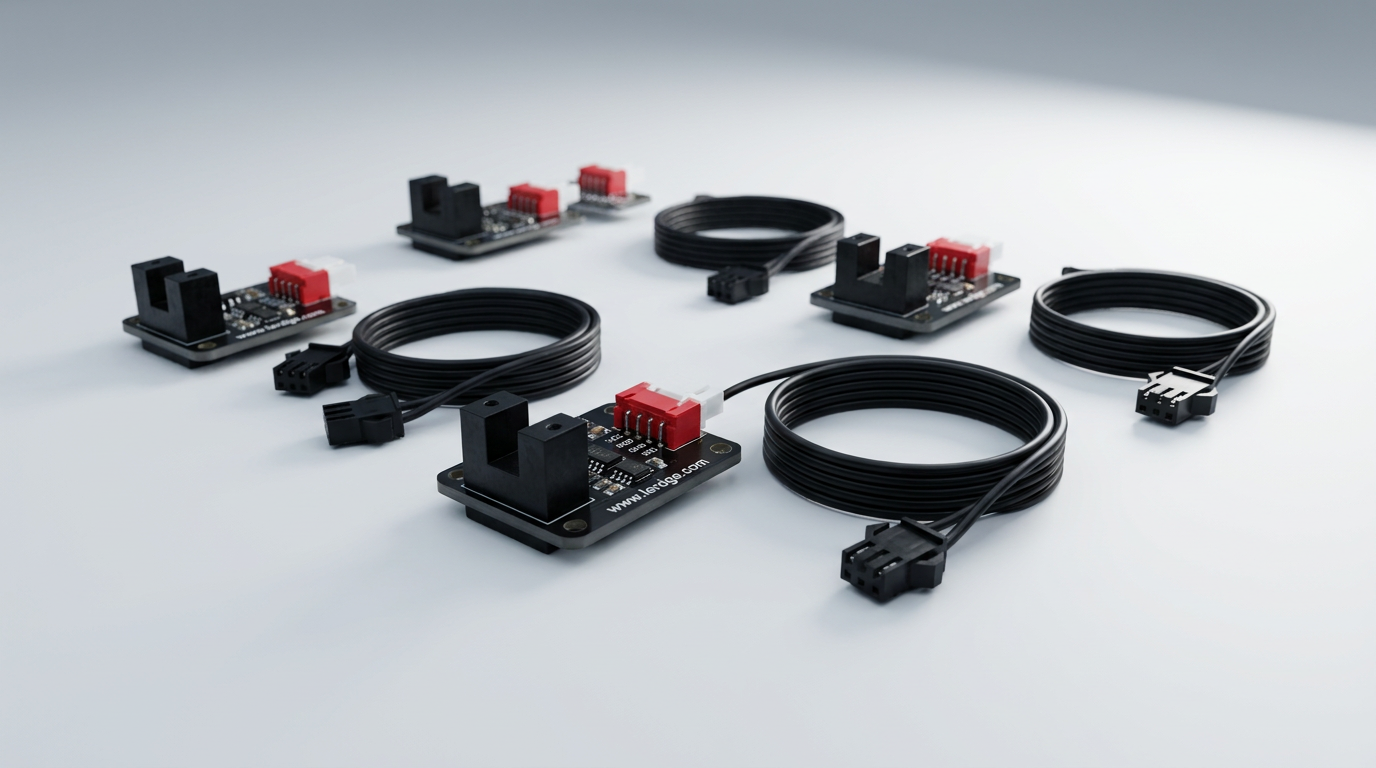
The MakerHawk 6pcs Optical Endstop package enters a market often dominated by mechanical switches, promising enhanced precision and longevity through non-contact operation. While mechanical switches offer a clear physical trigger point, they inherently introduce wear and potential for positional drift over time. Optical alternatives like these aim to circumvent such issues, providing a repeatable digital signal without physical contact.
However, the perceived simplicity of optical sensing belies a more nuanced reality in real-world applications. Integrating these components effectively often requires an understanding of their electrical characteristics and the specific demands of the host machine. This is not a simple plug-and-play upgrade in every scenario.
Many purchasers are seeking an upgrade path from less reliable or less precise mechanical systems, or are embarking on custom builds where standard solutions fall short. The MakerHawk optical endstops position themselves as a cost-effective choice for these applications, but their success hinges on careful implementation.
What owners love
- + Delivers highly repeatable, precise readings
- + Non-contact operation ensures long lifespan
- + Works effectively in high-speed applications
- + Versatile for 3D printers, CNC, and custom projects
- + Excellent value for the price point
- + Bright LED indicator confirms trigger status
Common complaints
- − Some units exhibit loose, intermittent connectors
- − Can interfere with analog readings on specific microcontrollers (e.g., ESP32)
- − Wiring may require modification for certain 3D printer boards
- − Susceptible to ambient light interference outdoors
- − Requires custom mounting brackets or careful placement
- − The integrated LED cannot be turned off or dimmed
Design & Build
The MakerHawk optical endstops feature a compact design centered around an optical transmissive sensor. Owners report a clever design with a wide sensor aperture, facilitating easier alignment than some narrower alternatives. The build quality generally satisfies, with many noting the switches feel robust enough for their intended purpose. A notable design element is the integrated, bright LED indicator, which illuminates when the optical path is interrupted. While useful for troubleshooting and setup, owners also report it is exceptionally bright and cannot be disabled, a minor but recurring observation that contributes to what could be called 'the constant tell' - its operational state is always overtly visible.
Setup & Ease of Use
Integrating these optical endstops often requires more than a direct swap. While some users report seamless plug-and-play experiences, especially as filament run-out sensors, others encounter challenges. A key theme is the need for custom mounting solutions; the package does not include brackets, necessitating user-fabricated components or existing printable models. Furthermore, several owners highlight the importance of correct wiring, with some needing to re-pin connectors for compatibility with specific 3D printer boards like the SKR 1.4 Turbo. The absence of comprehensive instructions for placement or specific printer integration suggests these are intended for users comfortable with basic electronics and customization. This points to 'the maker's tax' - the implicit requirement for hands-on, problem-solving effort from the end-user for successful deployment.
Performance in Real Use
When properly implemented, these optical endstops deliver on their promise of high repeatability and precision. Owners using them for 3D printer homing, CNC router enhancements, and even high-speed solenoid detection consistently report accurate, reliable triggering. The non-contact nature is a significant advantage, eliminating the mechanical wear and bounce associated with traditional switches. However, performance is not universally flawless. One critical limitation is their susceptibility to ambient light, particularly outdoors, where direct sunlight can cause them to fail. Additionally, some specific materials, like certain types of printer paper, prove surprisingly translucent to the infrared light, requiring a double-layer for reliable detection. This highlights the 'environmental sensitivity' of optical solutions-their performance is inherently tied to ambient conditions and the properties of the material being detected.
Software & Ecosystem
The MakerHawk endstops provide a simple logical high/low output, though one advanced user noted their capacity for analog output based on obstruction level. This flexibility allows integration with various microcontrollers and control boards, from 3D printer mainboards running Marlin or Klipper to Arduino and Raspberry Pi projects. However, a significant caveat surfaces with ESP32 microcontrollers: when triggered to a high state, these endstops can introduce noise that interferes with analog readings on other pins. This specific interaction can render other analog sensors useless, a critical flaw for projects heavily reliant on ESP32's analog capabilities. This issue exemplifies 'the ripple effect'-a seemingly isolated component choice can have unexpected, wide-reaching implications across the entire electronic system, especially in finely tuned digital-analog interfaces.
Value & Reliability
Priced in the budget category, the MakerHawk optical endstops offer outstanding value for their performance, particularly given the included quantity. For most indoor, 3D printing, or CNC applications, owners consistently report a long service life with no issues, even in environments with some dust. The non-contact design inherently contributes to this longevity. However, quality control occasionally falls short. Several owners received units with loose connectors, leading to intermittent signals and requiring users to desolder and resolder connections. This inconsistency introduces a hidden cost, demanding additional time and technical skill from the user to achieve reliable operation, underscoring that while the per-unit price is low, the potential for individual unit failure requires verification upon receipt.
Verdict
Consider - These optical endstops deliver precision and longevity for users prepared for minor integration challenges.
They are a strong choice for tinkerers, custom machine builders, and 3D printer enthusiasts looking to upgrade from mechanical switches for enhanced accuracy and reliability. Users comfortable with basic wiring modifications, 3D printing custom mounts, or troubleshooting microcontroller interactions will find these an excellent value in the under $20 range. Avoid if you require a truly plug-and-play solution, or if your project critically depends on outdoor operation or uses an ESP32 board for sensitive analog readings.
Ultimately, these MakerHawk optical endstops are not just components; they represent a fundamental trade-off. They promise superior, non-contact performance over traditional mechanical switches, but they demand a more engaged user. This is less about purchasing a finished solution and more about acquiring raw potential, where the end product's quality is as much a reflection of the user's skill and effort as it is the component itself. They are tools for the truly hands-on builder, revealing the difference between a product's advertised feature set and its realized utility in a specific, custom context.
FAQ
More 3D Printers reviews

Flashforge Creator 5 Pro Review: Multi-Material Toolchanger

Bambu Lab P2S Combo Review: The 3D Printer Appliance
Hephi3d Tina2C Review: An Entry-Level 3D Printer for Kids
Creality SPARKX i7 Nano Combo Review: Multi-Color Printing for Novices

Entina Tina2 Plus Review: A Gateway to 3D Printing for Beginners
Creality SPARKX i7 Combo Review: A Streamlined Path to 3D Printing
This review is based on real experiences shared by owners in online communities.