
FLASHFORGE AD5M Pro Review: A Fast, Friendly, Yet Fickle 3D Printer
This review is based on real experiences shared by owners in online communities.
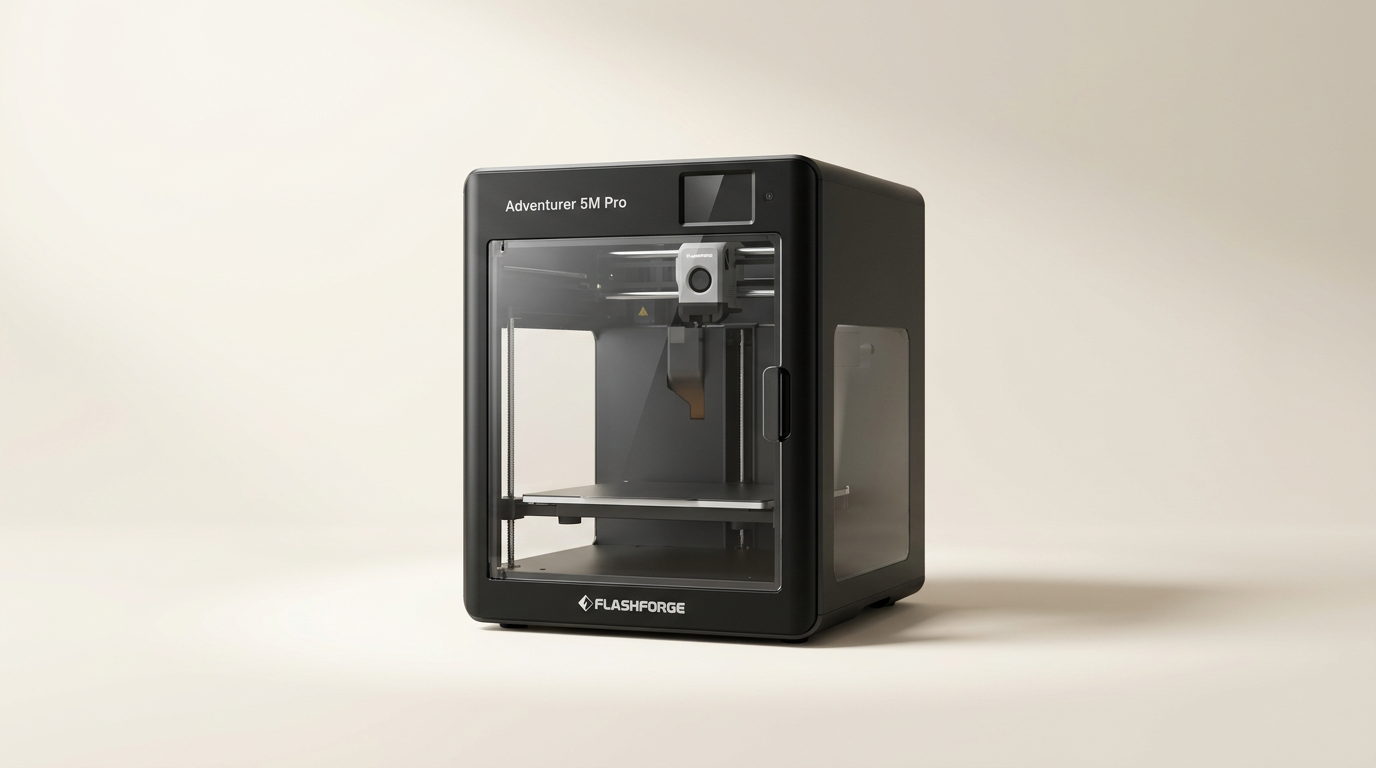
The Flashforge AD5M Pro emerges into a market segment increasingly defined by accessibility and speed, promising a high-velocity 3D printing experience without an exorbitant learning curve. Many modern printers target the 'plug-and-play' ideal, striving to bring complex additive manufacturing to a broader audience. The AD5M Pro attempts to deliver on this, blending rapid print capabilities with features designed for convenience, such as quiet operation and remote monitoring.
However, the path to mainstream adoption often reveals underlying tensions between ambitious performance claims and real-world consistency. While marketing emphasizes ease and speed, the true measure of a 3D printer lies in its sustained operational reliability and the consistency of its output. This review examines whether the AD5M Pro effectively bridges that gap, or if its advancements come with an unstated reliability premium.
What owners love
- + High-speed printing significantly reduces project times.
- + Straightforward initial setup, often enabling printing within minutes.
- + Quiet operation suitable for home or office environments.
- + Integrated Wi-Fi and app control enhance convenience.
- + Produces accurate, high-quality prints when functioning correctly.
Common complaints
- − Recurring issues with filament jamming and clogging.
- − Significant problems with extruder and nozzle reliability.
- − Frequent connectivity issues, particularly with Wi-Fi.
- − Software, especially updates, is often problematic.
- − Poor long-term reliability; several units fail shortly after purchase.
Design & Build
The Flashforge AD5M Pro features a CoreXY kinematic system, a design choice often associated with faster print speeds and greater stability due to its lighter moving mass and fixed print bed. Owners note its pleasing aesthetic and compact footprint, making it suitable for home use without dominating a workspace. The inclusion of a quick-swap hotend is a practical feature, allowing for easier maintenance and material changes, though its actual utility is often overshadowed by more fundamental reliability concerns. Despite a generally positive initial impression regarding its appearance, the underlying build quality faces scrutiny when common failure points, such as the extruder assembly, reveal design vulnerabilities.
Setup & Ease of Use
A significant draw for the AD5M Pro is its reputation for an exceptionally easy setup process. Numerous owners, including first-time 3D printer users and those gifting it to children, report being able to commence printing within minutes of unboxing. The initial test prints often succeed, offering an immediate gratification experience. This 'first-layer bliss' is a strong positive, signaling that Flashforge has invested in a streamlined onboarding. However, this initial ease frequently contrasts sharply with the longer-term experience. While setup gets users printing quickly, it does not inoculate the device against subsequent operational complexities, particularly those related to software and component reliability. The learning curve for optimizing settings for various projects is still present, as expected with any 3D printer, but the fundamental setup is indeed user-friendly.
Performance in Real Use
When operating without fault, the AD5M Pro delivers on its promise of high-speed, accurate printing. Users accustomed to older, slower machines commend its rapid output and the quality of its finished products. The built-in camera allows for remote monitoring, and its quiet operation is a noted benefit for home environments. The key operational characteristic, however, is its unpredictable reliability. A recurring pattern involves flawless performance for a short period, often days or a few weeks, followed by critical failures. Filament feeding issues, constant clogging, and extruder malfunctions are consistent complaints, leading to wasted material and aborted prints. This inconsistency transforms the machine from a rapid production tool into a frustrating maintenance project, undermining its speed advantage with downtime.
Software & Ecosystem
The Flashforge AD5M Pro leverages an app for remote control, a feature highly valued by owners for its convenience in managing prints away from the machine. However, the software experience is a point of contention. While some users adapt to FlashPrint, others report significant difficulties with Flashforge's Orca-based software, specifically regarding updates and functionality. Wi-Fi connectivity also presents a recurring problem, with several units frequently losing connection or failing to connect entirely. This unreliable digital interface, combined with concerns over product registration processes, detracts from an otherwise potentially strong integrated ecosystem. The 'walled garden' effect, where proprietary software is necessary for full functionality, becomes a significant drawback when that software proves unstable.
Value & Reliability
Priced around $500 to $600, the AD5M Pro positions itself as an accessible high-speed option. The initial value proposition appears strong, offering advanced features at a mid-range price point. However, the consistent reports of premature failures severely impact its long-term value. Multiple owners experience critical component failure, such as extruder malfunctions, shortly after purchase, some within days or weeks. This pattern suggests a 'reliability cliff' where the initial positive experience quickly degrades into frustration and the need for returns or repairs. While customer support is sometimes responsive, the need for extensive troubleshooting or part replacement so early in the product lifecycle indicates a significant quality control issue that diminishes its actual cost-effectiveness. A low purchase price does not equate to good value if the product requires constant intervention or fails outright.
Verdict
Hold Off - The Flashforge AD5M Pro offers impressive speed and initial ease but is plagued by persistent reliability issues.
This printer is suitable for hobbyists who enjoy tinkering, possess a strong understanding of 3D printer mechanics, and are prepared for frequent troubleshooting. Its rapid print speeds and accessible setup could appeal to those seeking quick results for simple, low-stakes projects, provided they understand the inherent risks. Individuals comfortable with potential returns and replacements might also consider it for the peak performance moments.
Conversely, those seeking a truly reliable, set-and-forget machine for consistent output should avoid the AD5M Pro. Beginners without a high tolerance for frustration, or users who rely on their printer for critical projects, will find its propensity for jamming, connectivity failures, and premature component breakdown a significant impediment. Professional users or those with limited time for maintenance should look elsewhere.
The AD5M Pro exemplifies the 'speed-to-fragility' paradox prevalent in some segments of consumer 3D printing. While it delivers on the promise of rapid throughput and a deceptively simple first impression, it consistently demonstrates a structural frailty that sacrifices sustained operational integrity for upfront performance metrics. This trade-off, while perhaps acceptable for the most forgiving users, ultimately positions it as a product that prioritizes the initial 'wow' factor over the enduring utility expected from a long-term investment.
FAQ
More 3D Printers reviews
Creality Ender 5 Max Review: A High-Volume CoreXY for Production
MakerHawk Optical Endstops: Non-Contact Precision for 3D Printers
ELEGOO Saturn 4 Ultra 16K Review: The Silent Contender
Odilona 3D Printer Filament Storage Bags Review: A Gamble on Quality
Geeetech Smart 3D Printer Review: A Managed Entry Point
Anycubic ACE Pro Detection Module Review: Essential Upgrade
This review is based on real experiences shared by owners in online communities.