
ELEGOO Mercury Plus 3.0 Review: The Resin Printing Workhorse
This review is based on real experiences shared by owners in online communities.
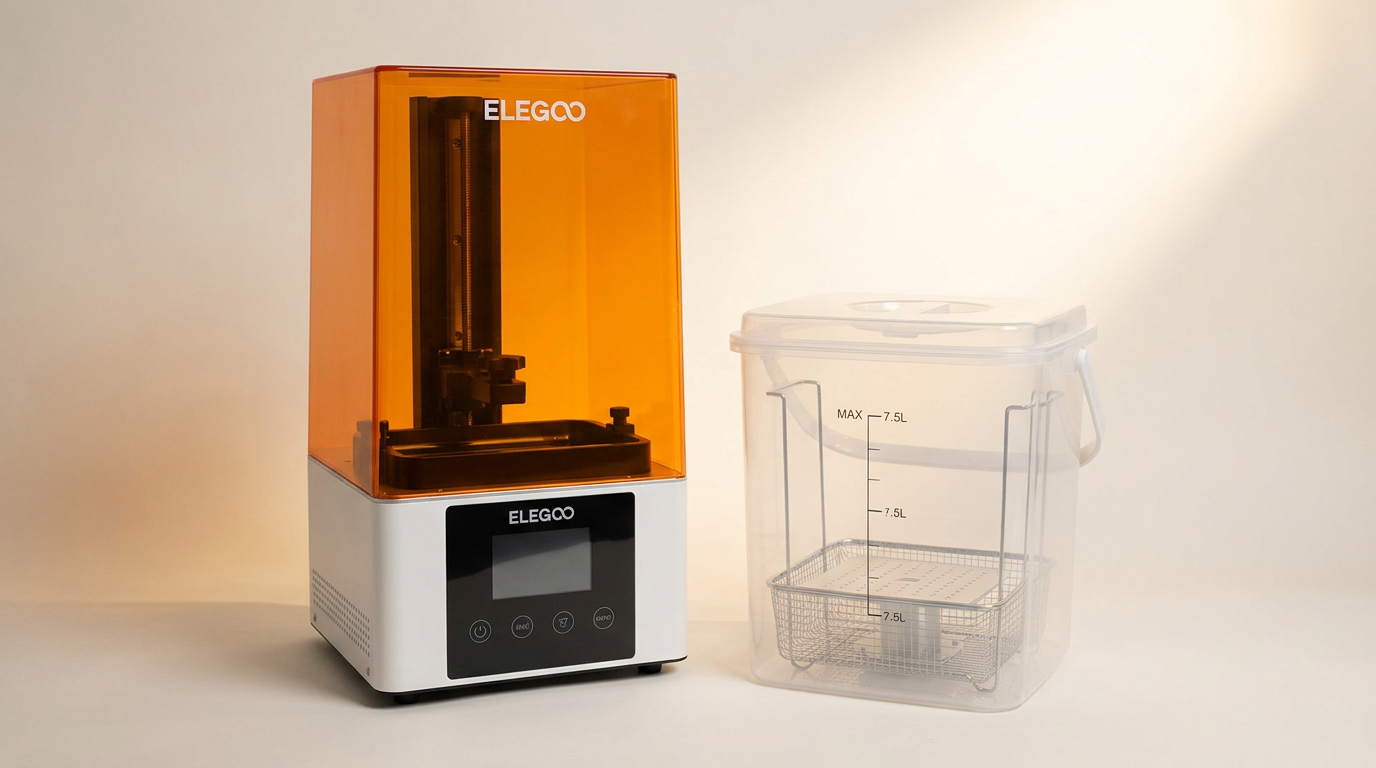
The ELEGOO Mercury Plus 3.0 enters a mature resin 3D printing ecosystem as a specialized appliance. Its function, post-processing printed models, is often considered the messy, inconvenient second act of resin printing. However, this device, along with its counterparts, streamlines a critical workflow.
While marketed as an essential accessory for ELEGOO's own printers, the Mercury Plus 3.0 aims to be a category-agnostic workhorse, bridging the gap for hobbyists whose printing ambitions have outgrown their initial smaller setups. The crucial question is whether its scale and integration translate into a truly efficient and reliable tool, or if its expanded capabilities introduce new points of friction.
Our assessment focuses on whether this unit delivers on its promise of simplifying the post-print experience, examining its capacity, operational convenience, and durability, especially under the demands of increased usage.
What owners love
- + Large capacity accommodates bigger prints and build plates
- + Efficient 2-in-1 cleaning and curing streamlines workflow
- + Effective 360-degree curing ensures model integrity
- + Easy to use, often described as 'push-button' simple
- + Reverse spin wash cycle effectively cleans crevices
- + Good value for its feature set and size
Common complaints
- − Wash cycle generates significant noise
- − Reports of poor build quality or fragility in some components
- − Inconsistent long-term reliability for a subset of units
- − Customer support issues reported for warranty claims
- − Challenges with cleaning build plates directly in the tub
Design & Build
The Mercury Plus 3.0 arrives as a substantial unit, designed to handle larger prints than its predecessors. Its integrated 2-in-1 form factor is a space-saving measure for many users with limited dedicated workshop area. The cleaning basin features a robust vortex mechanism, which owners confirm creates a 'literal cyclone' during operation. However, this physical intensity is not without its costs. While the machine appears well-packaged and visually capable, a recurring theme concerns its underlying construction. Some owners describe the build as feeling 'like paper' in certain areas, particularly when subjected to the weight of cleaning solvents. This suggests a potential 'structural ceiling' where the perceived robustness of the exterior does not always translate to the integrity of internal components or the resilience of the chassis under stress. The design choices prioritize capacity and functionality, but some material selections may introduce durability concerns for long-term, intensive use.
Setup & Ease of Use
Owners consistently report the Mercury Plus 3.0 is exceptionally easy to set up and operate, often describing it as 'push-button' simple. The dual-mode functionality, offering both a cleaning basket and a hanging option for the build plate, provides flexibility. Many users appreciate the ability to place the entire print platform directly into the wash bucket, a significant convenience factor that minimizes direct contact with uncured resin. This feature, when successful, epitomizes the unit's streamlined workflow. However, some feedback indicates that while the concept of cleaning the build plate with models attached is sound, the practical execution can be cumbersome for certain users or print configurations. The core user interface remains intuitive, with simple controls governing both wash and cure cycles. This focus on operational simplicity is a strong point, enabling users to integrate the device quickly into their workflow without a steep learning curve.
Performance in Real Use
The Mercury Plus 3.0 generally performs its core functions effectively. The wash cycle is praised for its thoroughness, with the reversing spin action ensuring comprehensive cleaning, even in intricate model crevices. Cure times are reported as fast, with the 24 UV LEDs and reflective mirrors providing uniform, 360-degree exposure. This attention to curing coverage is crucial for model durability and finish. The unit's large capacity is a significant upgrade for users moving from smaller stations, comfortably accommodating build plates from 10-inch printers like the Saturn series. This 'scale advantage' allows for greater print volume throughput. The primary operational drawback noted is noise during the wash cycle; owners describe it as sounding like a 'jet' or a 'cyclone'. While effective, this noise profile means the unit might be best relegated to a dedicated workshop or garage rather than a living space, representing a 'quiet-hours tax' for residential users.
Software & Ecosystem
As a dedicated wash and cure station, the Mercury Plus 3.0 does not feature complex software in the traditional sense. Its operation relies on simple, timed cycles controlled by physical buttons. This simplicity is often cited as a benefit, removing potential software-related complications. The unit's ecosystem compatibility is broad, designed to work with various resin 3D printers, particularly ELEGOO's own Mars and Saturn series, up to 10 inches. The availability of additional cleaning containers, sold separately, is a practical consideration for users who switch between different resin types (e.g., water-washable and IPA-based), enhancing its versatility. The core value here lies in its plug-and-play nature within existing resin printing setups, without demanding specific software integration or complex digital configuration. It acts as a reliable, analog companion to digital printing processes.
Value & Reliability
At its price point, typically around $150, the Mercury Plus 3.0 offers considerable value, especially given its large capacity and dual functionality. For many, it represents a worthwhile investment, saving significant time and improving print quality compared to manual post-processing. However, reliability emerges as a critical concern for a minority of owners. Reports indicate instances of units failing within a month of purchase, with issues ranging from motor failure to complete malfunction. The experience of troubleshooting with customer support is mixed, with some owners reporting protracted processes involving self-repair attempts and delays in receiving replacement parts. This creates a 'reliability roulette' scenario: while many users experience trouble-free operation, a notable subset encounters significant durability issues that undermine the initial value proposition. This inconsistency points to potential quality control variations in manufacturing or component sourcing.
Verdict
Consider - For resin 3D printer owners seeking a large-capacity, integrated wash and cure solution, this unit offers significant convenience and performance when it operates as intended.
This is a solid option for hobbyists or small-scale producers who are outgrowing smaller wash and cure stations and require the capacity for larger prints. Users with ELEGOO Mars or Saturn printers, in particular, will find its compatibility with their build plates a major benefit. Those who print infrequently or are willing to manage potential support interactions should also consider it. However, buyers should be aware of the 'reliability roulette' and factor in the potential for component fragility. If absolute, unflinching reliability is paramount for a production environment, or if you prefer completely hands-off customer service experiences, you might explore alternatives. It's not suited for users who cannot tolerate the wash cycle's noise or who operate in noise-sensitive environments.
Ultimately, the Mercury Plus 3.0 embodies the modern resin printing workflow's pragmatic trade-offs: it delivers on capacity and functionality, but a discernible 'quality lottery' exists for a subset of components. This unit isn't just about scaling up; it reveals the tension between delivering advanced hobbyist capabilities at an accessible price point and the underlying robustness required for sustained, problem-free operation.
FAQ
More 3D Printers reviews
Refresh Sports Boomerang for Kids Review: Fun Returns, But at What Cost?
ANYCUBIC Photon Mono 4 & Wash & Cure 3.0 Review
3D Central DNA Double Helix: A Desk Ornament with a Scale Problem
ELEGOO Centauri Carbon 2 Combo Review: Bridging the Speed Gap
Creality Ender 3 V3 SE Review: A Gateway to 3D Printing
Creality Ender 5 Max Review: A High-Volume CoreXY for Production
This review is based on real experiences shared by owners in online communities.