
Einstar Rockit: A Compact 3D Scanner for Industrial Detail
This review is based on real experiences shared by owners in online communities.
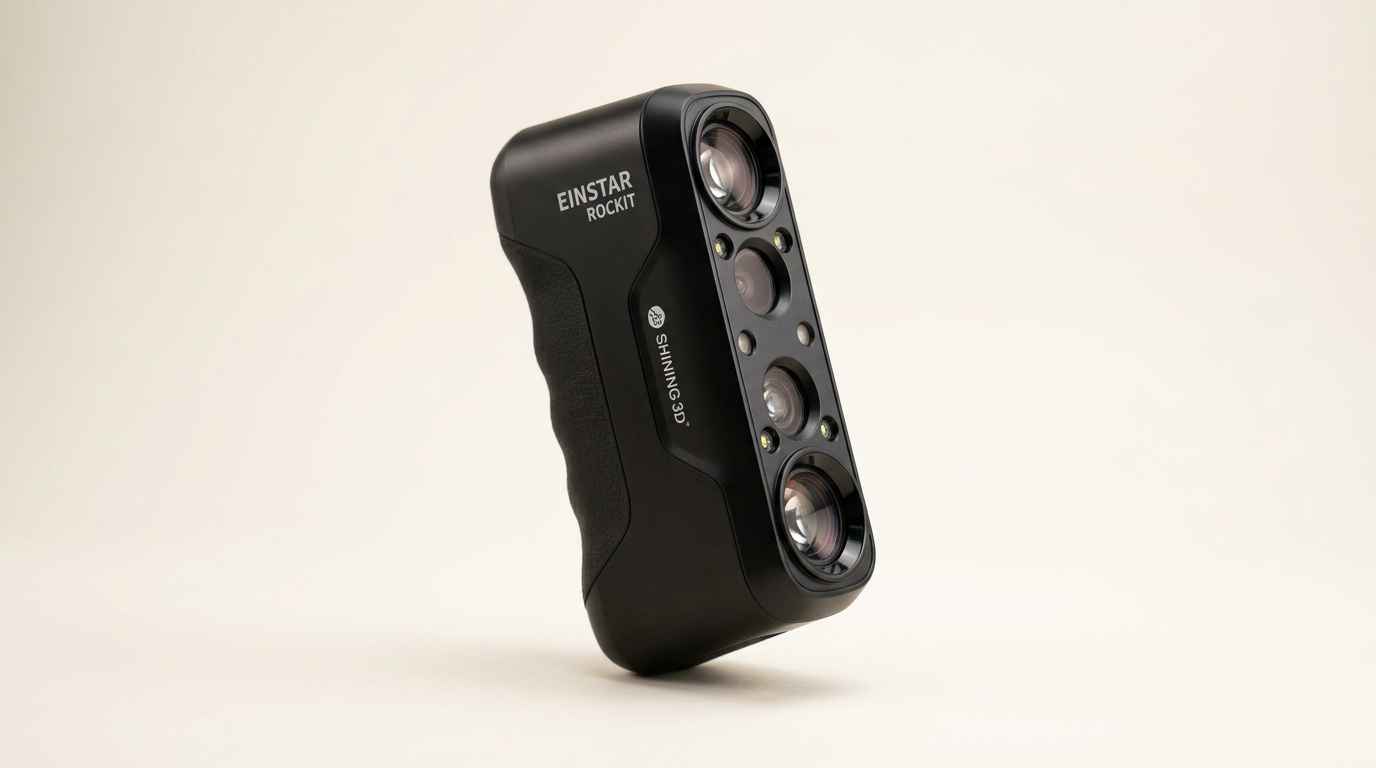
The Einstar Rockit 3D scanner enters a professional market increasingly segmented by resolution and portability, positioning itself as a compact solution that balances both. While many handheld scanners prioritize either speed for large objects or minute detail for small ones, the Rockit attempts to bridge this gap with a dual light source approach designed to address a wider array of scanning challenges. This strategy aims to deliver industrial-grade precision without sacrificing the agility required for field work or complex geometries.
What often goes unstated in this category is the 'software tax' a scanner imposes on its users. The Rockit seeks to minimize this burden by offering a robust, well-supported software ecosystem. This can significantly reduce the learning curve and integration friction, turning a high-resolution capture device into a genuinely productive tool rather than a data collection bottleneck. This focus on backend experience is a critical, often overlooked, component of a scanner's true value.
This review assesses whether the Rockit successfully delivers on its promise of versatile, high-resolution scanning, particularly through its dual light sources and software integration. We examine its practical performance, build quality, and overall value proposition for professionals who demand both precision and operational flexibility.
What owners love
- + Dual light sources adapt to diverse scanning needs
- + Compact form factor enhances portability
- + Responsive 3D scanning performance
- + Software is robust and well supported with updates
- + Wireless operation with swappable battery adds flexibility
- + Effective at capturing detail on reflective or dark surfaces
Common complaints
- − Slippery casing requires user modifications for secure grip
- − Strong odor from the case renders it unusable for some
- − Not considered lightweight despite compact size
- − Initial investment is substantial
- − Limited long-term user feedback for comprehensive reliability assessment
Design & Build
The Einstar Rockit presents as a compact handheld unit, a characteristic owners frequently highlight. While its smaller footprint is advantageous for portability and maneuvering in tight spaces, the scanner is not described as lightweight. A recurring observation involves the unit's casing material, which some users found to be 'slippery.' This ergonomic oversight suggests a design choice prioritizing aesthetics or material strength over practical handling. Owners have addressed this by adding aftermarket grips and lanyards, indicating a 'grip gap' in the initial product design. The inclusion of a swappable internal battery, offering up to three hours of runtime, underscores its design for extended, untethered operation, a clear benefit for field applications.
Setup & Ease of Use
The Rockit emphasizes user convenience through its wireless capabilities and real-time syncing. Its built-in Wi-Fi facilitates seamless data transfer to a PC, although a wired option remains available for environments with high interference. This dual connectivity approach mitigates potential setup frustrations. The scanner’s ability to operate without markers on richly detailed surfaces simplifies initial preparation, while the option for marker alignment at 90 frames per second allows for smooth capture on less feature-rich objects. The integrated 5 MP color camera contributes to ease of use by directly capturing vivid textures, reducing post-processing steps for realistic models.
Performance in Real Use
The Rockit distinguishes itself with a dual light source system, offering a Blue Laser for large-area scanning with 38 lines and IR VCSEL for fine detail and outdoor reliability. This 'Adaptive Illumination Layering' provides versatility that covers everything from industrial components to large outdoor structures. Owners report responsive 3D scanning, with the device demonstrating capability on challenging surfaces like black or reflective materials without requiring spray. The IR VCSEL mode performs effectively outdoors, even in bright environments up to 110,000 Lux, expanding its utility beyond controlled indoor settings. This allows for reliable capture in conditions that typically impede other scanners, validating its claim of material and environmental adaptability. However, one notable complaint involves a 'strong odor' emanating from the carrying case, rendering it unusable for some. This 'scent tax' is a surprising quality control issue for a professional-grade device.
Software & Ecosystem
The EXStar Hub software is central to the Rockit's appeal. Described by owners as 'fantastic' and 'well supported,' it streamlines workflows through a unified interface. This strong software foundation is a significant competitive advantage, reducing system load and improving performance, which directly translates to faster scanning and increased mobility. Owner confidence in future updates suggests a reliable long-term ecosystem. This commitment to ongoing software development helps future-proof the investment, offering users a pathway for enhanced functionality and stability over time. The software’s intuitive design also lowers the barrier to entry for complex 3D scanning tasks, making advanced features more accessible.
Value & Reliability
Positioned in the premium segment, the Einstar Rockit represents a substantial investment. Its value proposition is anchored in its dual light source versatility and robust software ecosystem, which contribute to its potential for high resolution and broad application. While its build quality is generally good, the ergonomic and material issues, such as the slippery casing and strong case odor, detract from its perceived premium status. The scanner is relatively new to market, so long-term reliability reports are not yet widespread. However, the manufacturer's stated commitment to software updates through EXStar Hub suggests an investment in longevity and user satisfaction, which is a key factor for expensive professional tools. For professionals who can mitigate the initial ergonomic quirks, the Rockit offers a powerful combination of features for its price point, falling in the mid to high thousands.
Verdict
Buy - The Einstar Rockit delivers versatile, high-resolution 3D scanning capabilities backed by robust software, suitable for demanding professional applications.
This scanner is ideal for engineers, product designers, and artists who require precise 3D data capture across a range of objects and environments, including challenging reflective or dark surfaces. Its dual light sources make it particularly well-suited for mixed industrial and outdoor applications, while the strong software support enhances long-term utility. Professionals seeking a compact, wireless solution for under $2,000 that minimizes post-processing time will find significant value here. Those sensitive to material odors or unwilling to address ergonomic shortcomings like a slippery grip should consider alternatives.
The Rockit embodies the 'versatility premium' trend in professional 3D scanning. It recognizes that specialized tools, while excellent in their niche, often present workflow friction when projects demand adaptability. By offering a comprehensive solution that can pivot between fine detail and outdoor environments, it silently suggests a future where professional tools prioritize seamless transitions over singular focus, albeit with a few practical compromises in the present.
FAQ
More 3D Scanners reviews
Revopoint INSPIRE 2 3D Scanner Review: Unpacking the Accessory Echo Chamber
Creality 6mm 3D Scanning Markers Review: Essential Tracking Aid
TOSUKKI 6mm Positioning Targets Review: The Refined Generic Choice
AESUB 3DTOOLS 3D Scanner Spray Review: The 'Evaporative Enabler'
Creality 8-inch Rotating Turntable: A Solid Scanner Accessory

Generic 12 Piece Multi-Angle Markers Review: Essential 3D Scanning Dots
This review is based on real experiences shared by owners in online communities.