
EinScan Rigil Lite 3D Scanner Review: Unchained Scanning Power
This review is based on real experiences shared by owners in online communities.
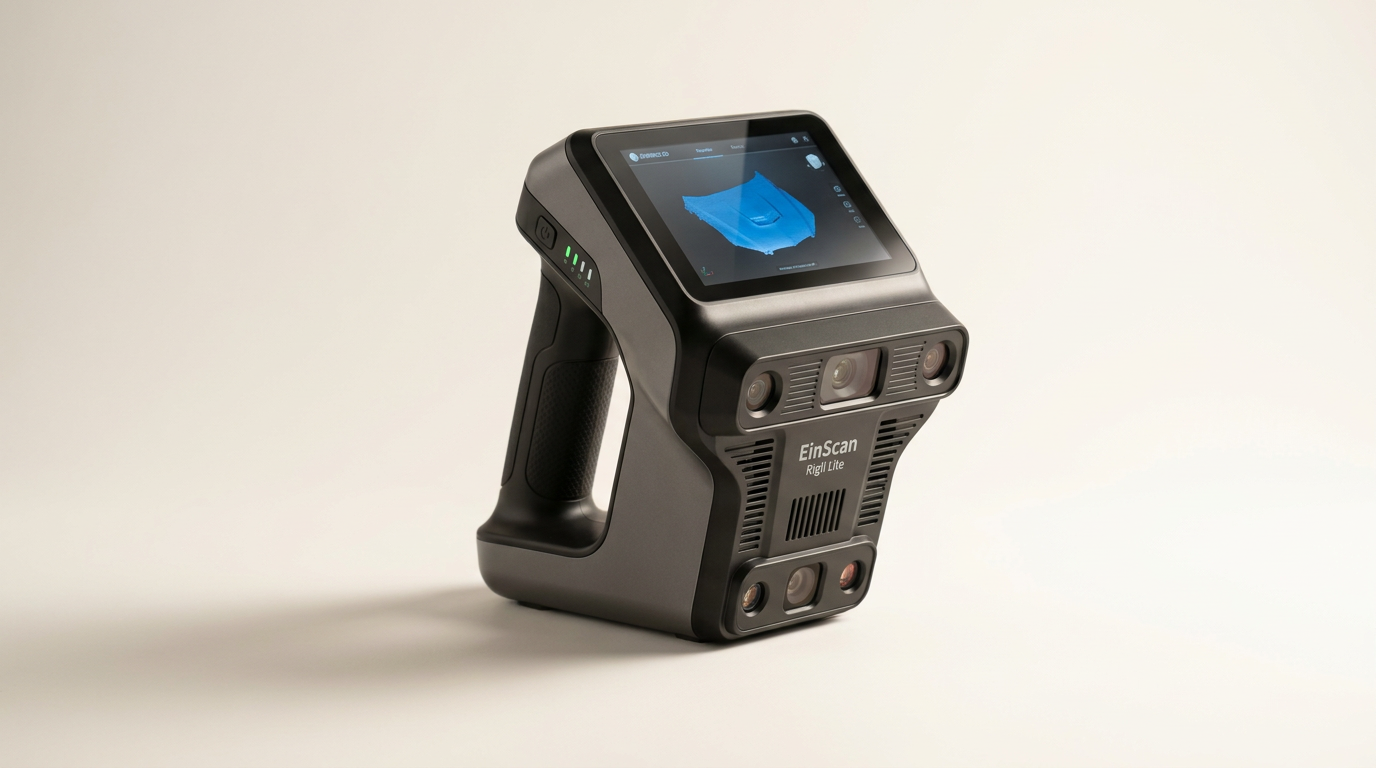
The professional 3D scanning market often presents a compromise: robust performance tethered to a high-powered workstation, or portability limited by processing bottlenecks. The EinScan Rigil Lite posits a different path, consolidating scanning, processing, and storage into a single, handheld device. This integrated approach challenges the traditional workflow, positioning the Rigil Lite not merely as a scanner, but as a mobile digital capture studio, enabling users to move beyond the "tethered workshop" paradigm.
Historically, achieving high-fidelity 3D scans required a dedicated setup, often involving specialized software and powerful computing resources. The Rigil Lite attempts to democratize this process, offering an unchained scanning experience. It introduces a concept we term the "Processing Parity" model, where the device itself holds enough computational power to reduce the reliance on external hardware for initial data capture and processing.
This shift allows users to capture and refine models directly on-site, a significant advantage for applications ranging from cultural heritage preservation to rapid prototyping in diverse environments. The core question becomes whether its advanced capabilities and integrated design truly deliver a superior user experience that justifies its premium position within the portable scanning segment, particularly when compared to its wired and less capable counterparts.
What owners love
- + Integrated design provides all-in-one scanning and processing.
- + Exceptional tracking performance, even on complex geometries.
- + Marker-free scanning reduces preparation time significantly.
- + Dual laser modes offer both speed and fine detail capture.
- + High-resolution color texture acquisition with 5MP camera.
- + Supports outdoor scanning and large object capture.
Common complaints
- − Premium price point compared to entry-level options.
- − Only one owner review available for long-term reliability assessment.
- − Specific software features or limitations are not detailed by owners.
- − Battery life in real-world scenarios not extensively reported.
Design & Build
The EinScan Rigil Lite differentiates itself with an "all-in-one" design philosophy. It integrates a 6.4-inch 2K touchscreen, 24GB of RAM, and a 512GB SSD directly into the handheld unit. This architecture positions the device as a self-contained scanning ecosystem, moving beyond the traditional scanner-plus-PC setup. The physical construction suggests a robust tool intended for diverse environments, from studio to field. This design choice represents a significant investment in user convenience, aiming to eliminate the "hardware impedance" common in professional scanning where multiple components must be coordinated for successful capture.
Setup & Ease of Use
The Rigil Lite's primary appeal in setup and use stems from its integrated nature. With built-in processing and storage, the initial hurdle of connecting to and configuring a separate computer is removed. Owners emphasize the lack of markers required for many tasks, a key feature that simplifies pre-scan preparation. This marker-free capability, combined with scene-adaptive scanning and reflective surface presets, streamlines the workflow, making the device accessible for both experienced technicians and those newer to 3D scanning. The onboard interface likely contributes to a more intuitive setup, reducing the learning curve associated with external software dependencies.
Performance in Real Use
Owners consistently report the Rigil Lite delivers exceptional performance, particularly in tracking and detail capture. The combination of 17+17 crossed laser lines for speed and 7 parallel lines for fine details provides a versatile approach to various object types and geometries. A key highlight is its "crazy tracking" ability, maintaining lock on complex shapes and around corners without the need for markers or scanning spray, a frequent pain point in other scanners. The integration of IR scanning alongside laser technology further enhances its tracking stability and ability to handle challenging surfaces. This multi-modal approach enables what we might call "Adaptive Engagement" where the scanner dynamically adjusts its capture strategy to the object's complexity, minimizing user intervention.
Software & Ecosystem
While the Rigil Lite boasts onboard processing, its ecosystem extends to desktop software for advanced post-processing. The EXScan Rigil Software provides essential tools for multi-project alignment, noise reduction, mesh editing, and coordinate alignment. This hybrid approach, where initial capture and basic processing occur on-device, but more intensive refinement happens on a workstation, leverages the strengths of both platforms. Owners value the ability to move from raw scan data to usable digital models for various applications like CAD modeling and 3D printing. The emphasis on powerful software tools suggests an understanding that raw scan data is only the first step in a complete workflow.
Value & Reliability
Positioned at a premium price point, the Rigil Lite necessitates a clear justification for its investment. Owners who have experience with other scanners, even capable ones like the Rockit, describe the Rigil Lite as being "on another level" due to its advanced features and integrated processing. While long-term reliability data is limited due to its newer market presence, the robust feature set-IR and laser scanning, high-resolution texture, and powerful onboard hardware-suggests a device built for demanding professional use. Its value proposition centers on time savings through marker-free operation, enhanced tracking, and the convenience of a self-contained unit, which can translate to significant efficiency gains in a professional setting. The integrated storage and RAM also hint at a longer functional lifecycle for its onboard processing capabilities.
Verdict
Buy - The EinScan Rigil Lite offers an unparalleled portable 3D scanning experience, justifying its premium cost through advanced capabilities and integrated design.
This scanner is an excellent investment for professionals, engineers, educators, and prosumers who require high-fidelity 3D models with minimal setup and maximum portability. Those engaged in reverse engineering, product design, cultural heritage documentation, or anyone needing to capture complex objects on-site without a tethered PC will find its feature set highly advantageous. If your workflow demands efficiency, superior tracking, and the ability to scan diverse materials without extensive preparation, and your budget allows for an expenditure well north of $3000, the Rigil Lite is a compelling choice.
Conversely, hobbyists or users with infrequent scanning needs may find the price prohibitive, particularly if their projects do not demand the Rigil Lite's advanced tracking or integrated processing. Budget-conscious buyers or those who can comfortably operate a wired setup with a dedicated PC may find more affordable solutions satisfactory. The Rigil Lite redefines the "mobile workstation" in 3D scanning; it's less about moving a scanner around and more about carrying a complete, uncompromised capture pipeline in hand. This integrated power, which we call "Untethered Utility," represents a significant leap for the category, promising to unlock new efficiencies and applications previously constrained by traditional hardware dependencies.
FAQ
More 3D Scanners reviews
Revopoint INSPIRE 2 3D Scanner Review: Unpacking the Accessory Echo Chamber
Creality 6mm 3D Scanning Markers Review: Essential Tracking Aid
TOSUKKI 6mm Positioning Targets Review: The Refined Generic Choice
AESUB 3DTOOLS 3D Scanner Spray Review: The 'Evaporative Enabler'
Creality 8-inch Rotating Turntable: A Solid Scanner Accessory

Generic 12 Piece Multi-Angle Markers Review: Essential 3D Scanning Dots
This review is based on real experiences shared by owners in online communities.