
Dynta Silk PLA Bundle Review: 6 Colors, 250g Spools
By AValidReview. An AI-assisted summary of customer feedback, not a hands-on test.
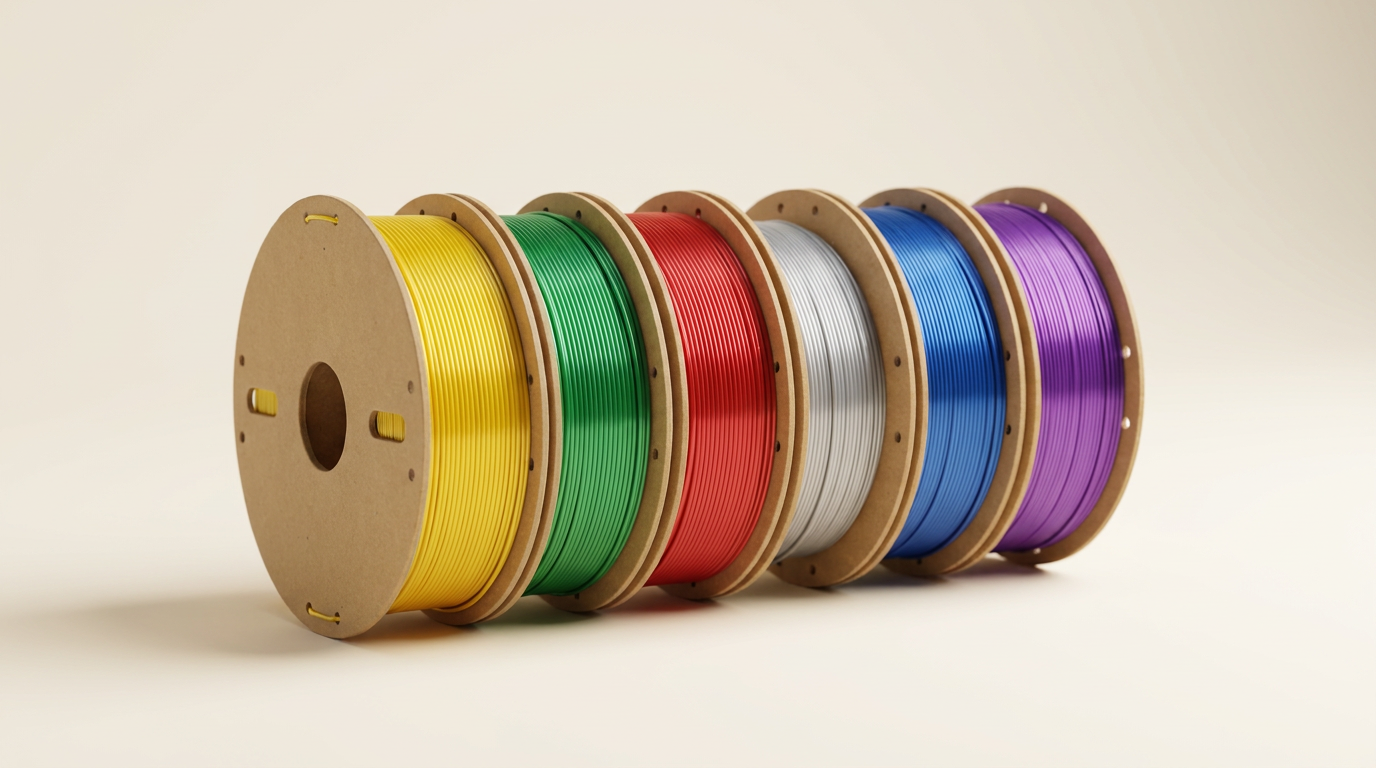
The mini-spool bundle exists to solve a common hobbyist frustration: storing several half-empty, oxidized one-kilogram rolls just to produce seasonal ornaments or multicolor accents. Yet downsizing filament spools frequently introduces what we call the sample-pack paradox. While micro-spools grant immediate color flexibility, their unusual physical dimensions often clash with the standard spool holders and automated feeding mechanisms designed around full-size rolls.
The Dynta Silk PLA bundle tackles low-volume printing by packaging six 250-gram spools (totaling 1.5 kilograms) in gold, silver, red, green, blue, and purple. Sitting in the budget-friendly under-$30 tier, it aims at hobbyists running desktop beds who want bright, iridescent surfaces without investing in six full-sized spools.
Our assessment reveals a capable decorative filament that delivers deep luster and respectable bed adhesion straight from the bag. However, buyers must navigate non-standard spool dimensions and the physical limits of silk polymer chemistry before loading it into their print queues.
What owners love
- + High-gloss surface finish with minimal visible layer lines
- + Convenient 250g spool sizes for low-volume color variety
- + Reliable first-layer adhesion across smooth and textured build plates
- + Low stringing behavior on standard generic silk profiles
- + Vibrant holiday and display color assortment
Common complaints
- − Non-standard spool dimensions can bind on stock spool hangers
- − Reduced interlayer shear strength makes thin articulated parts brittle
- − Occasional factory winding overlaps cause mid-print feeding stops
- − Higher price per kilogram than standard bulk single-color spools
Design & Build
Dynta packages this set as six individual vacuum-sealed 250-gram spools. The colors lean heavily toward rich metallics and jewel tones, with the gold and silver offering a mirror-adjacent gloss rather than a dull matte sheen. Filament diameter measures consistently close to the specified 1.75mm standard across most colors, though user reports note rare rough patches on select batches that can catch in tight bowden tubes.
The physical spools present an engineering trade-off we call the spool-hub mismatch. Because 250-gram spools lack the width and center bore standard of traditional 1-kilogram spools, they frequently sit awkwardly on universal gantry arms. Owners often find the inner opening binds on standard stock brackets, requiring either a custom printable adapter or a freestanding off-printer roller base to avoid tension errors at the extruder.
Setup & Ease of Use
Loading Dynta Silk PLA is straightforward on standard direct-drive toolheads, provided the filament has a clear path off the spool. Dynta advertises that these spools require no drying out of the package. While prints completed cleanly immediately after unboxing for most users, silk blends are naturally hygroscopic. Running these spools through a dry box before a 12-hour print run noticeably tightens perimeter consistency and prevents minor surface popping.
First-layer behavior is remarkably forgiving. When laid down on textured PEI or specialized cold plates without glue, the plastic spreads evenly without immediate corner warping. Users across multiple hardware configurations, including the Bambu Lab A1 Mini and Flashforge Adventurer series, report clean benchy baselines with zero brim requirements when keeping bed temperatures between 55 and 60 degrees Celsius.
Performance in Real Use
In cosmetic evaluation, Dynta excels. The extruded filament hides micro-layer transitions exceptionally well due to high light refraction. Horizontal hulls and curved domes show consistent sheen without the matte clouding that occurs when silk PLA is run through erratic hotends. Benchmark prints like the 3DBenchy finish with clean overhangs, sharp bow geometry, and negligible stringing across open gaps.
Where the material falters is in mechanical applications, falling victim to what we define as the silk sheen penalty. The chemical modifiers and elastomers blended into PLA to generate high surface luster inherently weaken interlayer bonding. While decorative statues, festive trees, and display vases hold up admirably, small mechanical prints such as articulated fidget toys often snap across layer boundaries under light shear stress. If you need structural integrity or high fatigue resistance, standard PLA or PETG remains mandatory.
Software & Ecosystem
You do not need vendor-specific profiles to get clean output from this bundle. Slicing with generic silk PLA presets in OrcaSlicer, Bambu Studio, or Cura yields dependable results on the first attempt. Dynta claims printing capabilities up to 500 millimeters per second, but pushing speed past 150 millimeters per second dulls the silk effect into a satin sheen because the outer perimeter cools before the reflective polymers align.
Feeding systems require caution. While smaller printers like the Bambu A1 Mini handle the 250-gram rolls cleanly from top-mounted or side-mounted single pegs, these mini-spools do not seat reliably in enclosed multi-material feeder bays without third-party spool weight rings or center adapter hubs. Winding quality is generally orderly, though several users experienced crossed loops halfway through a roll, causing extruder stops during unmonitored prints.
Value & Reliability
Priced in the $20 to $35 range for a combined 1.5 kilograms of material, the Dynta bundle occupies a distinct cost bracket. On a strict per-kilogram calculation, buyers pay a premium over single-spool utility PLA. However, the value calculation flips for makers who rarely consume full rolls of specialty colors. Buying six individual 1-kilogram spools of silk filament would demand an investment well north of $100, leaving most of that plastic to degrade in long-term storage.
Reliability remains slightly variable. The vast majority of spools feed without intervention, but occasional manufacturing oversights, such as minor diameter bulges or tangled wind lines, keep this bundle just below top-tier filament brands. For low-stakes decorative projects, it represents a cost-effective path to color diversity.
Verdict
Consider - Excellent decorative sheen and palette variety offset by fragile layer adhesion and awkward spool dimensions.
This bundle is ideal for owners of small-format printers, school makerspaces, and hobbyists who produce holiday decorations, tabletop display pieces, or cosmetic prototypes. If you want six expressive metallic colors without cluttering your workshop with six full-sized spools, Dynta fits the brief. Skip this pack if your queue consists of functional mechanical parts, structural brackets, or toys intended for heavy handling, as the silk formula shears under minor torque.
The true appeal of the Dynta bundle is color agility rather than material economy. Treat this six-pack as an artist palette for cosmetic finish work rather than everyday utility plastic, account for the mini-spool mounting quirks, and it will deliver eye-catching display prints every time.
FAQ
More 3D Printer Parts & Accessories reviews
HysiPrui P1S/P1P Integrated Hotend Review: Cheap Spares, Real Trade-Offs
HP OfficeJet Pro 8135 Review: The Cloud-Tethered Workhorse
HzdaDeve Bambu P1S Hotend 3-Pack Review: Value Meets Risk
Fannova 23.6" Large Printer Stand Review
Ultrafashs 3D Printer Cleaning Rope Review
ELEGOO 3D Printer Adhesive Glue Review: Reliable Bed Adhesion
This review is based on real experiences shared by owners in online communities.