
Creality Extension Pole Tripod Review: A Minimalist Stand
This review is based on real experiences shared by owners in online communities.
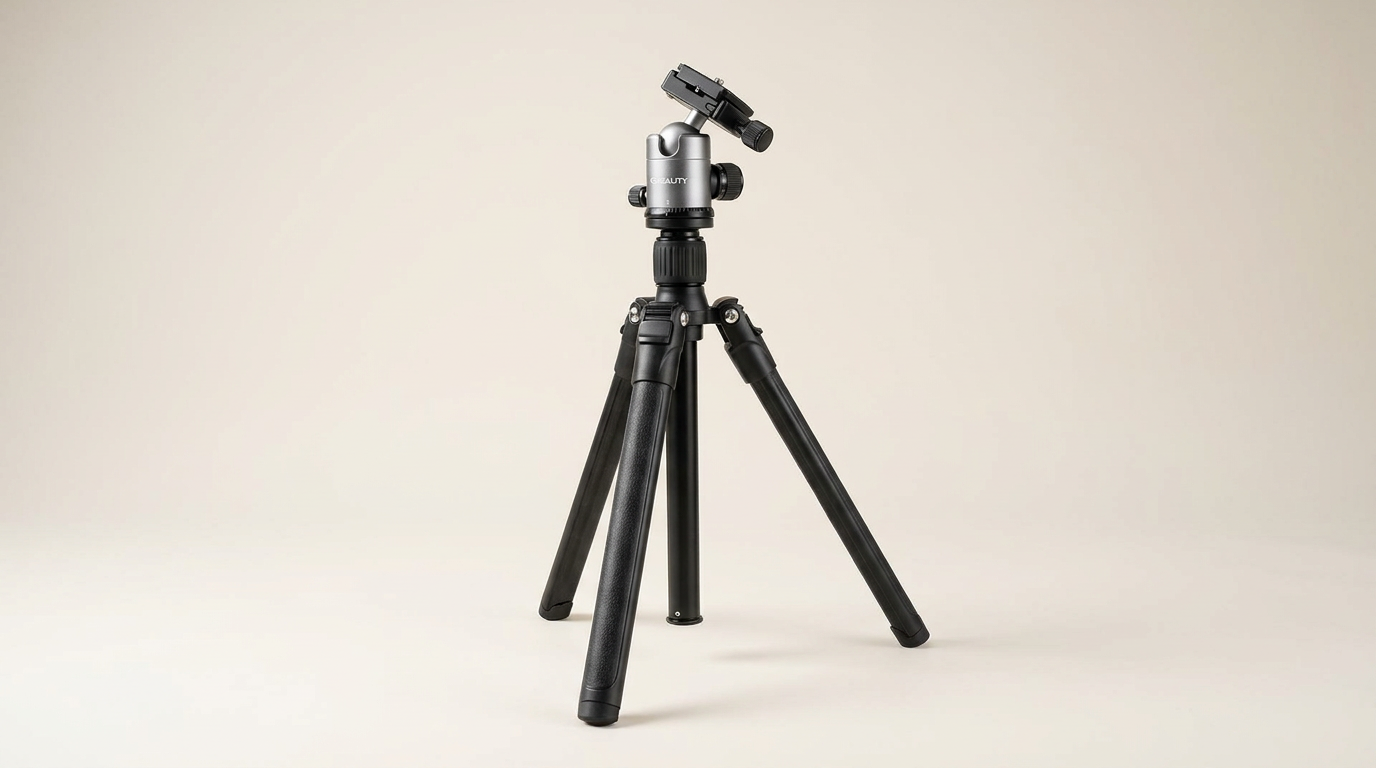
In the specialized world of 3D scanning, accessories often represent functional necessities rather than technological advancements. The Creality Extension Pole Tripod, designed for the CR-Scan Otter and Raptor, embodies this principle directly. It presents itself as a straightforward solution for scanner positioning, aiming to address basic stability and reach requirements without introducing complexity.
Most peripheral accessories in this niche space are judged on their ability to perform their primary function invisibly, allowing the core tool-the scanner-to take center stage. This Creality tripod's design philosophy appears to prioritize minimalist utility, offering a simple extension and stable base. The real question for potential buyers is whether this simplicity translates into robust practical support or if its understated nature hints at limitations in more dynamic scanning scenarios.
This review evaluates the tripod's role within the broader 3D scanning workflow, examining its construction, ease of integration, and its potential impact on user experience, especially given its dedicated pairing with specific Creality scanners. We will explore whether this accessory achieves its goal as an uncomplicated utility or if its singular focus inadvertently creates a 'utility ceiling' for advanced applications.
What owners love
- + Lightweight and portable design for easy transport
- + Dual function as both an extension pole and tripod stand
- + Specific compatibility with Creality CR-Scan Otter/Raptor
- + Sturdy construction providing stable support
- + Simple and quick setup process
Common complaints
- − Maximum extension length is limited
- − Lack of advanced features or significant adjustability
- − Feedback is limited, suggesting a narrow range of owner experiences
- − Potential for a 'utility ceiling' in diverse scanning environments
Design & Build
The Creality Extension Pole Tripod's design emphasizes portability and straightforward functionality. Constructed to be lightweight at approximately 93 grams, it remains substantial enough to support up to 11 pounds, indicating a robust material choice despite its minimal mass. Owners consistently describe it as 'sturdy,' suggesting the build quality meets expectations for its intended use.
Its 2-in-1 configuration, combining an extension pole and tripod, reflects a practical approach to accessory design, reducing the need for multiple components. The integration of soft rubber on both the grip and feet enhances user comfort during handheld operation and provides anti-slip stability when used as a tripod. This tactile consideration indicates an understanding of the user's interaction points. The limited 4.7-inch extension, however, defines a 'fixed-range utility' that may constrain its application in scenarios requiring greater reach or variable height adjustments. This design choice underscores its role as a basic positional tool rather than a versatile, multi-angle mounting system.
Setup & Ease of Use
Setting up the Creality Extension Pole Tripod is a process designed for efficiency. It attaches to compatible CR-Scan Otter/Raptor scanners via a standard 1/4 inch caliber screw, a widely adopted interface that ensures broad compatibility beyond Creality's ecosystem if an adapter is used. Owners report the attachment process as 'easy to set up and use,' requiring minimal effort.
Specialized instructions detail accessing the scanner's mounting point, noting a plastic cover that needs to be unlatched. This detail, while specific to Creality's scanner body, is presented as a minor step rather than a significant hurdle. Once attached, users can adjust the angle and secure it, providing a stable platform for both handheld and fixed-position scanning. The ease of setup aligns with the accessory's overall philosophy of being a non-disruptive aid to the scanning workflow, preventing 'pre-scan friction' that complex setups often introduce.
Performance in Real Use
In practical application, the Creality Extension Pole Tripod performs its fundamental roles effectively. It serves as both a handle for manual scanning operations and a static stand for fixed camera position scanning. Owners find it to be a 'great stand,' suggesting it reliably holds the scanner in place.
Its lightweight nature contributes to ease of manipulation during handheld use, reducing user fatigue over extended scanning sessions. When deployed as a tripod, the soft rubber feet prevent unwanted movement on smooth surfaces, contributing to scanning precision. However, the limited extension length dictates the effective operational envelope. Users requiring significant height or reach adjustments for larger objects or overhead scans will find its capabilities constrained. This defines a 'proximity scanning niche' for the tripod, best suited for objects within arm's reach or positioned on a workbench, rather than serving as a universal mounting solution.
Software & Ecosystem
As a purely mechanical accessory, the Creality Extension Pole Tripod does not feature any integrated software components or direct digital interaction. Its utility is entirely physical, supporting the hardware within the broader Creality 3D scanning ecosystem. Its compatibility with the CR-Scan Otter and Raptor scanners means it integrates seamlessly with the physical dimensions and mounting points of these specific devices.
While the tripod itself is a standalone mechanical piece, its value is intrinsically tied to the performance and user experience of the Creality scanners it supports. A well-designed accessory like this aims to enhance the usability of the primary device, potentially streamlining workflows within Creality's proprietary scanning software by providing stable data capture. Its existence reinforces Creality's commitment to providing a complete toolset, even if this particular component functions as a silent, enabling partner rather than a feature-rich addition.
Value & Reliability
Priced around $20 to $30, the Creality Extension Pole Tripod occupies an accessible segment of the accessory market. Owners describe it as both 'lightweight and sturdy,' which are critical attributes for a utilitarian device. The reliability stems from its simple mechanical nature; without complex electronics or moving parts, points of failure are minimized. The consistent positive feedback, though limited in volume, underscores its dependable performance for its stated purpose.
Its specific design for Creality's CR-Scan Otter and Raptor scanners means it offers a tailored fit and function, which often translates to better stability than generic alternatives. This dedicated compatibility adds value by ensuring proper balance and attachment. For users invested in the Creality scanning ecosystem, this accessory represents a low-cost, high-reliability addition that directly addresses basic ergonomic and positioning needs, offering a clear 'functional increment' to their setup.
Verdict
Buy - This accessory delivers reliable, straightforward support for compatible Creality scanners at a reasonable cost.
This tripod is an excellent fit for owners of Creality CR-Scan Otter or Raptor scanners who require a basic, portable solution for handheld scanning or stable fixed-position work. Its lightweight design and dual functionality make it ideal for individuals prioritizing ease of transport and quick setup, particularly for scanning objects on a workbench or within a confined space. It represents a sensible investment for enhancing the fundamental usability of these specific scanners without significant expenditure.
However, users who need extensive reach, complex angle adjustments, or intend to scan large or unusually positioned objects may find its limited extension a constraint. Those seeking a highly versatile mounting system for diverse environments might need to explore more advanced, and likely more expensive, third-party options. The Creality Extension Pole Tripod excels as a purpose-built helper, defining a 'bounded utility' that serves its niche perfectly but does not attempt to extend beyond it. It is a testament to the idea that sometimes the most effective tool is the one that simply and reliably does its one job.
FAQ
More 3D Scanners reviews
Revopoint INSPIRE 2 3D Scanner Review: Unpacking the Accessory Echo Chamber

Creality 6mm 3D Scanning Markers Review: Essential Tracking Aid
TOSUKKI 6mm Positioning Targets Review: The Refined Generic Choice
AESUB 3DTOOLS 3D Scanner Spray Review: The 'Evaporative Enabler'
Creality 8-inch Rotating Turntable: A Solid Scanner Accessory

Generic 12 Piece Multi-Angle Markers Review: Essential 3D Scanning Dots
This review is based on real experiences shared by owners in online communities.