
Creality Ender 5 Max Review: A High-Volume CoreXY for Production
This review is based on real experiences shared by owners in online communities.
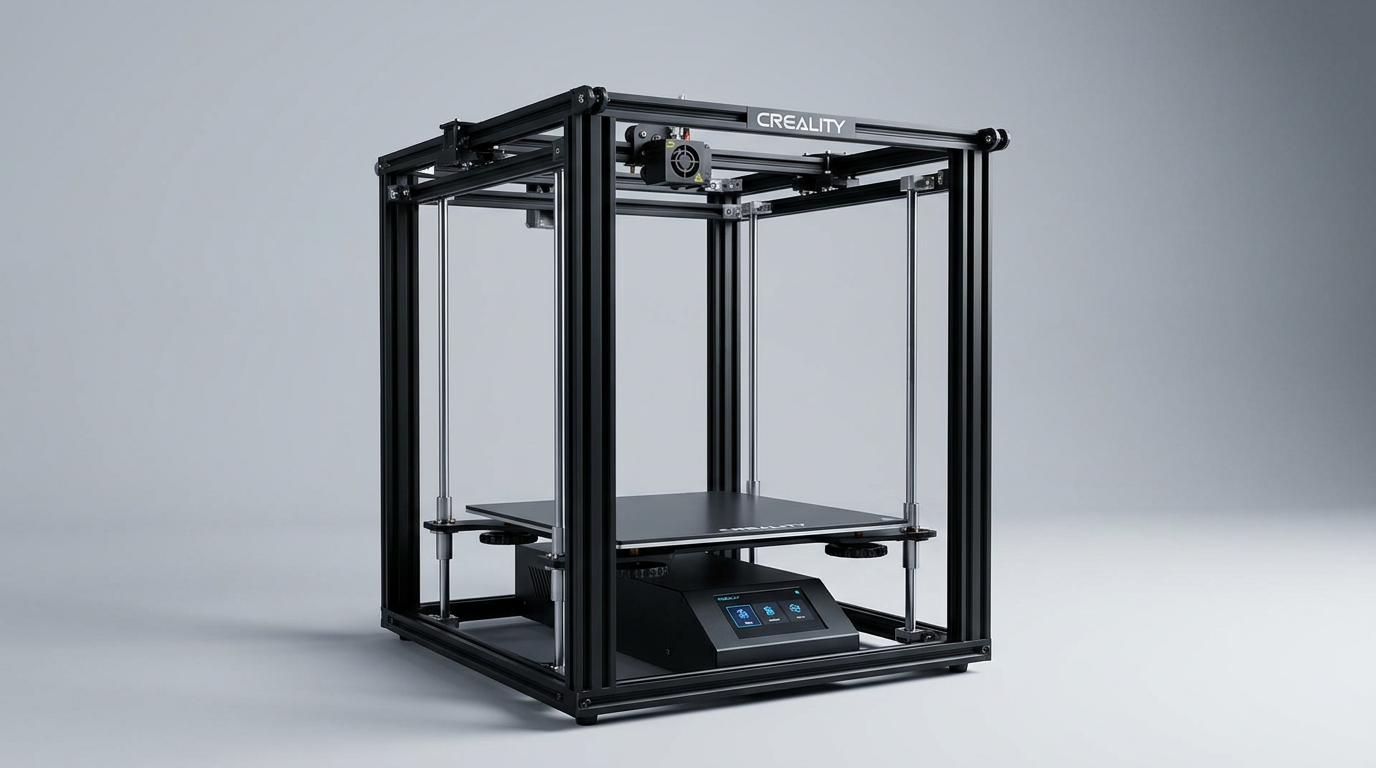
The Creality Ender 5 Max arrives as a proposition for scale, promising expansive build volume and high-speed CoreXY mechanics in a market increasingly defined by rapid prototyping and batch production. While its large format and touted 700 mm/s print speed suggest a direct challenge to more established industrial solutions, the Ender 5 Max quietly serves a specific niche: the aspiring print farm or the prosumer seeking significant throughput without the upfront capital of enterprise-grade systems.
Most buyers looking at large-format consumer printers focus on print area alone. However, the Ender 5 Max's true utility lies in its architecture. The CoreXY system, coupled with Creality's ecosystem ambitions, positions this printer as a foundation for a distributed production model rather than a singular flagship machine for hobbyists. This distinction shapes its strengths and exposes its particular compromises.
Our assessment, informed by extensive owner feedback, reveals a printer that delivers on its core promise of scale and speed for specific applications, yet introduces a hidden cost related to consistency and expected refinement. This review delves into whether the Ender 5 Max successfully bridges the gap between prosumer accessibility and industrial ambition.
What owners love
- + Expansive 400x400x400mm build volume for large projects
- + CoreXY motion system facilitates high print speeds
- + All-metal frame and linear rails contribute to stability
- + Automated 64-point leveling simplifies first layer setup
- + WLAN control and multi-printer management support print farms
Common complaints
- − Reports of extended bed heating times can impede workflow
- − Inconsistent reliability, with some units failing early
- − Software experience, particularly Klipper implementation, receives criticism
- − Touchscreen controls are occasionally unresponsive or counter-intuitive
- − Some units exhibit manufacturing defects upon arrival
Design & Build
The Ender 5 Max features an all-metal frame, a design choice consistently praised by owners for its perceived sturdiness. This robust construction aims to mitigate vibrations inherent in large-format, high-speed printing, a critical factor for maintaining print quality across its substantial 400 mm³ build volume. The inclusion of a precise X-axis linear rail reinforces this commitment to stability, providing a more consistent movement path for the printhead over wider spans. Owners note the machine’s solid appearance and feel, particularly appreciating that key structural components are metal rather than plastic. This emphasis on structural integrity represents a strategic investment in the printer's ability to handle the physical demands of high-volume or large-scale production, differentiating it from more budget-focused machines where structural compromises are common.
Setup & Ease of Use
Initial setup for the Ender 5 Max generally proves straightforward for experienced users. The printer incorporates a 64-point auto-leveling system and automatic Z-offset, features intended to streamline the critical first-layer adhesion process. These automated systems largely fulfill their promise, with many owners reporting successful calibration without significant manual intervention. This automation is a significant benefit, especially for a printer with such a large bed, where manual leveling can become tedious and error-prone. However, the user interface and software experience introduce a friction point. While the touch controls are present, some users report them to be unresponsive or imprecise, indicating a potential 'interface penalty' where the physical build quality outpaces the control experience. This suggests a disconnect between the hardware's capabilities and the accessibility of its operation.
Performance in Real Use
The Ender 5 Max aims for speed, with its CoreXY system theoretically enabling print speeds up to 700 mm/s. Many owners confirm that the printer delivers on this promise, producing fast and precise results. The machine's large build volume facilitates printing oversized models or batch production, supporting its intended use for print farms. However, this speed is sometimes overshadowed by practical limitations. A recurring complaint concerns the bed heating time; some users report delays stretching several minutes to reach target temperatures, which can significantly impact overall throughput despite rapid printing. This disparity creates a 'speed bottleneck' where the printer’s impressive travel speeds are undercut by preparatory delays. While the printer can produce high-quality output, long-term consistency is not uniformly reported, with some users experiencing early failures that point to underlying manufacturing or component weaknesses.
Software & Ecosystem
Creality positions the Ender 5 Max as a hub for scaled production, integrating WLAN multi-printer control and grouped management. This ecosystem approach is a forward-thinking design, recognizing the growing trend of distributed manufacturing. However, the printer's software experience itself draws mixed reactions. While it supports Klipper, owners describe the implementation as 'overly simplified' or a 'forked Klipper' that limits advanced control and customization. This constrained Klipper experience can be a significant drawback for users accustomed to the full flexibility of the Klipper ecosystem, hindering optimization. The promise of multi-printer control is strong on paper, but the practical usability of the software interface for managing these functions receives less direct praise, suggesting that the ecosystem's potential is not yet fully realized in its current iteration.
Value & Reliability
Priced in the upper range for consumer-grade large-format printers, the Ender 5 Max presents a value proposition for users prioritizing build volume and speed. Owners praise its quality-to-price ratio when units perform as expected. The dual-gear extruder and 1000W rapid-heating bed contribute to its material versatility and continuous production capabilities. However, reliability remains a notable concern. A subset of owners reports significant issues, including units failing within hours or days of operation, necessitating replacements. This inconsistency introduces a 'reliability lottery' where the experience can vary dramatically from one machine to another. While some users achieve their business goals with the printer, these early-failure reports temper the overall value, suggesting that despite its robust features, quality control can be inconsistent.
Verdict
Consider - The Creality Ender 5 Max offers compelling features for large-volume, high-speed printing, but inconsistent reliability and software limitations warrant caution.
This printer is suitable for hobbyists or small businesses willing to engage with some troubleshooting, particularly if their primary need is an expansive build area and fast print speeds for prototyping or batch work. Users who value throughput over absolute set-it-and-forget-it reliability, and who operate within a larger Creality ecosystem, might find its features align with their goals. Those considering multiple units for a print farm on a budget may also find this a viable, albeit sometimes demanding, option in the sub-$1000 range.
However, individuals seeking an immediately robust, trouble-free solution or those without technical aptitude should explore alternatives. If your budget allows for printers well north of $1000, particularly offerings from competitors known for refined software and consistent performance, you will likely encounter fewer operational hurdles. This is not the printer for users prioritizing an ultra-polished user experience or guaranteed long-term stability out of the box.
The Ender 5 Max embodies Creality's 'feature-forward' strategy, pushing boundaries on size and speed at a competitive price. Yet, it also reveals the 'Creality Conundrum' at its core: significant hardware potential often outpaces the software refinement and consistent quality control needed to deliver a truly premium, hassle-free experience. Its appeal is greatest for the technically inclined user who can extract its value despite its imperfections, rather than for the average consumer seeking a seamless solution.
FAQ
More 3D Printers reviews
Flashforge Creator 5 Pro Review: Multi-Material Toolchanger
Bambu Lab P2S Combo Review: The 3D Printer Appliance
Hephi3d Tina2C Review: An Entry-Level 3D Printer for Kids
Creality SPARKX i7 Nano Combo Review: Multi-Color Printing for Novices
Entina Tina2 Plus Review: A Gateway to 3D Printing for Beginners
Creality SPARKX i7 Combo Review: A Streamlined Path to 3D Printing
This review is based on real experiences shared by owners in online communities.