
Creality CR-Scan Raptor Review: Metrology-Grade Scanning for the Dedicated
By AValidReview. An AI-assisted summary of customer feedback, not a hands-on test.
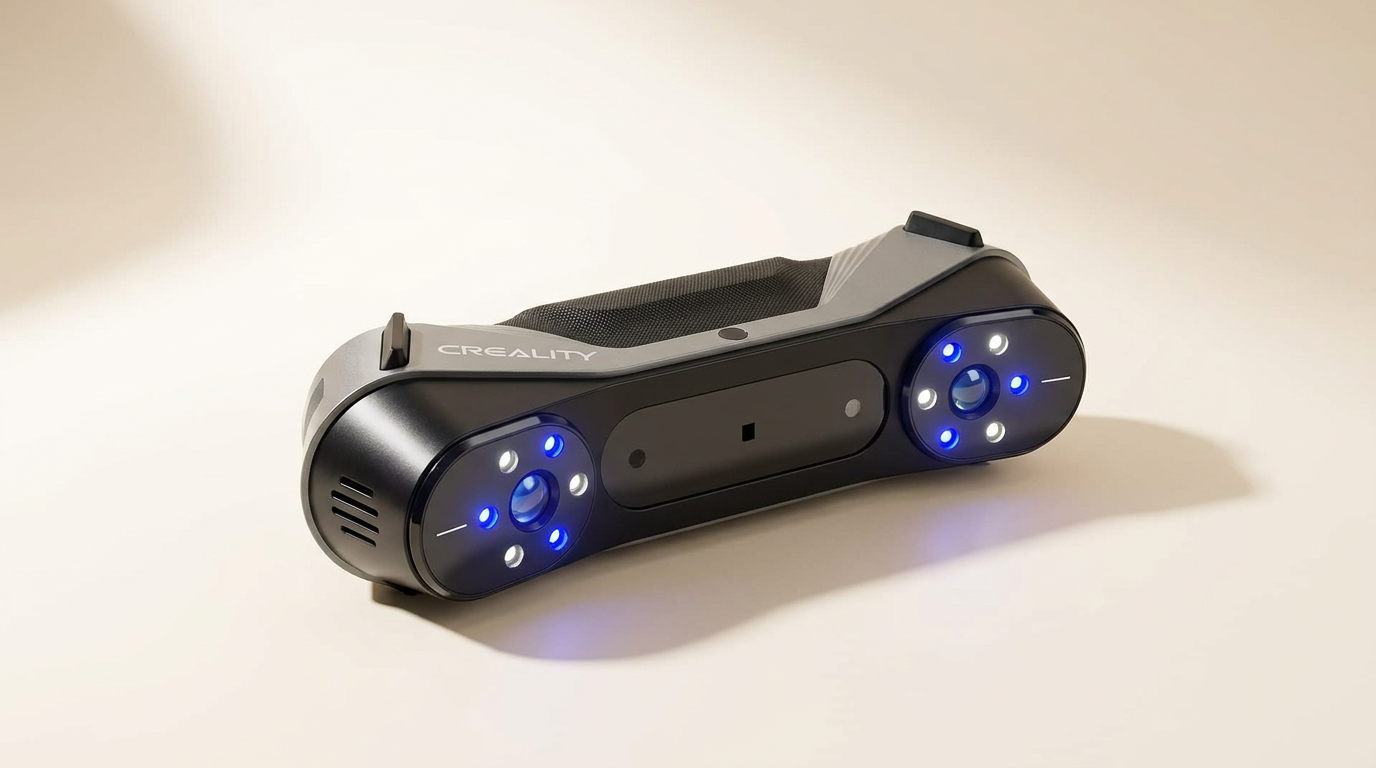
The Creality CR-Scan Raptor enters a competitive market for high-precision 3D scanning, promising metrology-grade accuracy typically reserved for much more expensive industrial solutions. While consumer 3D scanning often emphasizes accessibility and general-purpose utility, the Raptor, with its 0.02mm accuracy claims and dual blue light/NIR scanning, positions itself squarely at the professional end of the spectrum, particularly for engineering and reverse engineering applications.
This scanner represents a notable shift from Creality's more hobbyist-focused offerings, aiming for a segment that demands rigorous detail and repeatable results. Its target user isn't just looking to digitize an object, but to capture precise geometric data for critical analysis, fitment, or manufacturing. Understanding this distinction is crucial to evaluating the Raptor's strengths and its few, but significant, compromises.
What emerges from owner feedback is a powerful tool capable of delivering on its accuracy promises, provided the user commits to a robust supporting ecosystem. The Raptor embodies what we term the "Precision-Power Pact": achieving its advertised capabilities hinges directly on pairing it with workstation-grade computing and understanding its operational requirements, which extend beyond the scanner unit itself.
What owners love
- + Delivers exceptional scanning accuracy, reaching 0.02mm
- + Effective for reverse engineering tasks
- + Fast scanning speeds and smooth operation with powerful hardware
- + Dual blue light and NIR modes support diverse object sizes
- + Robust software supports standard output formats like OBJ and STL
Common complaints
- − Requires simultaneous connection to both a computer and power outlet
- − Demands very high-end computing specifications for optimal performance
- − Included tripod or stand components are reported as fragile
- − Not suited for truly mobile or untethered scanning scenarios
- − Steep learning curve or setup effort for optimal use
Design & Build
The CR-Scan Raptor presents a professional appearance, weighing 372g, which owners find comfortable for handheld operation. Its design integrates a ring LED indicator system and mechanical buttons for exposure control, features that enhance usability during active scanning. The physical unit itself is compact and portable, a convenience noted by users for transport. However, a recurring complaint surfaces regarding the ancillary equipment: the included tripod or stand is described as having weak plastic components that feel prone to breakage. This suggests a disconnect between the scanner's high-grade build and the quality of its accessories, creating a small but significant friction point for users expecting uniform industrial quality across the package.
Setup & Ease of Use
Owners report the Raptor operates as intended once properly configured. The scanner features an innovative 2-in-1 design combining blue light for intricate detail and NIR (Near-Infrared) for broader coverage and tracking. This dual functionality is essential for covering a wide range of object sizes, from small components to larger assemblies. The primary operational hurdle, however, is the scanner's dependency: it requires simultaneous connection to both a computer and a power outlet. This eliminates true wireless mobility, a feature found in some comparable scanners in this price band. This "Tethered Performance Tax" means that while the scanner itself is lightweight, its operational footprint is significantly larger, limiting its utility in field or untethered scanning scenarios, and potentially frustrating users expecting more flexibility.
Performance in Real Use
The CR-Scan Raptor consistently delivers on its promise of high-quality scanning, with owners reporting very good output quality and confirming its utility as a reverse engineering tool. Its 0.02mm accuracy claim appears validated in practice for those with appropriate setups. The scanner's ability to maintain smooth operation and capture data quickly is frequently tied to the host computer's specifications. Users with top-tier processors (e.g., AMD Ryzen 9 7900X) and ample RAM (32GB or more) describe a very smooth experience, enabling fast scanning. Conversely, the device struggles or becomes frustrating with underpowered systems, reinforcing the "Precision-Power Pact" theme. The scanner's anti-shake tracking and marker recognition features, bolstered by 12 infrared LEDs, aid in scanning featureless objects, contributing to its overall robustness in challenging conditions.
Software & Ecosystem
Creality provides user-friendly software that supports multiple industry-standard data formats including OBJ, STL, and PLY. This broad compatibility ensures that scanned data integrates seamlessly into various CAD, 3D modeling, and design software ecosystems. This flexibility is a significant advantage for professionals who need to incorporate scan data into existing workflows for animation, presentation, printing, or design. The software also helps manage the scanner's distinct blue light and NIR modes, allowing users to optimize for different object characteristics. While the software itself is robust, the overall ecosystem demands powerful computing resources. Owners emphasize the critical role of a high-end CPU, a dedicated Nvidia graphics card (8GB VRAM recommended), and substantial RAM (32GB recommended) for an optimal experience, signifying a significant upfront investment beyond the scanner itself.
Value & Reliability
The Creality CR-Scan Raptor is positioned as an industrial-grade scanner, and its price point reflects this, typically falling around $1000. Owners who have the requisite high-performance computing infrastructure find it to be an "awesome scanner" and a valuable tool for demanding applications like reverse engineering. However, the requirement for constant power and computer tethering is a significant constraint, and one user noted it made the device "basically useless" for their mobile needs, especially when compared to fully wireless alternatives in a similar price range. This points to a specific "Operational Flexibility Gap": while the raw scanning power is present, the practical deployment is less versatile than some might expect. Long-term reliability is suggested by positive feedback from users who integrate it into their workflow, but the fragility of the included stand raises minor concerns about the complete package durability.
Verdict
Consider - For dedicated engineering tasks requiring extreme accuracy, the Raptor delivers, but be prepared for a substantial computing investment.
This scanner is best suited for professionals and advanced users in engineering, product development, or reverse engineering who already possess a powerful workstation or are prepared to invest in one. Its precise accuracy and dual scanning modes make it ideal for capturing intricate details on a variety of object sizes in a fixed workshop environment. Those needing metrology-grade data for critical applications will find the Raptor a capable tool.
Conversely, users seeking a mobile, untethered, or plug-and-play scanning solution should look elsewhere. Its reliance on constant power and a high-spec computer makes it impractical for field work or casual scanning. Hobbyists or those with budget constraints on their computing setup will find the total cost of ownership, including the necessary hardware upgrades, prohibitive.
The CR-Scan Raptor isn't just a scanner; it's a component of a high-performance data acquisition system. Its true value lies not in standalone convenience, but in its ability to unlock "Precision-Power Pact" workflows, where consistent, high-fidelity data extraction is paramount, outweighing considerations of untethered operation.
FAQ
More 3D Scanners reviews
Revopoint INSPIRE 2 3D Scanner Review: Unpacking the Accessory Echo Chamber
Creality 6mm 3D Scanning Markers Review: Essential Tracking Aid
TOSUKKI 6mm Positioning Targets Review: The Refined Generic Choice
AESUB 3DTOOLS 3D Scanner Spray Review: The 'Evaporative Enabler'
Creality 8-inch Rotating Turntable: A Solid Scanner Accessory

Generic 12 Piece Multi-Angle Markers Review: Essential 3D Scanning Dots
This review is based on real experiences shared by owners in online communities.