
Anycubic Kobra S1 Max Combo Review: High-Volume Ambition
By AValidReview. An AI-assisted summary of customer feedback, not a hands-on test.
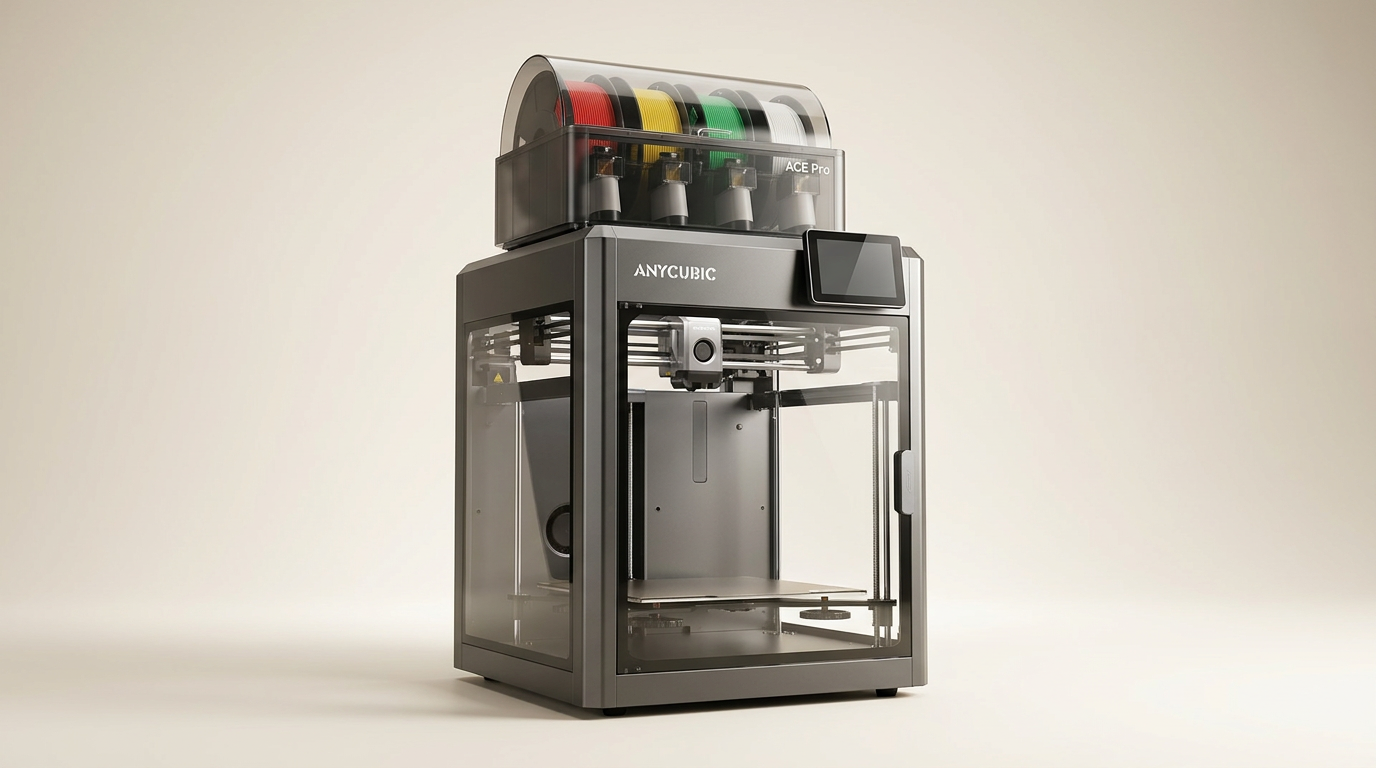
Most consumer 3D printers hit a ceiling around the 250-millimeter mark. Crossing into 350x350x350 mm territory is not just an incremental stretch of the gantry; it fundamentally changes the nature of the tool. Large-format printing introduces what we call the endurance multiplier. On a four-hour decorative print, a minor feed hesitation or sensor misread is a small annoyance. On a 48-hour structural ASA print consuming two kilograms of filament, that same hiccup is an expensive, catastrophic failure.
The Anycubic Kobra S1 Max Combo aims to bring industrial capacity to the high-end consumer market, landing in the rough neighborhood of $1,000. It arrives armed with an actively heated chamber, an all-metal CoreXY frame, and the ACE 2 Pro multi-color material system. It does not just promise larger prints; it promises that you can print demanding engineering materials at scale without dividing models into pieces.
Yet running a machine of this scale reveals a sharp tension in modern additive manufacturing. While the core motion system and thermal enclosure perform admirably, marrying a massive workspace to an automated multi-spool switcher tests the limits of consumer-grade filament handling. The S1 Max is a formidable piece of hardware, but its real-world success hinges entirely on what you load into the spool bay.
What owners love
- + Expansive 350x350x350 mm build volume handles full-scale parts in one piece
- + Actively heated 65C chamber prevents warping on large ABS and ASA prints
- + Rigid CoreXY frame and glass panels provide stability and premium fit
- + LeviQ 3.0 bed leveling creates consistently flat, reliable first layers
- + High print speeds noticeably trim multi-day print durations
Common complaints
- − ACE 2 Pro filament management unit introduces feed errors on long jobs
- − Enormous footprint and heavy frame require significant dedicated bench space
- − Lacks integrated air filtration for toxic engineering filament fumes
- − Hotend prone to clogs when transitioning between high-temp and low-temp filaments
Design & Build
The Kobra S1 Max is an imposing machine. Weighing enough to warrant a two-person lift, it commands a footprint that will overwhelm a standard computer desk. Anycubic upgraded the exterior noticeably over its smaller sibling, outfitting the Max with real tempered glass for both the front hinged door and the top lid. This is not purely cosmetic; the rigidity and thermal retention of glass are necessary to support the actively heated 65C chamber.
Underneath the clean aesthetic sits a stout CoreXY metal chassis. CoreXY architecture is critical at this scale. By keeping the massive 350 mm build plate stationary along the Y-axis and moving it strictly downward on the Z-axis, Anycubic avoids the violent bed slinging that ruins tall prints on traditional printers. The internal motion system remains remarkably quiet during operation, with the enclosure dampening high-speed toolhead noise.
One noticeable design oversight is the lack of an integrated carbon or HEPA air filtration system. We call this the chamber disconnect: Anycubic explicitly designed this printer to cook technical filaments like ABS and ASA at high ambient temperatures, yet vents those styrene-laden fumes directly into your room. If you plan to exploit the heated chamber, you must budget for an external ventilation setup.
Setup & Ease of Use
Unboxing the S1 Max is a physical workout, though Anycubic includes thoughtful touches like lower box tear strips to make extraction manageable. Setup is largely pre-assembled, guided by clear touchscreen prompts on the front display. You will need roughly 30 minutes to unbolt the bed transit brackets, mount the runout sensors, attach the PTFE tubing, and seat the ACE 2 Pro filament hub.
Documentation is mostly clear, though owners note small discrepancies, such as setup guides that still reference a discontinued lead-screw dust cover. Once powered on, the LeviQ 3.0 auto-leveling system runs through its 49-point matrix. This is arguably the machine's strongest software-hardware integration. Across a bed this large, thermal expansion can easily introduce minor bowl shapes or ridges, yet the S1 Max consistently maps out these variances to lay down glass-flat first layers out of the box.
Physical placement demands advance planning. Setting the ACE 2 Pro unit directly on top of the glass lid may seem space-efficient, but it complicates maintenance. If you need to clear a feed path or vent the chamber for standard PLA printing, lifting off a loaded multi-spool box quickly becomes frustrating. Side-mounting the filament unit is far more practical if your bench allows it.
Performance in Real Use
When operating as a single-material production workhorse, the Kobra S1 Max is genuinely impressive. The combination of high-speed kinematics, 20,000 mm/s acceleration, and a rigid gantry lets you print large mechanical parts in a fraction of the time required by older bedslingers. Structural prints in ASA and PETG exhibit superb layer fusion, clean vertical walls, and dimensional accuracy that rivals printers costing significantly more.
The 65C heated chamber makes an immediate difference for high-shrinkage polymers. Where large ABS enclosures typically split along layer lines on unheated machines, the S1 Max keeps internal temperatures consistent enough to prevent warping across the entire 350 mm expanse. Adhesion to the textured build sheet is reliable when hot, and completed prints release cleanly once the plate cools down.
The weak link emerges when switching filament chemistries. Users frequently encounter nozzle clogs when swapping from high-temp materials like ASA down to PLA. The transition requires meticulous flushing at elevated temperatures; otherwise, leftover engineering plastic solidifies in the cold zone and chokes lower-temp extrusions.
Software & Ecosystem
Anycubic's software stack provides the basic slicing profiles, cloud management, and remote monitoring expected of modern machines. The onboard interface is responsive and easy to navigate, cleanly displaying chamber heat, nozzle metrics, and spool telemetry. However, the machine's automated intelligence features produce mixed results. The onboard AI monitoring camera frequently flags false positives, pausing prints unnecessarily or failing to spot actual early-stage defects.
The bundled ACE 2 Pro system is where most user friction concentrates. While it handles basic four-color jobs adequately on short prints, multi-material printing on a large-format bed is inherently risky. A multi-color print running over several days requires hundreds of retractions and filament swaps. Owners report intermittent feed errors, sensor false alarms, and occasional mechanical jams in the feeder tubes.
If you treat the ACE 2 Pro primarily as an automated spool-backup bank, seamlessly rolling over to a fresh roll of PETG when the first runs out, it proves quite practical. As an ambitious multicolor tool for intricate, multi-day decorative prints, the feeding mechanism simply lacks the rock-solid reliability necessary to justify the high filament purge waste.
Value & Reliability
Positioned around the $1,000 tier, the Kobra S1 Max Combo operates in a thin sliver of the market. Few competitors offer an enclosed CoreXY frame with a 350 mm cube and an actively heated chamber without creeping well past this budget. On pure volume-per-dollar metrics, Anycubic delivers immense physical machine for the money.
Reliability, however, requires careful contextualization. As a functional prototyping tool running single-material engineering jobs, long-term feedback shows it can log hundreds of hours with minimal downtime. The metal frame, robust Z-axis lead screws, and thermal components hold up well under steady production cycles.
The reliability compromises emerge in customer support and quality control. Initial shipments have seen occasional cracked glass panels or fragile feeder clips, and Anycubic's support turnaround can be slow when processing replacement parts. Buyers should view this machine as a high-capacity production platform that requires mechanical sympathy, not an appliance you can run blindly without basic troubleshooting skills.
Verdict
Consider - A formidable, high-volume workhorse for functional engineering prototypes, hampered only by a finicky multi-color system.
Buy the Kobra S1 Max Combo if you are an engineer, prop builder, or small business needing to print large, single-piece ASA, ABS, or PETG parts without paying industrial machinery prices. Its rigid CoreXY chassis, massive 350 mm envelope, and true heated chamber deliver structural results that smaller desktop printers cannot match.
Skip this bundle if your primary objective is printing multi-color decorative models or if you lack a well-ventilated workshop. The ACE 2 Pro multi-material system adds unwanted failure points to multi-day print runs, and the lack of internal air filtration makes it unsuitable for standard living spaces.
Most buyers assume a combo unit makes a large-format printer universally versatile, but the S1 Max actually excels by being specialized. It is fundamentally an industrial prototyping station wearing consumer clothes. Use the multi-spool unit for automatic runout switching rather than multi-color art, and you will unlock one of the most capable large-format platforms currently available near this price point.
FAQ
More 3D Printers reviews
Anycubic ACE 2 Pro Review: Heated Multi-Material Feeding
Magic Jimmy AI 3D Printer for Kids Review
Bambu Lab AMS lite Review: The Multi-Color Upgrade Dilemma
AOSEED AI 3D Printer for Kids Review: Capable Fun
Anycubic Kobra S1 ACE 2 Pro Combo Review: Enclosed Multicolor Value
FLASHFORGE AD5M Pro Review: High Speed Enclosure on a Budget
This review is based on real experiences shared by owners in online communities.