
Wefuit 0.2mm Hardened Steel Hotend Review: Budget Precision
This review is based on real experiences shared by owners in online communities.
Bambu Lab built its reputation on frictionless printing, but the official consumable ecosystem carries a distinct fine-bore tax. Switching to a 0.2mm nozzle enables stunning mechanical detail and miniature printing, yet it also dramatically increases the risk of micro-clogs that turn expensive first-party parts into paperweights. For budget-conscious makers, that risk often keeps the smallest nozzles sitting unused in a drawer.
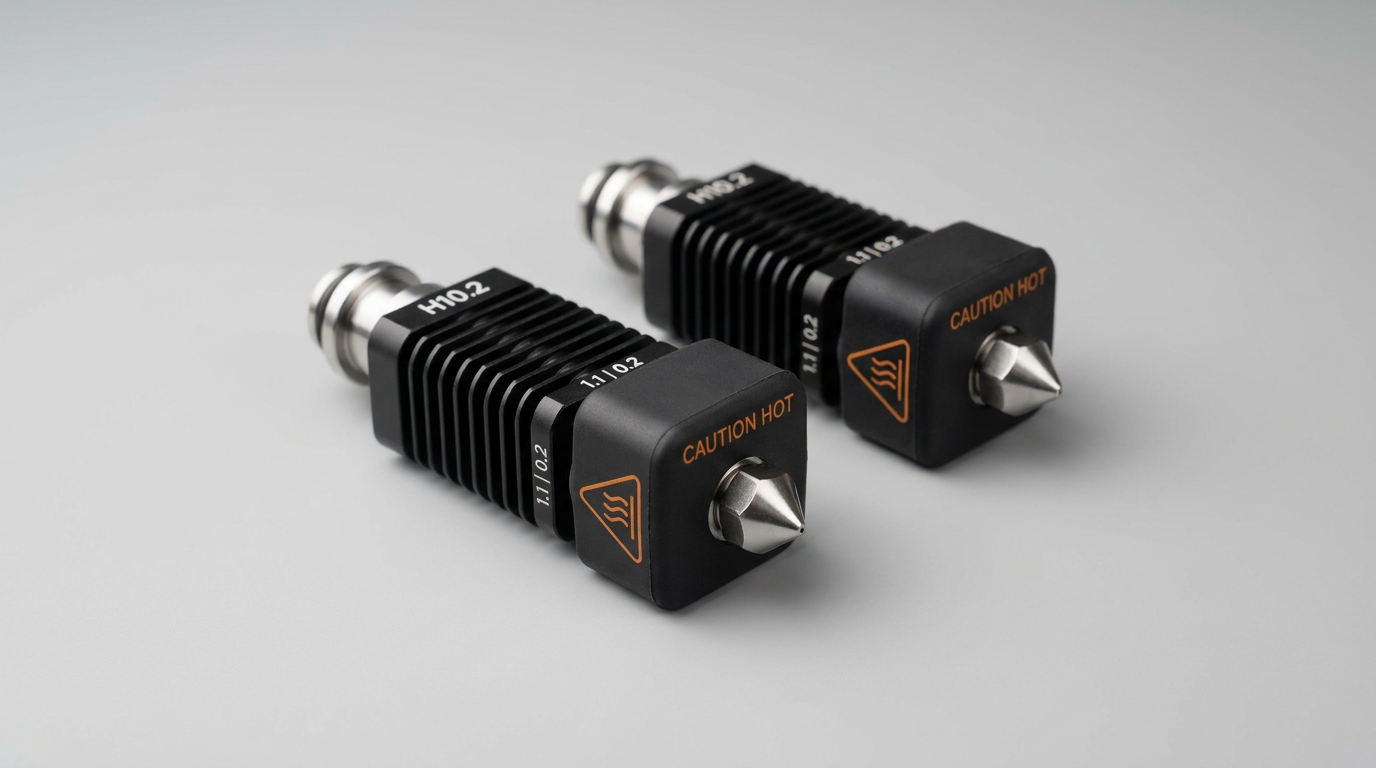
The Wefuit 2-Pack 0.2mm Hardened Steel Hotend challenges that dynamic. Sold in the under $20 price bracket for a pair, this aftermarket drop-in kit promises genuine OEM dimensional parity, hardened steel wear resistance, and plug-and-play installation across the Bambu Lab lineup, including the A1 Mini, P2S, and H2 series. It targets users who want high-resolution output without the dread of writing off costly original equipment.
After examining extensive real-world feedback from production-level users, the question is not merely whether Wefuit undercut the pricing, but whether it preserved the exacting thermal and flow tolerances Bambu hardware demands. The results prove that while third-party hardware requires attentive installation, the printing performance matches first-party components step for step.
What owners love
- + Matches OEM print fidelity at ultra-fine layer heights down to 0.06mm
- + Complete modular assemblies eliminate wiring and thermal paste mess
- + Hardened steel tip resists wear from abrasive filaments
- + Priced at roughly half the cost of first-party alternatives
- + Reliable flow-rate consistency during Bambu Studio calibration tests
Common complaints
- − Included removal wrenches strip easily under standard torque
- − Nozzle tips are impractical to replace individually; best treated as a sealed core
- − Improper seating against the internal carriage magnet causes immediate extrusion failures
Design & Build
The Wefuit package arrives as a fully integrated drop-in module comprising a hardened steel 0.2mm nozzle, all-metal heat break, heater block, and fitted silicone sock. Machining quality across the metal interfaces is clean, with no visible burrs or thread slop. The inclusion of hardened steel at this price point is a notable upgrade over standard brass, offering resilience against abrasive additives. However, buyers should be wary of what we call the swappable tip fallacy. Although the vendor ships tiny hand tools intended for nozzle disassembly, the wrench metal is notoriously soft and strips almost immediately under torque. In practice, this hotend should be treated as a unified, sealed consumable unit rather than a serviceable modular assembly. Given the low price band per unit, swapping the entire assembly is far more rational than trying to rebuild the core by hand.
Setup & Ease of Use
Installation follows the standard Bambu hotend procedure: loosen the retaining clamp, drop the module into place, and secure the fasteners. Yet the primary source of initial frustration stems from what we term the magnetic seating trap. Bambu toolheads rely on a rear magnet to pull the hotend flush against the assembly backplate before the retention clip is closed. Multiple owners report initial print failures, clogs, and diagnostic errors that disappeared once they realized the hotend was sitting slightly proud of the carriage. If the magnet does not audibly latch the heat sink flat against the housing, the nozzle sits angled, leading to leveling discrepancies and extrusion jams. Once seated correctly, the physical swap requires less than five minutes and demands zero wiring adjustments or thermal grease application.
Performance in Real Use
Once secured, extrusion performance is virtually indistinguishable from first-party hardware. In real-world testing on robotics parts and detailed miniatures, owners successfully executed 0.06mm layer height profiles with crisp dimensional accuracy, sharp overhangs, and clean bridging. Flow-rate calibration in Bambu Studio confirms consistent delivery: test passes land at nominal baselines with zero scatter or under-extrusion gaps. The hardened steel tip maintains steady thermal transfer despite the inherent thermal penalty steel carries over brass. Long-term reliability is equally impressive, with several users logging over 100 continuous operational hours without experiencing a single clog, even after the OEM components they replaced had repeatedly jammed.
Software & Ecosystem
Because this hotend adheres to factory exterior dimensions, the broader printer software ecosystem treats it as a native component. The bed leveling routine and automated resonance testing proceed without errors, and users report that camera-based plate recognition features function normally. In Bambu Studio, selecting the standard 0.2mm nozzle profile produces immediate, viable prints without requiring modified start g-code or bespoke thermal offsets. The silicone sock fits snugly, retaining the internal thermal profile during high-speed cooling fan cycles and preventing the toolhead temperature errors that often plague poorly insulated aftermarket components.
Value & Reliability
At roughly half the price of original Bambu Lab hotends, this two-pack fundamentally changes the economic calculus of high-detail additive manufacturing. The fine-bore format is inherently vulnerable to filament debris, particulate contamination, and user error. Buying two complete hardened steel assemblies in the $15 to $20 range lowers the financial stakes of running tight tolerances. For print farms and hobbyists churning out tabletop miniatures, the Wefuit hotends transform 0.2mm printing from a fragile, high-maintenance chore into a predictable, low-cost capability.
Verdict
Buy - Delivers genuine OEM-equivalent extrusion fidelity and hardened durability at half the cost of first-party hardware.
FAQ
More 3D Printer Parts & Accessories reviews
HzdaDeve P1S/P1P Hotend Assembly Review: Cheap Downtime Insurance

3DZWMAN RGB LED Lamp Kit 001 Review: Better Than OEM
ELEGOO Filament Storage Bags Review: The Unsung Hero of 3D Printing
BambooSegD RGB LED Lamp Kit: The 3D Printer Accessory Standard
Creality TPU 95A: A Flexible Filament for Patient Printers
UniTak3D Quick-Swap Hotend 0.4mm Review: A Solid Bambu A1 Alternative
This review is based on real experiences shared by owners in online communities.