
Topacme 3D Relief Art Pen Review: Magic Popcorn Pens Tested
By AValidReview. An AI-assisted summary of customer feedback, not a hands-on test.
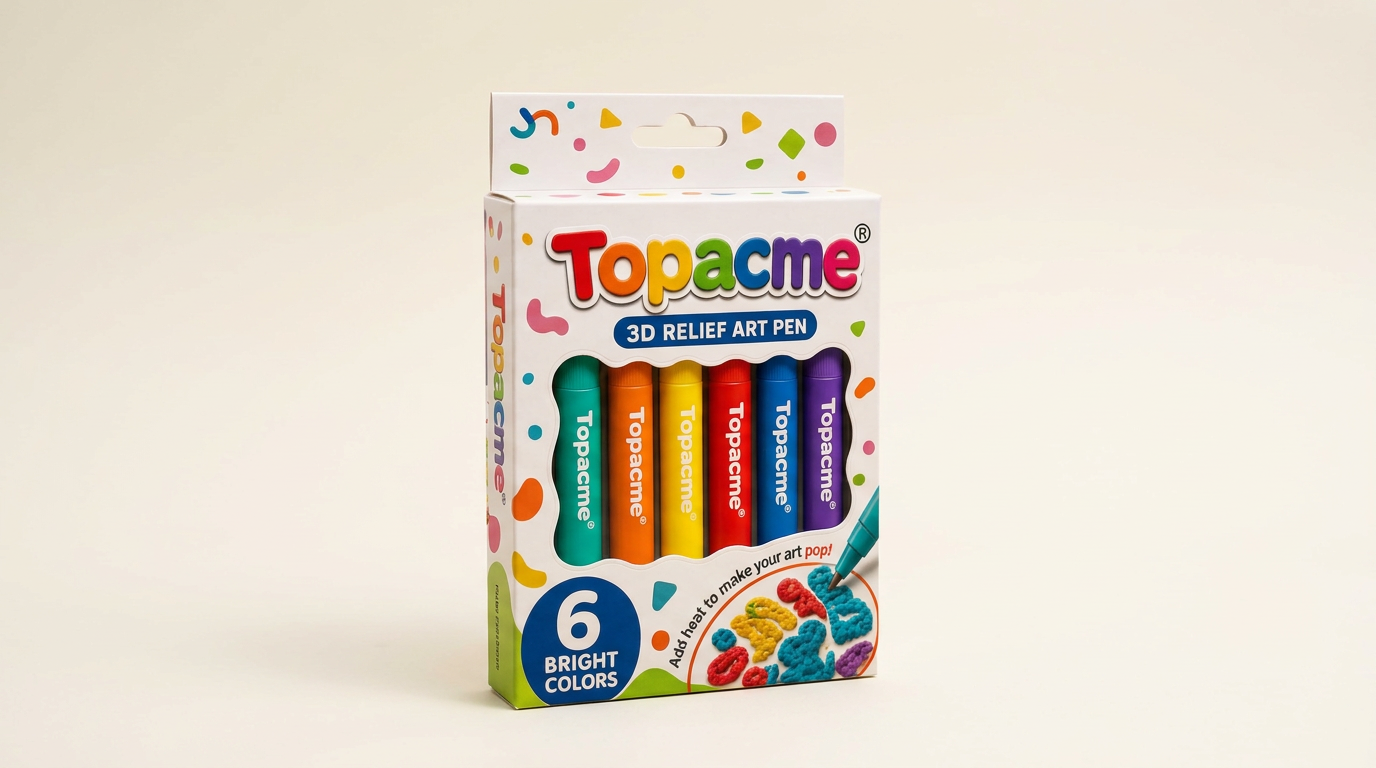
The modern craft sector frequently falls prey to algorithmic category arbitrage, where cheap novelty formulations are rebranded with tech-adjacent keywords to capture search traffic. The Topacme 3D Relief Art Pen arrives labeled as an additive manufacturing tool, yet it holds no mechanical extrusion system, no heating elements, and no filament. It is simply a set of squeeze-dispensed paint tubes engineered to foam up when exposed to external heat, marketed as a magic popcorn pen that brings flat illustrations into the third dimension.
The pitch hinges on effortless transformation: lay down a line of liquid, blast it with a common household hair dryer for two minutes, and watch chemical blowing agents swell into puffy, tactile geometry. The lived reality for the vast majority of owners is a study in frustration. What marketing clips present as an instantaneous, satisfying pop instead behaves like stubborn, watery craft pigment that stubbornly resists thermal expansion.
While a tiny contingent of patient crafters manage to coax modest dimensional texture on greeting cards and wooden ornaments, the overwhelming consensus points to widespread operational failure. Between misleading digital advertisements and finicky chemical thresholds, this kit rarely delivers on its primary promise.
What owners love
- + Bright neon pigments that look vivid on paper and cardstock
- + Adheres cleanly to porous materials including unvarnished wood
- + Water-soluble formula washes away from skin and hard surfaces
- + Inexpensive entry price comfortably under twenty dollars
Common complaints
- − Frequently fails to puff or expand under hair dryer heat
- − Requires high heat exposure times exceeding five minutes
- − Misleading promotional media exaggerates final dimensional volume
- − Applicator tip design encourages flat puddling rather than bead formation
- − Unsuitable for young children due to extended heat gun demands
Design & Build
The Topacme kit consists of six colorful squeeze tubes equipped with tapered plastic nozzles. Despite the pen nomenclature, the tool features no moving parts or powered components. The barrel plastic is relatively thin, requiring consistent thumb pressure to maintain uniform line weight. The fine tips are designed to lay down precise detailing, but the low viscosity of the fluid undermines that goal. Instead of retaining a tight bead, the ink tends to settle outward into a thin film. This design flaw introduces what can be called the blob tax: users who brush or draw flat strokes get zero elevation later, while those who squeeze out heavy droplets risk uncurable wet spots that never fully set.
Setup & Ease of Use
Preparation is ostensibly simple, requiring only an absorbent substrate and a hair dryer. However, bridging the gap between application and reaction reveals the central flaw in the user experience. The packaging suggests a brief two-minute thermal treatment, but real-world tests show that even five minutes of direct, high-heat air frequently leaves the paint wet, glossy, and entirely flat. For young children, the intended audience for novelty crafts, holding a heavy, hot appliance over a sheet of paper for five uninterrupted minutes is an unrealistic expectation. Furthermore, the high-velocity air stream from standard blow dryers easily scatters the wet, pooled ink across the workspace before any foaming reaction can begin.
Performance in Real Use
When evaluated on basic decorative utility, the pigment itself is undeniably bright. The neon pink, green, and yellow hues offer good contrast on cardstock and light wood grain. The breakdown happens entirely during activation, ensnared in the thermal activation trap. For a blowing agent to foam, the applied temperature must vaporize micro-encapsulated gas without scorching the cellulose substrate beneath it. Standard hair dryers rarely strike this balance. Owners report experimenting with every permutation, including drying the ink overnight, heating it while wet, applying dense blobs, and sweeping on thin glazes, only to achieve zero elevation. In rare instances where the formula does respond, the resulting finish resembles a mildly curdled acrylic rather than the billowy popcorn structure depicted in commercial demonstrations.
Software & Ecosystem
Because this kit is filed under 3D pens rather than basic children paint, prospective buyers receive none of the ecosystem support expected in additive manufacturing. There are no thermal charts, no application guides, and no troubleshooting matrices included in the box. Buyers must navigate the process purely by trial and error. The promotional ecosystem surrounding the product relies heavily on digitally modified footage and synthetic imagery that showcase impossibly crisp, inch-tall structures rising from paper surfaces. The absence of authentic reference material leaves consumers believing their hair dryer technique is defective, when the paint formulation itself is simply inadequate.
Value & Reliability
Retailing in the budget tier under twenty dollars, the Topacme set is cheap enough to tempt impulse buyers, yet its near-total failure rate makes it an exceptionally poor value. Once a tube fails to activate on a project, there is no workaround; the remaining tubes share the exact same chemical formulation. Long-term reliability is equally compromised. Several owners note that the formula separates inside the tubes rapidly, causing an oily fluid to eject before the colored binder. Given that return shipping logistics often rival the initial purchase cost, many disappointed buyers simply discard the set, effectively turning a modest craft purchase into outright plastic waste.
Verdict
Stay Away - The Topacme 3D Relief Art Pen fails its core chemical premise, delivering flat, uncooperative paint rather than the advertised expanding 3D textures.
This kit cannot be recommended to parents, educators, or hobbyists seeking an engaging craft project. While a determined adult with an industrial heat gun might occasionally trigger faint surface bubbling on heavy cardstock, the sheer effort required completely negates any creative satisfaction. If you want true 3D effects, invest in an actual entry-level 3D printing pen with low-temperature PCL filament, or buy reputable dimensional fabric paint that air-dries into a raised bead without thermal drama.
The Topacme pen represents the worst impulses of viral product design, built around computer-generated imagery that promises instant physical magic but delivers only messy frustration. When an art supply relies on the thermal activation trap, requiring heat levels that test both the safety limits of household appliances and the patience of children, it stops being a creative tool and becomes an exercise in deceptive marketing.
FAQ
More 3D Printing Pens reviews
This review is based on real experiences shared by owners in online communities.