
Avlpjno Popcorn Pens Review: Puffy Ink That Stays Flat
By AValidReview.
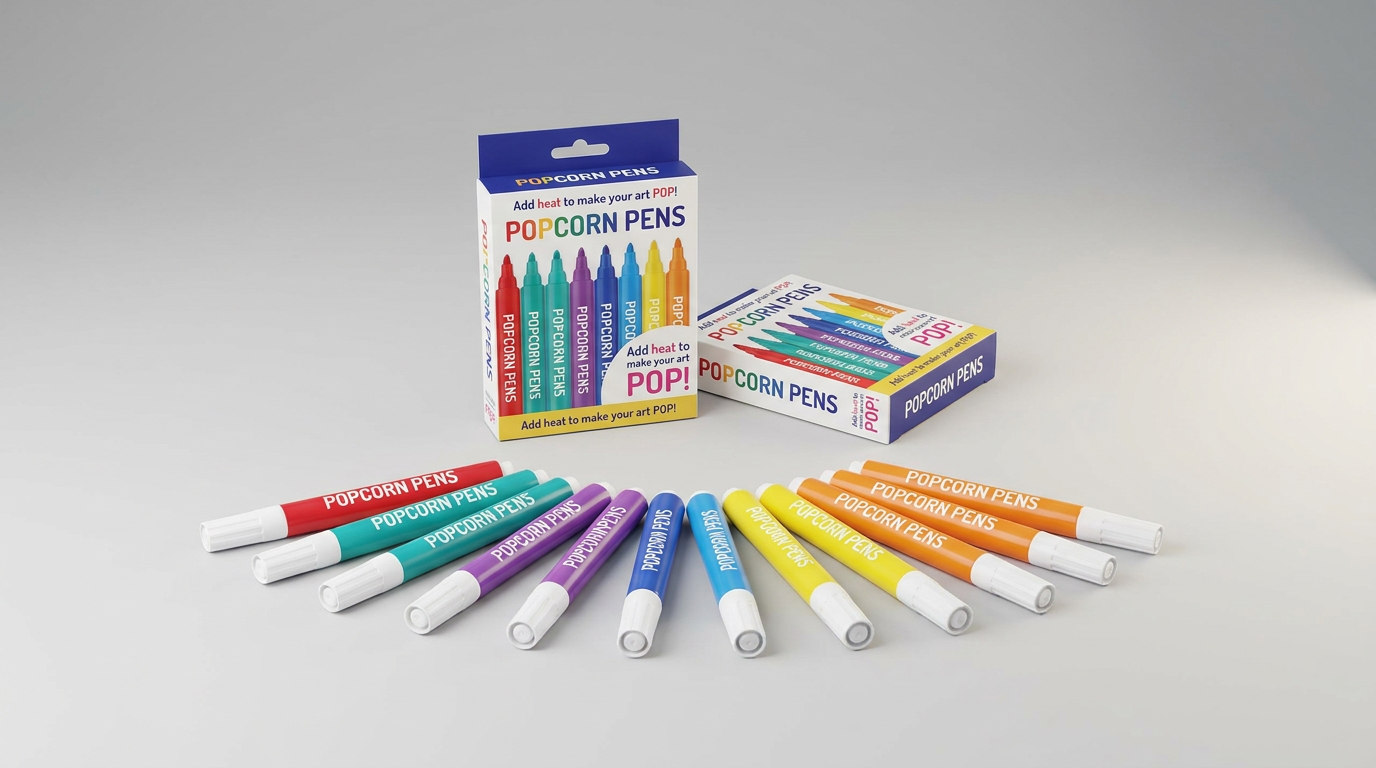
Novelty craft tools often rely on a single chemical gimmick to justify their existence. In the case of the Avlpjno Popcorn Pens, that gimmick is micro-encapsulated thermal expansion: you draw a line of wet liquid, direct hot air at the page, and watch flat ink swell into tactile, foam-like relief. It is an enticing pitch for children and greeting card makers, especially when filed into digital retail listings alongside additive manufacturing tools and actual 3D pens.
Yet the distance between promotional demonstrations and bench performance could hardly be wider. These pens represent what we call the puff deficit, a phenomenon where the core reaction required to deliver the advertised experience fails entirely in home conditions. Instead of foaming into cloud-like popcorn textures, the fluid behaves like ordinary, over-diluted pigment that dries without any verticality.
At a price point in the $30 range for a twelve-pack split across two boxes, expectations for reliable chemical activation are not unreasonable. Avlpjno promises fine-line precision and dramatic pop, but owners encounter immediate frustration. When a product is built around a single transformation, failing that transformation makes it an absolute non-starter.
What owners love
- + Twin-box packaging provides twelve distinct colored markers
- + Fine tips allow accurate initial line placement on heavy cardstock
- + Functions as standard wet-line liquid marker pigment
- + Requires no specialty batteries, cords, or melting filaments
Common complaints
- − Ink consistently fails to puff up or expand under heat application
- − Severely overpriced in the $30 range for inert marker fluid
- − Misleadingly categorized alongside genuine 3D printing equipment
- − Zero dimensional relief undermines the advertised purpose
Design & Build
The Avlpjno Popcorn Pens come split across two retail boxes containing six pens each, totaling twelve colors. Physically, the pens mirror generic squeeze-style craft applicators. The barrels are constructed from lightweight semi-flexible plastic designed to be compressed by hand, feeding liquid to a relatively fine dispensing nib. This fine tip is ostensibly meant for precise lettering and line art on paper surfaces.
In the hand, the pens feel insubstantial. The plastic barrels show mold flash along the seams, and the tips rely on direct squeeze pressure rather than a valve mechanism to control flow. Because volumetric control depends entirely on user grip, children frequently flood the paper with excess liquid. The broader issue, however, is structural category misdirection: while listed alongside additive manufacturing equipment, the internal construction shares nothing with motorized 3D printing pens that feed and melt polymer filaments. It is entirely a passive chemical marker disguised under technical tags.
Setup & Ease of Use
Getting started is straightforward in theory. You uncap a pen, squeeze the barrel to lay down ink on cardstock, and apply heat using a household hairdryer or craft heat gun to trigger the foaming reaction. The manufacturer advises that standard household heating devices will activate the micro-bubbles suspended in the fluid.
In practice, this thermal trigger process introduces what we term the heat-transfer paradox. To activate expansion chemistry, the ink requires sustained, concentrated thermal energy. However, household hairdryers operating at air velocities sufficient to deliver heat tend to scatter the wet ink across the page before it can cure. Even when users pin down the paper and apply steady warmth, the expected rapid bubbling never materializes. Instead, users are left waving loud appliances at damp paper with no observable shift in elevation.
Performance in Real Use
Real-world testing reveals that the ink suffers from total thermal failure. When heat is applied, the marks do not pop, bubble, or build into three-dimensional foam. Owners report zero expansion after sustained heating cycles, rendering the popcorn moniker entirely fictitious. The ink simply transitions from wet fluid to dry, slightly shiny residue.
This lack of volumetric rise is not a subtle variance in height; it is a complete functional stall. Genuine expanding craft inks use gas-releasing blowing agents activated around 100 degrees Celsius. In the Avlpjno formulation, that chemical engine appears inert or under-concentrated. The drawn lines remain as flat as standard water-based markers, yet take far longer to cure because the carrier fluid is thick and viscous. If the dimensional feature does not work, the artwork remains ordinary marker scribbles on warped, heat-stressed paper.
Software & Ecosystem
Because these pens are categorized within additive manufacturing and 3D printing pens, buyers searching for entry-level digital fabrication tools will find zero compatible ecosystem here. There are no temperature controls, no swappable nozzles, no digital presets, and no printable design templates included in the package.
Avlpjno provides neither an instructional guide detailing optimal thermal wattage nor recommendations for paper weights that resist heat deformation. Users must guess the distance, heat setting, and exposure time required to coax a reaction out of the ink. The lack of standard technical documentation leaves buyers stranded when the fluid refuses to react, highlighting the sheer disconnect between technical classification and budget craft imports.
Value & Reliability
Selling in the $30 range for twelve small pens, the Avlpjno kit demands a significant premium over standard children markers. That premium is predicated entirely on the 3D puff novelty. When that novelty fails on the first attempt, the value proposition collapses immediately.
Reliability is non-existent. A defective 3D printing pen might have a jam that can be cleared, but a chemically defective ink batch offers no troubleshooting path. Once laid on paper, inert ink cannot be fixed by higher heat or alternative techniques; excessive heat simply scorches the page. Paying high-tier craft prices for markers that deliver low-tier pigment performance makes this one of the most frustrating purchases in the novelty craft space.
Verdict
Stay Away - The ink completely fails to expand into 3D textures, leaving behind ordinary flat marks at an inflated price.
This kit is not suitable for craft hobbyists, card makers, or parents looking for an engaging sensory activity for kids. The inability to produce raised lines makes it a failure for anyone seeking dimensional art tools. Those searching for true additive manufacturing or 3D pens should look to established filament-melting styluses from brands like 3Doodler, while casual crafters should stick to reliable fabric puff paints from recognized art suppliers.
The Avlpjno Popcorn Pens represent the worst outcome of algorithmic marketplace search capture. By tagging cheap, inert liquid markers with additive manufacturing keywords, the manufacturer sets expectations of high-tech creativity while shipping a defective chemical mixture. It is an empty promise packaged in plastic, and buyers should steer well clear.
FAQ
More 3D Printing Pens reviews
ROVIA 6 Colors Popcorn Pens Review: 3D Heat-Activated Art
Popcorn 3D Relief Art Pens Review: Chemistry Without Context
3D Pen Filament Refills 20 Colors Review: Reliable PLA Pack
3D Relief Art Popcorn Pens Review: Novelty Craft Gimmick
SCRIB3D P1 3D Printing Pen Bundle Review: High Utility, Real Risks
Omexry Popcorn Pens Review: Messy Chemistry
This review is based on real experiences shared by owners in online communities.