
SUNLU PLA Plus Filament Review: The Workhorse for Reliable Prints
This review is based on real experiences shared by owners in online communities.
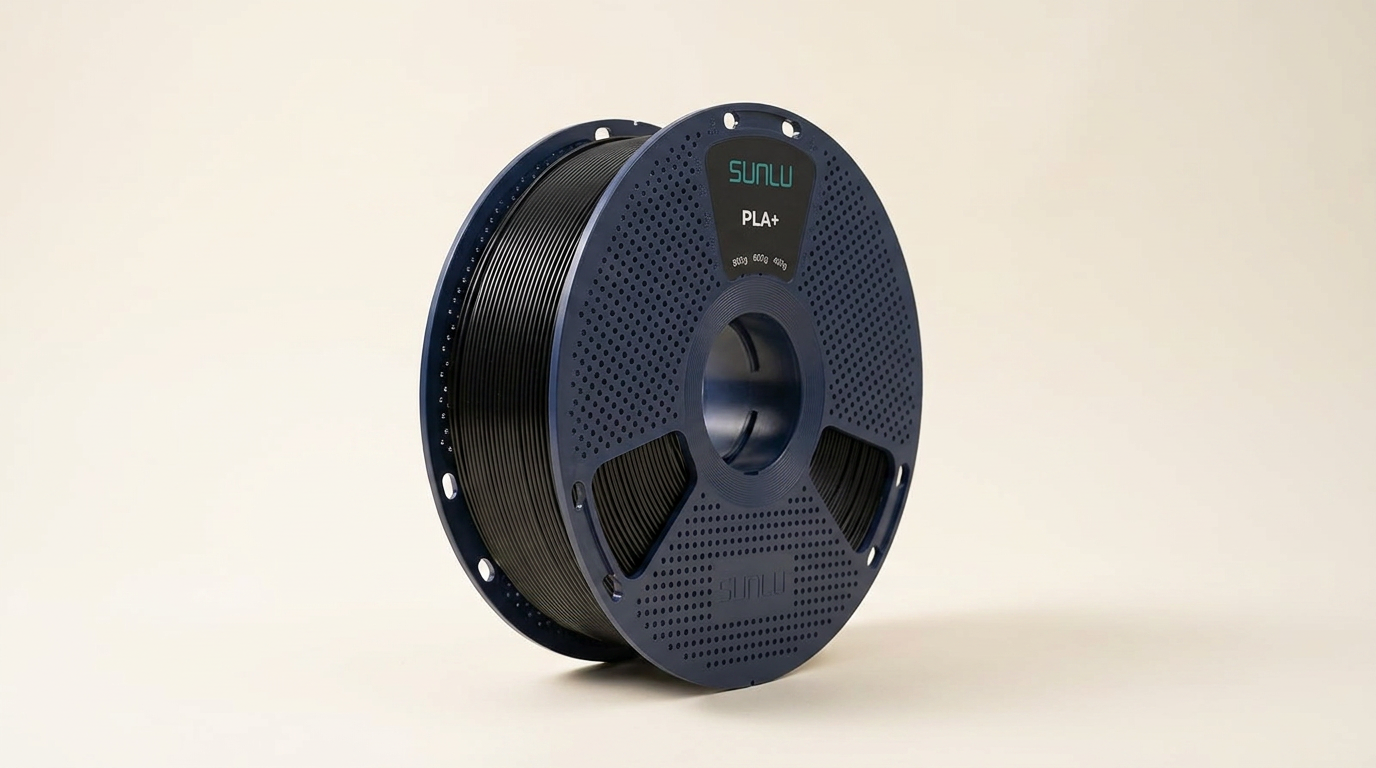
In a 3D printing market often characterized by brand loyalty and material experimentation, SUNLU PLA Plus emerges as a quiet constant. While other manufacturers chase incremental performance gains or exotic material blends, SUNLU has focused on delivering foundational reliability at an accessible price point. This isn't a filament designed to break benchmarks or redefine material science; rather, it cultivates a loyal following by consistently performing its core function without fuss. Many users consider it a default choice when seeking dependable results for everyday printing tasks.
This consistent performance fosters a distinct phenomenon: the 'Utility Default' filament. It becomes the go-to, not because of standout features, but because it rarely fails. This review examines how SUNLU PLA Plus achieves this status through its construction, ease of use, and print consistency, contrasting its practical virtues against marketing claims of superior strength or innovation. The real value often lies not in what a product claims, but in what it reliably delivers print after print.
Our analysis draws from extensive owner feedback, revealing a clear pattern of satisfaction centered on its straightforward application and consistent output. We evaluate its suitability for various FDM setups, from entry-level machines to advanced Bambu Lab printers, to determine its true standing as a general-purpose material for a wide range of makers.
What owners love
- + Consistent, reliable print quality for everyday use
- + Strong layer adhesion and durable finished prints
- + Excellent value for its price point
- + Rarely experiences tangles or clogs
- + Good compatibility across many FDM printers
Common complaints
- − Requires proper drying, like all filaments, to avoid microbubbles
- − Limited color selection in refillable spool options currently
- − Strength improvements over standard PLA are incremental for most users
- − Some spools are still plastic, despite move towards refillable
Design & Build
SUNLU PLA Plus filament arrives consistently vacuum-sealed, indicating proper moisture control at packaging. Owners frequently mention the filament's neatly wound spools, a critical factor for uninterrupted printing. The brand's claim of advanced winding technology appears substantiated by user reports of tangle-free operation. While the material is marketed as '3 times stronger' than standard PLA, owners focus more on its general durability and good layer adhesion in finished prints, rather than specific numerical strength gains. The spools themselves are undergoing a transition; while many are still traditional plastic, the inclusion of refillable spools compatible with systems like Bambu Lab's AMS is a notable move towards broader ecosystem integration and reduced waste, signaling an evolving commitment to user convenience and environmental considerations. This practical evolution in spool design, driven by contemporary printer architectures, is a more impactful design element than incremental material strength.
Setup & Ease of Use
User experience with SUNLU PLA Plus is characterized by straightforward setup and minimal operational hurdles. Many owners report successful prints directly out of the box, often using default PLA settings on various FDM printers. Recommended print temperatures range from 210°C-235°C for the nozzle and 55°C-65°C for the bed, aligning with standard PLA Plus requirements. Several long-term users, particularly those with Bambu Lab machines, note that the filament prints well with established PLA settings, requiring little to no calibration. This 'plug-and-play' characteristic is a significant advantage, reducing the barrier to entry for new users and streamlining workflows for experienced ones. Adhesion to common build surfaces, such as PEI textured beds, is consistently reported as excellent, contributing to a high first-layer success rate. The cumulative effect of these small efficiencies establishes a low 'operational tax' for this filament, minimizing preparation and troubleshooting time.
Performance in Real Use
In day-to-day operation, SUNLU PLA Plus consistently delivers clean, detailed prints. Owners frequently highlight smooth extrusion, minimal stringing, and an absence of clogs. The material's dimensional accuracy of +/- 0.02mm is a common manufacturing specification, but its real-world impact is reflected in the consistent print quality and successful outcomes reported across diverse printer models. While one owner humorously mentioned trying TPU, the vast majority of positive feedback centers on PLA Plus specifically. Several users confirm its suitability for functional parts requiring greater strength and durability than standard PLA. However, moisture absorption, a universal PLA issue, requires proper filament storage or a dryer. Neglecting this leads to 'microbubbles' and rough prints, a trade-off inherent to hygroscopic materials rather than a specific fault of SUNLU. This highlights a user responsibility more than a product flaw, distinguishing it from filaments with inherent printing difficulties.
Software & Ecosystem
As a filament, SUNLU PLA Plus primarily interacts with the broader 3D printing ecosystem through its compatibility with various FDM printers and slicer software. It does not possess proprietary software or a dedicated digital ecosystem. However, its 'Workhorse Compatibility' is a key advantage, with users explicitly mentioning its seamless integration with popular machines like the Ender 3, Ender 3 V2, and Bambu Lab P1S/A1/X1 Carbon. The fact that it works well with Bambu Lab's AMS system when loaded onto refillable spools is particularly noteworthy, addressing a common pain point for users of that specific platform. The brand's decision to offer refillable spools, even if not universally available for all colors, demonstrates an awareness of current trends in machine design and user demand for more sustainable and integrated solutions. This pragmatic approach to ecosystem fit, rather than an attempt to create its own, serves its user base effectively.
Value & Reliability
The consistent theme across owner feedback is the exceptional value proposition of SUNLU PLA Plus. Many users refer to it as 'the best for the price,' 'cheap and reliable,' or offering 'unbeatable value.' This underscores a core strength: delivering consistent, high-quality results without commanding a premium price. Owners frequently reiterate their intent to repurchase, citing its reliability as the primary driver. This repeated loyalty is a strong indicator of its long-term performance and perceived cost-effectiveness. In a segment where material quality can fluctuate significantly, SUNLU has established a reputation for dependable output roll after roll. This reliability, combined with its accessible pricing typically under $20 per kilogram, creates a compelling offering for both casual hobbyists and prolific makers who prioritize consistent performance over experimental features. It embodies a 'cost-per-successful-print' efficiency that many find difficult to match.
Verdict
Buy - This filament provides exceptional print reliability and consistent quality at a highly competitive price point.
This is an ideal choice for anyone seeking a general-purpose PLA Plus for everyday FDM printing, especially if consistency and cost-effectiveness are priorities. Hobbyists, educational institutions, and small businesses producing functional prototypes or common prints will find significant value here. Those operating multiple printers or machines with sensitive filament feeding systems, like Bambu Lab's AMS, will appreciate its well-wound spools and broad compatibility. You should skip this if your primary need is for specialized material properties beyond enhanced PLA strength, such as exotic colors, extreme durability, or very specific engineering-grade characteristics, which typically come at a much higher cost.
SUNLU PLA Plus has mastered the art of the 'Utility Default' filament, positioning itself not as a disruptive innovator, but as the quiet, consistent backbone of a productive print farm. Its real genius lies in its sheer lack of drama, turning predictable performance into its most compelling feature in a market often chasing novelty. It proves that in 3D printing, sometimes the most advanced feature is simply always working.
FAQ
More 3D Printing Supplies reviews
Kretrum 3Doodler Start+ Refills: Expanding Creative Horizons
Kretrum 40 Colors PLA 3D Pen Filament Refills Review
Fanttik T1 Max Review: A Cordless Soldering Iron for the Modern Maker
ELEGOO Silk PLA Filament Review: A Budget Silk Filament Leader
ELEGOO Matte PLA Filament: A Premium Finish for Everyday Prints
ELEGOO PLA Filament Bundle Review: The Daily Driver Standard
This review is based on real experiences shared by owners in online communities.