
ACESAY Glow in the Dark PLA+ Review: Novelty With Hidden Costs
By AValidReview. An AI-assisted summary of customer feedback, not a hands-on test.
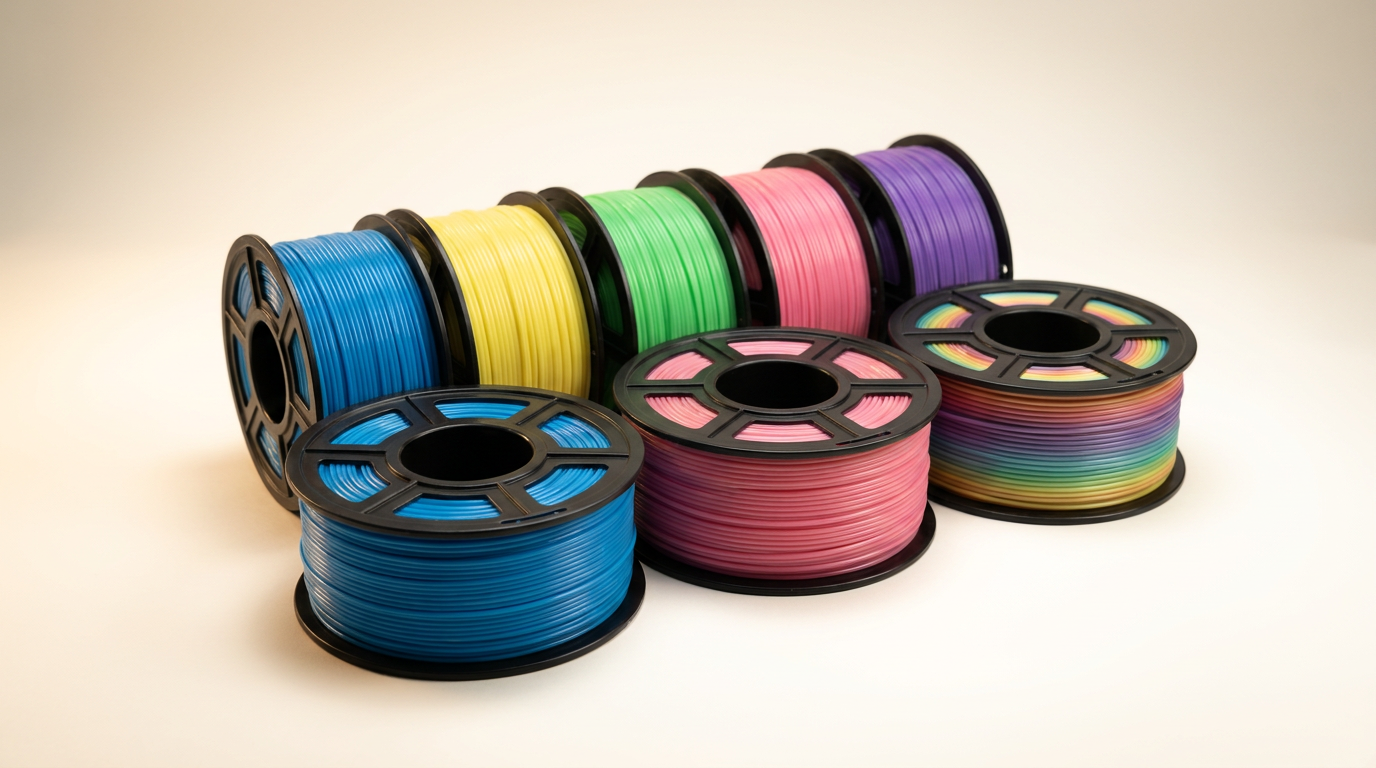
Glow-in-the-dark filament is often marketed as a casual weekend novelty, but under the hood, it behaves like an industrial abrasive composite. ACESAY pitches its 6-pack 200g bundle as an accessible sampler for hobbyists wanting to print glowing desk toys and seasonal ornaments without buying multiple full-sized spools. That proposition sounds practical, but it runs headfirst into what we call the phosphor pigment tax: the physical reality that blending phosphorescent particles with colored dyes creates dramatic variations in printability and brightness across the same box.
While this six-spool bundle lets you experiment across green, blue, yellow, red, purple, and rainbow without committing to individual one-kilogram rolls, it demands realistic expectations. You are not buying standard, forgiving PLA. Between abrasive wear on stock hardware and batch-dependent brittleness, this bundle rewards prepared tinkerers while frustrating anyone expecting standard plug-and-play extrusion.
What owners love
- + Green and rainbow rolls deliver intense, punchy luminescence
- + Daylight appearance is vibrant rather than dull or washed out
- + Low total financial commitment to test multiple glowing shades
- + Solid layer adhesion on basic direct-drive printers when dialed in
Common complaints
- − Severe filament brittleness causes snaps inside feeder tubes
- − Red, purple, and blue rolls produce weak or negligible glow
- − Lightweight 200g spools struggle in automated multi-material systems
- − Abrasive phosphorescent particles rapidly chew through brass nozzles
Design & Build
The primary selling point of the ACESAY bundle is its division: 1.2 kilograms of total material split evenly across six compact 200g mini spools. Physically, the raw filament displays rich, semi-translucent pigmentation in normal room light. Unlike older glow filaments that looked like murky off-white plastic by day, these rolls look attractive on the shelf before they ever see darkness.
However, the structural integrity of the strand reveals the underlying composition trade-off. Glow filament requires heavy loading with inorganic phosphorescent powders, typically strontium aluminate derivatives. In ACESAY's blend, this additive load creates what owners describe as extreme brittleness. Multiple users report strands snapping cleanly off the spool during feeding or snapping inside Bowden tubes before reaching the melt zone. If the filament path involves tight bend radii, the material has a tendency to fracture rather than flex.
Setup & Ease of Use
Approaching this filament requires understanding the tooling pre-requisite: standard brass nozzles will not survive it. Phosphorescent additives act like microscopic sandpaper inside your hotend. Users running stock brass tips find their 0.4mm orifices rapidly eroded into flared, inaccurate gaps, destroying print accuracy. Swapping to a hardened steel or wear-resistant nozzle is mandatory before loading the first spool.
Beyond nozzle selection, feeding mechanics prove tricky. Several owners report their printer extruder gears slipping against the filament surface, causing interrupted feeds and thermal errors. Because these are 200g mini spools, they present what we call the micro-spool penalty. They lack the physical mass required to seat firmly on standard rollers, causing them to jump, lift, and bind when an extruder pulls sharply. In open-frame setups with simple overhead spool holders, feeding is manageable, but constrained paths create persistent friction.
Performance in Real Use
When tuned correctly on a machine with a hardened nozzle, ACESAY PLA+ can produce clean decorative objects, smooth star ceiling prints, and fun holiday trinkets with respectable layer adhesion. But print performance and luminescence vary dramatically across the six included colors, demonstrating a distinct luminescence gradient.
The green and rainbow spools are clear standouts, charging rapidly under daylight or UV light to produce a bright, sustained nighttime radiance. Yellow offers an acceptable ambient glow. In sharp contrast, the red, purple, and blue spools fall flat. Owners consistently report that the darker dyes absorb the charging wavelengths and block the phosphorescent light from escaping, resulting in prints that barely glow at all. Furthermore, users frequently note stringing tendencies that resist standard retraction settings, even after overnight drying.
Software & Ecosystem
ACESAY labels this material as PLA+, but running it on default high-speed PLA slicer profiles is a recipe for failure. Achieving clean layer bonding without clogging requires bumping nozzle temperatures up slightly and pulling speeds down. Some owners even resorted to running the filament under generic PETG profiles to push sufficient heat into the melt zone.
Compatibility with automated multi-material ecosystems like the Bambu Lab AMS is a major pain point. Between the small spool dimensions and the brittle strand chemistry, AMS units struggle. The spool rims do not roll reliably on the motorized rollers, and the abrasive, brittle line frequently snaps inside the internal PTFE tubing and hubs. Clearing broken fragments out of multi-material feed lines requires tedious teardowns, making this bundle ill-suited for automated multi-color switching.
Value & Reliability
Priced in the $25 to $35 range for a combined 1.2 kilograms, the ACESAY bundle is an affordable way to test multiple glow colors without spending triple that sum on individual full-sized spools. For hobbyists crafting occasional party props, Halloween skulls, or night lights for children, the package offers clear novelty value.
Reliability, however, is compromised by spool-to-spool variance and packaging quality. While rolls arrive individually vacuum-sealed with desiccant, several owners experienced brittle filament straight out of freshly unsealed bags. If half the pack delivers strong glow while the darker colors underperform, the functional cost per usable spool shifts upward. It is an acceptable budget sampler, but far from a dependable production material.
Verdict
Consider - A budget-friendly sampler for novelty prints that demands a hardened nozzle and tolerates wild inconsistencies across colors.
FAQ
More 3D Printing Supplies reviews
Kretrum Glow in the Dark PLA Review: Vivid Color, Subdued Glow
MarsWork Pre-Dried PLA Basic 8x250g Bundle Review
Meuymeu 8-Pack Silk and Glow PLA+ Filament Review
SUNLU 16 Color PLA Filament Bundle Review
ANYCUBIC Multicolor PLA 10KG Review: Budget Bulk Reality
ANYCUBIC PLA Filament Refill Review: Smart Spooling
This review is based on real experiences shared by owners in online communities.