
LOVOON Tricolor Silk PLA Review: Rich Sheen Without Purge Waste
By AValidReview.
Research-based review methodology
This article analyzes up to 40 saved owner reviews together with marketplace product information and manufacturer specifications. It is not a physical hands-on or laboratory test. Owner reports can be subjective, variant-specific, and unrepresentative of all buyers.
The 1–10 score is a converted marketplace rating: it doubles the saved five-star marketplace average and rounds it to one decimal. It is not an independent editorial measurement. The marketplace review total is the real saved listing count, not the number of reviews individually analyzed. The source sample is up to 40 saved reviews unless saved generation data establishes an exact analyzed count. See the full methodology.

The modern desktop 3D printing arms race is heavily centered on automated multi-material hardware, multi-toolhead gantries, and the substantial plastic waste discarded into purge buckets. Tricolor co-extruded filament offers a compelling counterpoint: achieving striking visual complexity out of a standard single-nozzle setup without discarding a single gram of filament on a purge tower. LOVOON Tricolor Silk PLA operates directly in this niche, combining red, blue, and green polymer streams along the length of a single 1.75mm strand.
Unlike traditional rainbow filaments that transition sequentially along the spool, this filament splits its cross-section longitudinally into three distinct color channels. The result is a dynamic shift in hue that changes depending on the viewing angle and nozzle travel direction. This dynamic provides what can be called the zero-purge multi-color dividend, granting entry-level printers aesthetic variety normally reserved for complex, multi-spool automation systems.
Customer accounts suggest that while silk-modified polymers frequently carry a reputation for poor inter-layer cohesion and finicky bed adhesion, LOVOON manages these trade-offs relatively well. By balancing filament flow, dimensional consistency, and high-gloss additives, this spool targets hobbyists and decorative makers who prioritize surface finish over structural utility.
What owners love
- + Delivers dynamic multi-color finishes without requiring multi-material hardware
- + Plastic spool construction prevents binding in automated material systems
- + Smooth silk finish conceals standard FDM layer stepping effectively
- + Consistent extrusion with minimal reported bubbling, stringing, or clogs
- + Broad compatibility spanning entry-level beds to high-speed CoreXY setups
Common complaints
- − Requires careful initial bed temperature tuning to secure first-layer adhesion
- − Silk polymer additives produce weaker mechanical bonds than standard PLA
- − Final color distribution remains strictly locked to model geometry and nozzle paths
- − Listing images do not consistently reflect the updated plastic spool design
Design & Build
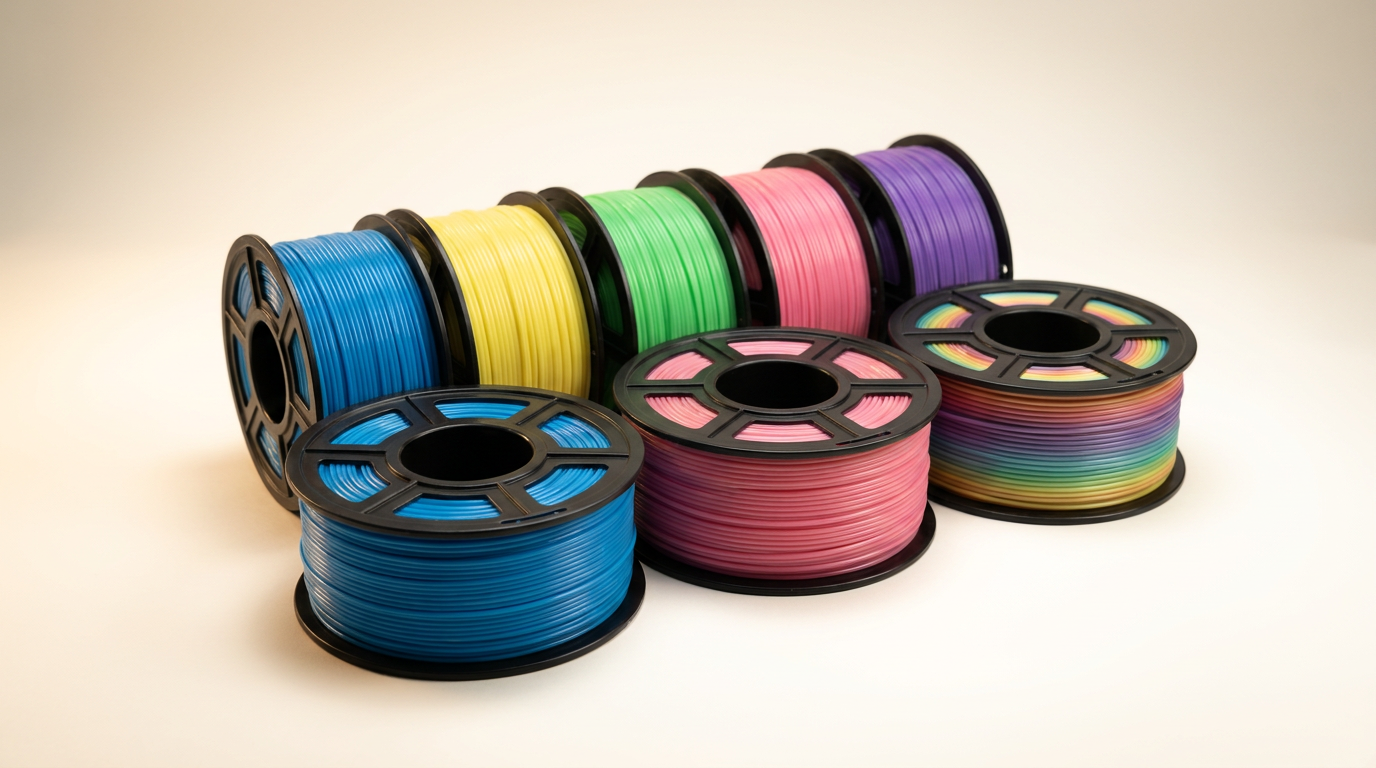
The LOVOON Tricolor filament relies on a co-extrusion manufacturing process where red, green, and blue PLA compounds are fused side-by-side into a single 1.75mm strand. The manufacturer specifies a dimensional tolerance of +/- 0.02mm, a critical threshold for preventing extrusion starvation or nozzle jams in modern tight-tolerance hotends. A notable physical design detail highlighted by buyers is the spool itself: while some product listings picture cardboard, shipped units arrive on smooth plastic flanges. For users operating enclosed automated feeding systems, this plastic spool eliminates the dust and rim friction problems frequently caused by cardboard edges during rewind cycles.
Setup & Ease of Use
Silk-modified filaments are historically prone to what can be termed the silk adhesion curve, where glossy surface agents reduce first-layer tackiness on bare print beds. LOVOON is not entirely immune to this physical reality; several users report that standard out-of-the-box PLA profiles failed to stick until they increased bed temperatures. Dialing in a heated bed to roughly 65 degrees Celsius, alongside a nozzle temperature between 220 and 230 degrees Celsius, consistently resolves these early layer issues. Once bed adhesion is secured, owners note the filament unspools cleanly and feeds without the aggressive brittleness or tangles common to cheaper decorative formulations.
Performance in Real Use
In operation, the filament exhibits an effect defined as orientation-locked aesthetics. Because the three colors travel side-by-side through the nozzle, the visual distribution across a finished part depends entirely on perimeter paths and model contours. Curved geometries, such as vases and articulated figures, show smooth, iridescent transitions as light hits different facets. Flat top surfaces, conversely, display alternating color stripes dictated by the infill raster angle. Reviewers running machines ranging from entry-level Toybox units to Bambu Lab A1 printers report minimal stringing and an absence of extrusion bubbling, provided the material remains dry.
Software & Ecosystem
Because this is physically a single-filament spool, it bypasses the slicing headaches of complex multi-color painting, purge block calculation, and filament retraction tuning. Any standard slicer profile tuned for generic silk PLA will process toolpaths normally. However, maximizing the visual output requires an intentional approach in software. Slicing with concentric surface patterns or aligning seam placement strategically helps control which color faces outward. Additionally, the spool dimensions fit neatly into popular automated feed systems like the Bambu AMS, operating smoothly without requiring printed spool adapter rings.
Value & Reliability
Priced in the $20 to $30 range for a 1-kilogram spool, LOVOON sits slightly above baseline monochrome PLA but remains competitive with specialty silk co-extrusions. The true value calculation comes from the lack of wasted material: whereas true multi-material prints often dump 30 to 50 percent of their mass into waste chutes, this co-extruded spool routes every gram directly into the object geometry. For print-on-demand shops making desk toys, decorative display pieces, or gifts, the combination of high visual appeal, predictable spool winding, and reliable feeding represents an efficient return on raw material investment.
Verdict
Buy - A reliable, zero-waste pathway to vibrant multi-colored prints without requiring multi-material hardware.
This filament is well suited for makers, educators, and small-scale craft sellers focused on visual presentation, figurines, and ornamental design. It grants single-extruder setups the ability to output eye-catching, multi-tonal objects with standard slicing profiles. Automated system owners will also appreciate the smooth plastic spool and tangle-free winding.
Functional prototype builders and mechanical engineers should pass. The additives that give silk PLA its glossy sheen inherently reduce layer shear strength, making this material unsuitable for structural brackets, functional tools, or outdoor load-bearing parts.
LOVOON Tricolor Silk succeeds because it exploits the geometry of the toolpath rather than the complexity of the hardware. It is a reminder that the fastest, cleanest way to add visual life to 3D prints is often smart polymer chemistry inside a single nozzle, rather than mechanical excess on the toolhead.
FAQ
More 3D Printing Supplies reviews
Bambu Lab 1.75mm PLA Review: The Cost of Convenience
ELEGOO Water Washable 3D Printer Resin Review: Detail vs Brittleness
SUNLU Silk PLA+ Filament Review: High Gloss, Low Friction
Siraya Tech Flex TPU Air Review

FLASHFORGE Rapid PLA Review: High-Speed Filament with Deep Color
ACESAY Glow in the Dark PLA+ Review: Novelty With Hidden Costs
This research-based review summarizes saved owner feedback and product information; it does not report physical testing.