
SUNLU 16 Color PLA Filament Bundle Review
This review is based on real experiences shared by owners in online communities.
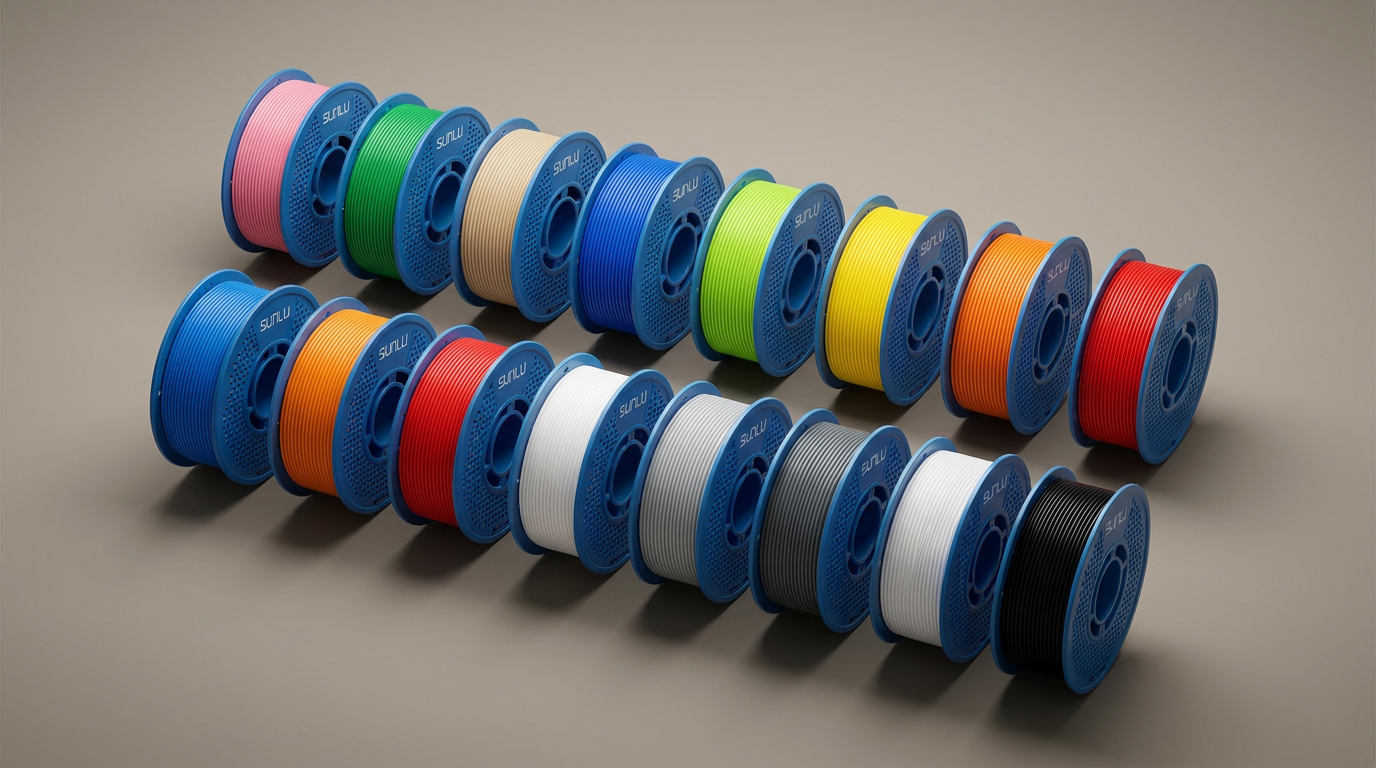
The modern maker faces an unspoken color commitment dilemma. Committing to a full one-kilogram spool of vibrant pink, olive green, or translucent orange makes little sense when an accent model only demands twenty grams of plastic. What follows is filament inventory bloat, where half-used spools slowly absorb atmospheric humidity on garage shelving. SUNLU addresses this logistical headache with its 16 Color PLA bundle, delivering four kilograms of material partitioned into compact 250-gram spools.
On paper, this mini-spool architecture is an ideal sampler for accent work and casual makers wanting immediate palette variety without overspending. It targets the hobbyist who wants to print toy figures, seasonal accents, or test multi-color slicing without investing hundreds of dollars across sixteen separate full-size rolls.
Yet downsizing the spool introduces what we call the small-spool penalty. Tight winding radiuses, non-standard spool dimensions, and spool-weight physics change how this filament behaves inside modern automated feed systems like the Bambu Lab AMS. SUNLU delivers exceptional per-gram palette diversity, but getting seamless reliability requires understanding the physical trade-offs of shrinking the spool.
What owners love
- + Broad 16-color palette without the bulk of full-size spools
- + Generous four-kilogram total capacity priced well under sixty dollars
- + Prints cleanly with vibrant saturation on standard single-extruder setups
- + Individually sealed spools reduce early moisture degradation
Common complaints
- − Requires custom printed adapters to function reliably inside AMS units
- − Noticeable batch and adhesion variance across specific color pigments
- − Tight spool hub diameter increases strand curvature and end-of-roll feed resistance
- − Inconsistent spool winding causes occasional snags and crossed loops
Design & Build
SUNLU packages this set into sixteen individually sealed 250-gram spools, totaling four kilograms of PLA. The material selection spans utility staples like black, white, and grey, while branching into transparent tones, wood PLA, and niche colors like olive green and bright pink. The physical spools themselves measure 140mm in outer diameter with a narrow 36.3mm width and a 53mm hub bore. This miniature form factor is dramatically smaller than standard 200mm diameter 1kg spools. While the reduced footprint makes storage remarkably simple, the tighter hub diameter creates significant coil memory. When filament sits tightly wound around a narrow core, it retains high internal mechanical tension. Multiple owners report that this curvature causes brittle behavior or feeding snags as the spool nears its final third, where the tight curve resists straight feeding through Bowden tubes. Furthermore, winding neatness varies across the pack. While several rolls feed without friction, user feedback highlights occasional criss-crossed loops that cause mid-print pauses when the extruder motor cannot overcome the tangled tension.
Setup & Ease of Use
Loading this filament into a traditional open-frame printer or overhead spool holder is completely straightforward. However, modern automated toolchangers tell a very different story. For users running multi-material hardware like the Bambu Lab AMS or AMS Lite, the small-spool penalty surfaces immediately. These compact 250-gram spools do not have the outer circumference or weight to rotate smoothly on the motorized rollers of an AMS system. A lightweight spool bounces, slips, and fails during automated filament retraction cycles. SUNLU acknowledges this reality, pointing users toward community-designed printable adapter rings on platforms like MakerWorld. Owners confirm that printing these adapters, typically out of PETG or PLA, is an mandatory step before loading these spools into an AMS enclosure. Having to print sixteen auxiliary rings just to use a multi-color sampler bundle introduces friction that catches unprepared buyers off guard. For multi-material enthusiasts, the bundle represents an interactive DIY preparation project before the first multi-color print even begins.
Performance in Real Use
When dialed in, the baseline mechanical and visual quality of SUNLU PLA is respectable. Standard colors such as grey, blue, black, and the clear translucent variants produce crisp layer stacking, smooth perimeter walls, and clean overhang details with minimal stringing. Surface finishes are rich and saturated, rendering tabletop miniatures and holiday models with accurate color representation. However, users encounter what can be described as a pigment variance tax. Print performance is not completely uniform across the sixteen spools. While dark and neutral colors adhere to textured PEI sheets with zero drama at default bed temperatures, owners consistently single out specific formulas, particularly the pink, yellow, and clear rolls, for poor first-layer adhesion and unexpected detachment mid-job. Adding adhesive glue or raising bed temperatures by five to ten degrees often stabilizes these temperamental pigments, but it proves that users cannot treat all sixteen spools as chemically identical clones.
Software & Ecosystem
SUNLU rates this PLA for nozzle temperatures between 210 and 240 degrees Celsius and speeds from 100 to 200 millimeters per second. In practice, default slicer profiles require minor adjustments. Makers running Orca Slicer or Bambu Studio report that generic PLA presets occasionally underextrude or struggle with flow rates on high-speed toolheads. Minor calibration of the volumetric flow rate and temperature brings consistency, but these spools do not offer plug-and-play ease for automated environments. Unlike first-party filament ecosystems, SUNLU spools carry no integrated RFID chips. Operators must manually assign filament profiles and map the correct color slots inside their slicer interfaces for every multi-material job. For users managing sixteen different colors across complex prints, this manual cataloging introduces a minor cognitive tax, requiring strict visual confirmation before committing to long multi-color prints.
Value & Reliability
Priced in the $50 to $60 range for four kilograms of total material, this bundle delivers undeniable value on raw metrics. Sourcing sixteen distinct one-kilogram spools from premium brands would easily require an outlay exceeding two hundred dollars, leaving the maker with mountains of surplus material. By offering a true desktop palette in manageable volumes, SUNLU unlocks budget multi-color exploration. The reliability trade-off lies in quality control tolerance. While most spools run cleanly from start to finish, the presence of an occasional tangled roll, brittle segment, or difficult-to-stick pigment means buyers must anticipate occasional failed prints. Furthermore, buyers report that official customer support links can be sluggish to resolve issues with individual bad spools within a pack. You accept a slightly higher margin for error in exchange for unmatched color variety at an entry-level price.
Verdict
Consider - A high-value color sampler that trades bulk storage clutter for the mechanical quirks of undersized spools.
FAQ
More 3D Printing Supplies reviews
ANYCUBIC Multicolor PLA 10KG Review: Budget Bulk Reality
ANYCUBIC PLA Filament Refill Review: Smart Spooling
ALECPEA 3D Print Glue Review: Precision Bonding for Makers
EONO3D Matte 95A TPU Review: The Layer-Hiding Flexible
SUNLU Matte Bone White PLA Filament Review: A Budget Workhorse
Fuitnerd Filament Storage Box: An Accessible Dry Storage Solution
This review is based on real experiences shared by owners in online communities.