
ANYCUBIC Multicolor PLA 10KG Review: Budget Bulk Reality
This review is based on real experiences shared by owners in online communities.
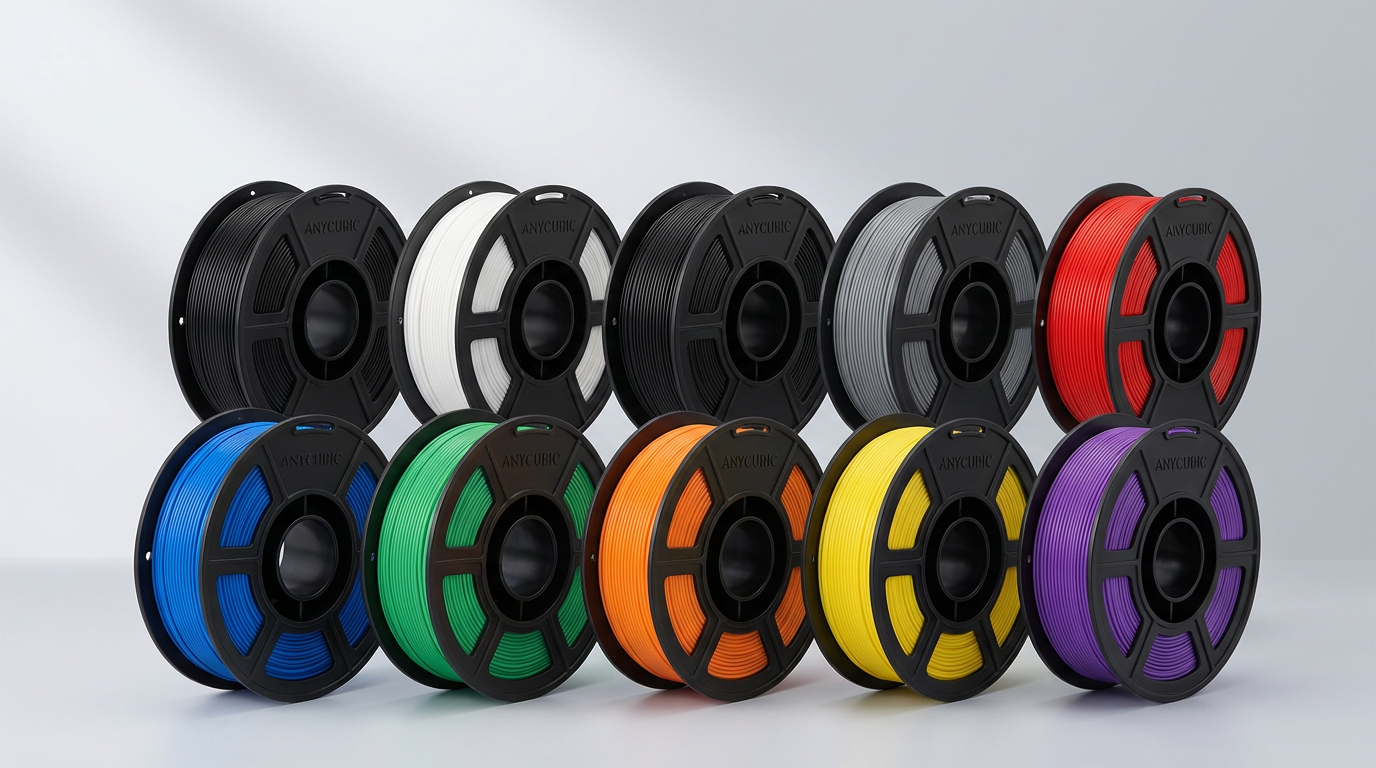
The modern desktop 3D printing workflow is increasingly dictated by automated material switchers. Upgrades like the Bambu Lab AMS, Creality CFS, and Anycubic ACE Pro have conditioned makers to keep an expansive rainbow of filament on standby. Anycubic addresses this exact demand with its 10KG Multicolor PLA bundle, pitching high print speeds, neat winding, and integrated identification chips at an attractive bulk tier in the $130 to $150 range.
Yet bulk purchasing introduces what we call the bulk-pack homogeneity myth: the expectation that ten different rolls of dyed plastic will behave identically straight out of the box. Sourcing a variety pack in a single carton amplifies minor factory variances, from spool winding tolerances to pigment-driven brittleness. A spool that glides effortlessly through a direct-drive toolhead can behave quite differently when asked to cycle through meters of Bowden tubing.
For operators running standalone print beds, this ten-spool collection provides undeniable value and respectable dimensional output. However, operators hoping for an uninterrupted multi-color printing experience will run directly into mechanical friction that marketing materials routinely gloss over.
What owners love
- + Exceptional per-kilogram value for a comprehensive ten-color starter palette
- + Smooth layer fusion and minimal stringing on standalone direct extruders
- + Deep, consistent color saturation across standard non-white hues
- + Reliable first-layer bed adhesion on properly cleaned textured PEI plates
- + Built-in smart identification support for Anycubic ACE Pro units
Common complaints
- − Frequent spool winding overlaps cause snagging and failed long prints
- − Slightly wide spool shoulders trigger clearance and retraction errors in third-party hubs
- − White filament exhibits rough diameter spots and higher clog frequency
- − Stiff polymer composition resists repeated mechanical retraction cycles
Design & Build
Anycubic distributes this bundle as ten individually sealed one-kilogram spools, each vacuum-packed with desiccant. The spools themselves are rigid plastic rather than cardboard, which prevents the dust shedding that frequently fouls enclosed feeder systems. However, spool geometry tells an important story. Several owners observe that the outer flange width is marginally broader than competing brands. While this extra width has no impact on a standard hanging spool holder, it produces slight mechanical rubbing against the internal walls of tight automated dry-boxes.
Winding quality is another area where factory execution diverges from promises. While the surface presentation appears tidy, internal wraps frequently suffer from crossed strands. Multiple owners report print stoppages halfway through a spool because tension pulled an underlying turn over the feed line. In additive manufacturing, neat winding is not a cosmetic luxury; an overlapping wrap is an immediate point of failure on unmonitored overnight runs.
Setup & Ease of Use
Setting up the Anycubic PLA bundle reveals clear baseline strengths alongside a need for proper material hygiene. The filament adheres predictably to textured PEI plates at standard bed temperatures between 55 and 60 degrees Celsius, provided the plate is thoroughly degreased with warm soap and water. Users who experience minor corner lifting almost universally resolve it with basic bed preparation rather than aggressive brim settings.
Moisture control remains mandatory. Despite the vacuum packaging, the material exhibits a somewhat rigid, brittle baseline characteristic straight out of the wrap. Running these spools through an active filament dryer before the initial print dramatically improves melt consistency and reduces snapping. For users on Anycubic hardware, the built-in identification chips automate temperature and color selection without manual entry, saving configuration steps during setup.
Performance in Real Use
On standard, single-material machines, the Anycubic PLA delivers admirable cosmetic finish. The plastic melts uniformly, producing smooth vertical walls with faint layer lines and minimal surface stringing at normal print speeds. Colors such as red, blue, and black show solid opacity and rich pigmentation across decorative models, mechanical brackets, and household organizers.
The real variance appears in what we term the white-pigment anomaly. While the darker colors flow without incident, the bundled white spool repeatedly surfaces in owner feedback as problematic. High concentrations of titanium dioxide pigment can make white PLA notably abrasive and brittle. In this bundle, the white spool displays inconsistent diameter uniformity and occasional rough spots, leading to intermittent nozzle clogs and feed pauses that never materialize with the companion colors.
Software & Ecosystem
Software profiles for standard PLA require minimal tweaking in popular slicers like OrcaSlicer, PrusaSlicer, or Bambu Studio. The standard generic PLA presets handle the thermal envelope with reasonable fidelity. The real friction emerges when integrating this material into automated multi-material systems, where users run into the retraction tax.
In systems like the Bambu Lab AMS and Creality CFS, the filament is subjected to continuous forward feeding and rapid mechanical retractions during color transitions. Owners of these multi-material units report frequent false tangle alerts, resistance errors, and binding. The filament is sufficiently rigid that repeated reverse cycling causes it to resist travel through complex tubing runs, requiring manual intervention after retractions. Direct-feed printing on those exact same printers proceeds smoothly, isolating the failure mode entirely to the automated feeder mechanics.
Value & Reliability
Priced well under $150 for ten full kilograms, this collection is unquestionably an aggressive budget proposition. Sourcing ten distinct shades individually from premium filament brands routinely costs considerably more. For high-volume hobbyists, print-farm operators, or makers printing single-color components continuously, the price-to-volume ratio easily compensates for minor spool monitoring.
Reliability, however, is bounded by how you deploy it. If you purchase this bundle expecting unassisted multi-color switching across 30-hour multi-material art pieces, the winding inconsistencies and feed resistance will cost you real time in failed prints and purged plastic. The true economic upside belongs to those running basic spool holders who need high color variety without paying premium per-spool prices.
Verdict
Consider - High-yield bulk value for single-extrusion workhorses, but frustratingly erratic in automated multi-color switchers.
This bundle makes immense sense for print-farm operators, educators, and hobbyists running open, direct-drive printers who want an instant library of vibrant primary colors on a lean budget. If your printer feeds directly from a standard external spool mount, you will enjoy clean layer lines, rich colors, and remarkably low operating costs.
Owners relying on multi-material multiplexers like the Bambu AMS or Creality CFS should steer clear. The combination of slightly oversized spool shoulders, occasional crossed winds, and mechanical stiffness creates excessive feeder resistance during high-frequency retraction routines.
Bulk-packaged filament is no longer just a question of plastic purity; it is an endurance trial for automated mechanical feeders. Until budget manufacturers standardize spool dimensions and winding precision to match modern automated feeder tolerances, high-volume multi-packs remain a functional bargain for basic printers, but a maintenance liability for automated multi-color setups.
FAQ
More 3D Printing Supplies reviews
ANYCUBIC PLA Filament Refill Review: Smart Spooling
ALECPEA 3D Print Glue Review: Precision Bonding for Makers
EONO3D Matte 95A TPU Review: The Layer-Hiding Flexible
SUNLU Matte Bone White PLA Filament Review: A Budget Workhorse
Fuitnerd Filament Storage Box: An Accessible Dry Storage Solution
SUNLU PLA+2.0 Filament Refill: An Unspooled Advantage for 3D Printing
This review is based on real experiences shared by owners in online communities.