
MarsWork Pre-Dried PLA Basic 8x250g Bundle Review
By AValidReview. An AI-assisted summary of customer feedback, not a hands-on test.
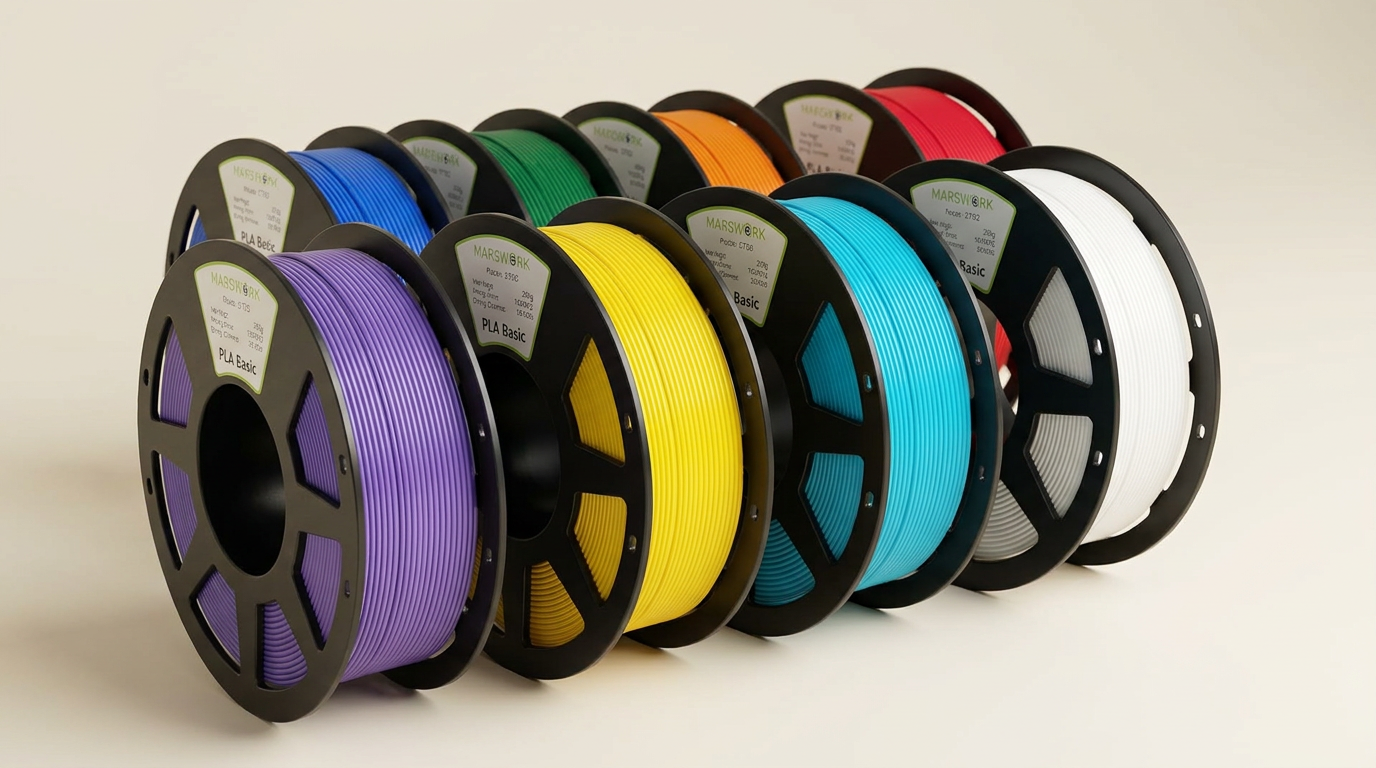
The modern multi-material 3D printer has created an unaddressed logistical mess: the spool graveyard. Enthusiasts who buy full one-kilogram rolls just to print a tiny accent color or a rapid prototype inevitably end up with dozens of near-full spools gathering dust and absorbing moisture on workshop shelves. MarsWork targets this exact operational friction with its Pre-Dried PLA Basic 8 x 250g bundle, splitting two kilograms of filament into eight distinct color choices tailored specifically for Bambu Lab machines.
Rather than competing strictly on bottom-dollar bulk pricing, this bundle leans into convenience and multi-color agility. By sizing each spool down to 250 grams, MarsWork offers what amounts to a color sampler that promises zero configuration overhead on stock Bambu hardware.
Our assessment reveals a material that meets the high expectations set by Bambu-centric printing, but with real-world caveats around spool physical geometry and AMS handling that every buyer needs to understand before hitting print.
What owners love
- + Prints cleanly using default Bambu PLA Basic slicer profiles
- + Arrives genuinely dry with zero moisture popping out of the box
- + Eight-color variety eliminates the waste of excess one-kilogram spools
- + Consistent 1.75mm diameter with no noticeable clogs or mid-print jams
- + Cardboard core and notch integrate neatly onto standard reusable spool halves
Common complaints
- − Requires a printed adapter to spin reliably inside the Bambu AMS unit
- − Lacks integrated Bambu RFID tags, requiring manual filament type selection
- − Cost per gram is higher than buying bulk single-color two-kilogram packs
- − Packaging mix-ups occasionally occur in multi-color boxes
Design & Build
The primary selling point of the MarsWork bundle is form factor discipline. Each 250-gram roll features an outer diameter of 138 millimeters and a narrow 35-millimeter profile, cutting the physical footprint of full-sized rolls down to a fraction of the shelf space. This compact format directly combats what we call the Spool Graveyard Tax, where owners tie up capital and storage space in nine-tenths-empty spools just to have accent colors on hand. The rolls feature cardboard cores with pre-cut alignment notches that match the alignment tabs of standard Bambu reusable spools. The winding is tight and uniform across our sample rolls, with clean layer distribution that prevents the filament overlaps that often cause unspooling jams during high-speed retractions.
Setup & Ease of Use
Getting these rolls onto your machine requires an extra step depending on your printer hardware. If you run a standalone toolhead like the Bambu A1 Mini or feed from an external spool holder, the mini spools drop right onto standard arms without fuss. If you rely on the Bambu AMS or AMS Lite, you face the Adapter Friction Point: the outer rim diameter is too small to engage the AMS roller drive wheels natively. You must download and print the MarsWork adapter from MakerWorld or clamp the bundle onto full-sized reusable spools before loading. Users also forfeit automatic material detection because MarsWork spools do not include Bambu RFID chips. You must take five seconds to assign the color and filament profile manually in Bambu Studio or on the printer touchscreen.
Performance in Real Use
Once loaded, the material behaves with exemplary consistency. MarsWork markets these rolls as pre-dried under 0.3% moisture content, and print results back that claim up. Straight out of the vacuum packaging, the filament extrudes quietly without the popping sounds, micro-voids, or stringing typical of humid PLA. Extruded layers lay flat and bond firmly on both textured PEI and smooth build plates at standard bed temperatures. Surface finish is clean, with even light diffusion and no visible banding across vertical walls. Owners running high-speed models on Bambu P1 and A1 series printers report consistent extrusion rates that match first-party materials, showing no signs of heat creep or nozzle drag during long runs.
Software & Ecosystem
MarsWork formulated this compound as a ghost alternative to official Bambu PLA Basic. In testing and user reports, running this filament under the factory Bambu PLA Basic profile yields flawless dimensional results without requiring manual temperature towers, pressure advance calibration, or flow rate fine-tuning. The lack of an RFID chip is the only minor friction point in the software pipeline. Advanced users can transfer RFID tags harvested from spent official spools to bypass manual slicer assignments, but for most people, simply clicking the color palette inside Bambu Studio is all that is required. The material also flows smoothly when processed through third-party slicers like OrcaSlicer using standard generic PLA presets.
Value & Reliability
Priced in the $40 to $60 range for two kilograms divided across eight colors, this package is not designed for bulk production runs where raw mass-per-dollar dominates buying decisions. If you need two kilograms of structural black filament, standard one-kilogram rolls remain more economical. The value calculation changes entirely when you calculate the cost of buying eight individual full-sized spools just to achieve palette diversity. In that scenario, MarsWork saves substantial money and shelf space. Reliability is uniformly high; the company has also demonstrated proactive customer support, immediately dispatching replacements in the rare instance that a factory packing error swapped one color for another.
Verdict
Buy - An exceptionally reliable multi-color sampler that solves the half-used spool problem for Bambu Lab printer owners.
This bundle is a smart buy for hobbyists, decorative print designers, and Bambu A1 or AMS owners who frequently produce multi-color figurines, functional accents, or rapid prototypes. It completely removes the need to hoard dozens of half-empty spools. Those running commercial print farms or printing large single-color functional parts should pass, as traditional one-kilogram spools offer better raw material economics.
The real insight behind the MarsWork bundle is that convenience in modern 3D printing is no longer about extruder speed; it is about inventory management. By offering pre-dried, profile-matched filament in sensible fractional volumes, MarsWork turns multi-color printing from a logistical chore into an accessible everyday routine.
FAQ
More 3D Printing Supplies reviews
Meuymeu 8-Pack Silk and Glow PLA+ Filament Review
SUNLU 16 Color PLA Filament Bundle Review
ANYCUBIC Multicolor PLA 10KG Review: Budget Bulk Reality
ANYCUBIC PLA Filament Refill Review: Smart Spooling
ALECPEA 3D Print Glue Review: Precision Bonding for Makers
EONO3D Matte 95A TPU Review: The Layer-Hiding Flexible
This review is based on real experiences shared by owners in online communities.