
Kretrum Glow in the Dark PLA Review: Vivid Color, Subdued Glow
By AValidReview. An AI-assisted summary of customer feedback, not a hands-on test.
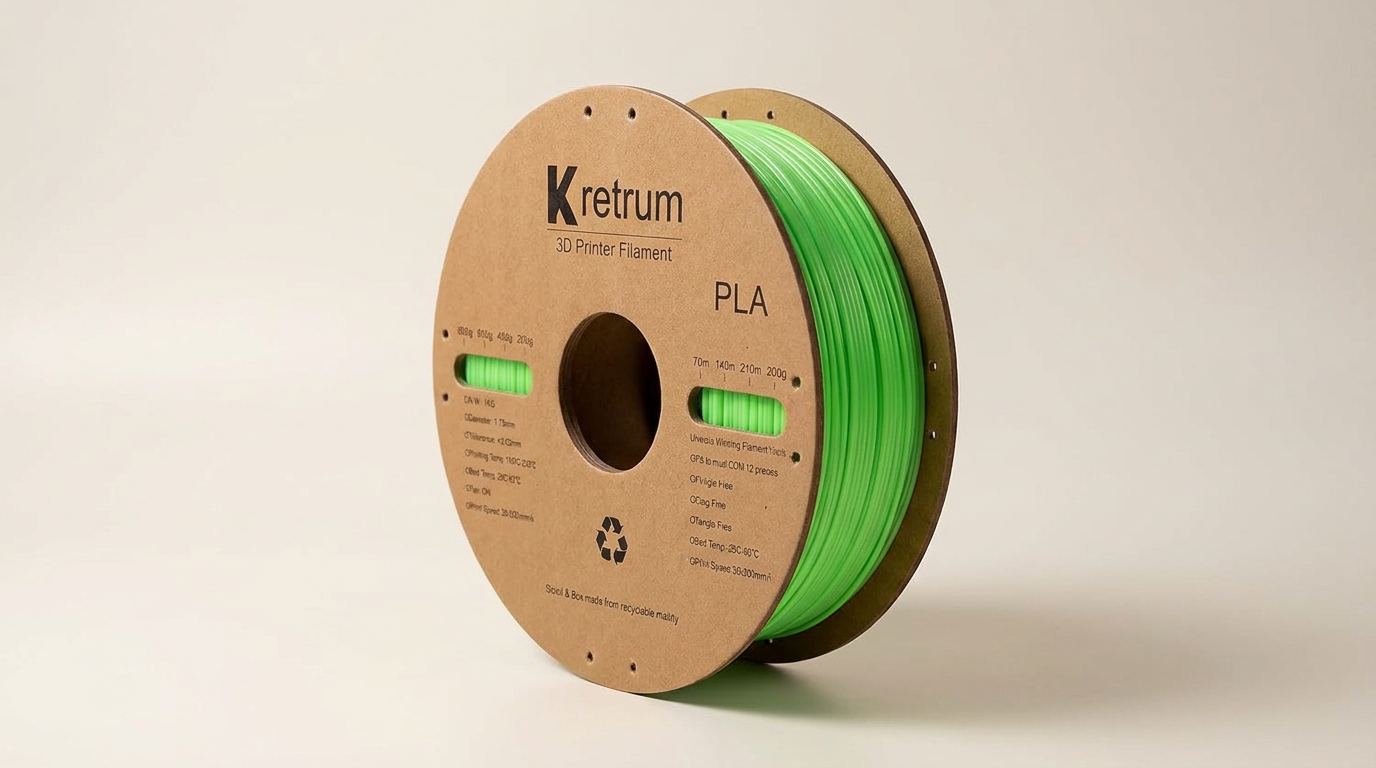
Most glow-in-the-dark filaments present an ugly daytime compromise: a dull, pale, milky plastic that yields ghostly figurines only appealing when the lights go out. Kretrum inverts that standard formula. Straight out of the vacuum seal, its spools present vibrant, semi-translucent jewel tones that look like premium decorative PLA on a sunny desktop. It prints cleanly, bridges reliably, and lays down uniform perimeters with very little slicer tweaking.
Yet that appealing daytime look triggers what we call the pigment paradox. In traditional phosphorescent materials, a translucent, unpigmented resin matrix allows ambient light to penetrate deeply and excite the luminous particles. By tinting the filament with deep blues, purples, and rich greens, Kretrum creates an internal optical filter. The dye absorbs incoming photons, choking the light before it can reach the embedded phosphors and muting the resulting luminescence.
The result is a spool of material with a split personality. Mechanically, it delivers smooth extrusion and tight dimensional stability that outclasses many cheap novelty filaments. Optically, its night mode is a subdued, fast-fading effect that frustrates buyers expecting an intense, radioactive-style beacon.
What owners love
- + Rich daytime color saturation avoids the sickly pale look of typical glow PLA
- + Tight dimensional consistency ensures predictable extrusion and bridging
- + Clean bed adhesion and low stringing across standard build plates
- + Cardboard spool construction cuts down on single-use plastic waste
- + Crisp detail reproduction with minimal warping on enclosed and open printers
Common complaints
- − Luminescence requires direct sunlight or UV blacklight to charge effectively
- − Embedded luminous particles rapidly wear down standard brass nozzles
- − Cardboard spool edges can create friction inside automated multi-material systems
- − Narrow thermal sweet spot that burns or strings if pushed past 210 degrees Celsius
Design & Build
Kretrum ships this material on an eco-friendly cardboard spool sealed inside a vacuum foil pouch with a generous desiccant pack. The physical filament measures close to its nominal 1.75 mm standard, with owner micrometer tests consistently validating the +/- 0.02 mm to 0.03 mm tolerance claim. While the filament feels slightly more brittle in hand than pure virgin PLA, snapping if folded completely in half, it unspools smoothly without persistent winding overlaps. The core structural distinction lies in the abrasive micro-additives suspended in the polymer. Those phosphorescent particles turn this spool into liquid sandpaper for standard 3D printer hardware, making a hardened steel or tungsten carbide nozzle an absolute prerequisite for anyone looking to preserve their extrusion geometry.
Setup & Ease of Use
Getting reliable first layers out of Kretrum PLA is straightforward on textured PEI and clean glass, but dialing in thermal settings requires restraint. The material runs best in a tighter thermal band than general-purpose PLA, typically between 190 and 205 degrees Celsius at the nozzle and 50 to 60 degrees on the bed. Push the hotend past 215 degrees, and the material becomes runny, prone to oozing, and emits an acrid scorched smell. Feeding reliability is generally high on standard standalone spool holders, but integration with automated feeder arrays like the Bambu AMS is mixed. The abrasive grit and raw cardboard spool edges can induce friction in tight Bowden paths, leading several owners to bypass multi-material enclosures entirely in favor of direct external feeds.
Performance in Real Use
From a purely mechanical standpoint, this filament excels at decorative output. Miniatures, cosplay props, and geometric display pieces emerge with crisp layer seams, smooth top surfaces, and support structures that detach cleanly without scarring. The trouble begins when the room goes dark. Prints charged under standard home LED ceiling fixtures produce an underwhelming, dull glimmer that fades within minutes. To coax out any meaningful luminescence, users must rely on targeted UV blacklights or direct afternoon sun, what we call UV-exclusive charging. Even when fully saturated with high-energy wavelengths, non-green variants like the blue and purple tones cast a soft, moody glow rather than a piercing light, acting more like ambient silhouette markers than vivid novelty toys.
Software & Ecosystem
Slicing for Kretrum Glow PLA requires minimal modification from default generic PLA profiles, provided retraction is tuned to prevent stringing. Retraction distances should remain conservative to avoid grinding the abrasive filament against internal extruder drive gears. Slicer fan speeds can remain at full blast after the initial layers, as the material handles bridging and steep overhangs with commendable stability. Where the ecosystem pushes back is in toolhead maintenance. Running a single kilogram of this material through a traditional brass nozzle will noticeably widen the orifice, degrading print accuracy on subsequent spools. Upgrading your printer toolpath with hardened components is an unavoidable hardware tax baked into the cost of this filament.
Value & Reliability
Priced in the $25 to $30 range per kilogram, Kretrum sits slightly above commodity PLA spools and aligns with mid-tier specialty materials. If measured strictly by phosphorescent intensity per dollar, it struggles to compete against unpigmented, classic green glow filaments that light up brighter and hold energy longer. However, if evaluated as a dual-purpose material, a vibrant, reliable daylight filament with an entertaining after-dark bonus, the value proposition stabilizes. Spool-to-spool consistency is respectable, and moisture issues straight out of the box are minimal, though prolonged storage will require a dry box to keep brittleness in check over time.
Verdict
Consider - Excellent daylight print quality paired with a finicky, subdued glow that requires dedicated UV charging.
This filament makes sense for hobbyists already equipped with hardened nozzles who want colorful, high-detail display models that look sharp under office lighting and carry a fun, subtle night-light accent. It works well for Halloween tchotchkes, tabletop scenery, and indoor safety markers where blinding brightness is unnecessary.
Pass on this spool if you rely on stock brass nozzles, depend on automated multi-material dryboxes, or expect indoor room lamps to charge your prints into bright lanterns. You will be better served by traditional pale-green specialty phosphorescent filaments.
Kretrum exposes an inescapable engineering reality of budget specialty polymers: you cannot maximize daytime pigment saturation without starving the phosphorescent chemistry beneath it. Buy it for the rich color and dependable layer lines, and treat the quiet, moody glow as a secondary perk rather than the main event.
FAQ
More 3D Printing Supplies reviews
ACESAY Glow in the Dark PLA+ Review: Novelty With Hidden Costs
MarsWork Pre-Dried PLA Basic 8x250g Bundle Review
Meuymeu 8-Pack Silk and Glow PLA+ Filament Review
SUNLU 16 Color PLA Filament Bundle Review
ANYCUBIC Multicolor PLA 10KG Review: Budget Bulk Reality
ANYCUBIC PLA Filament Refill Review: Smart Spooling
This review is based on real experiences shared by owners in online communities.