
SUNLU Filament Connector Review: Maximizing 3D Printer Filament Utility
This review is based on real experiences shared by owners in online communities.
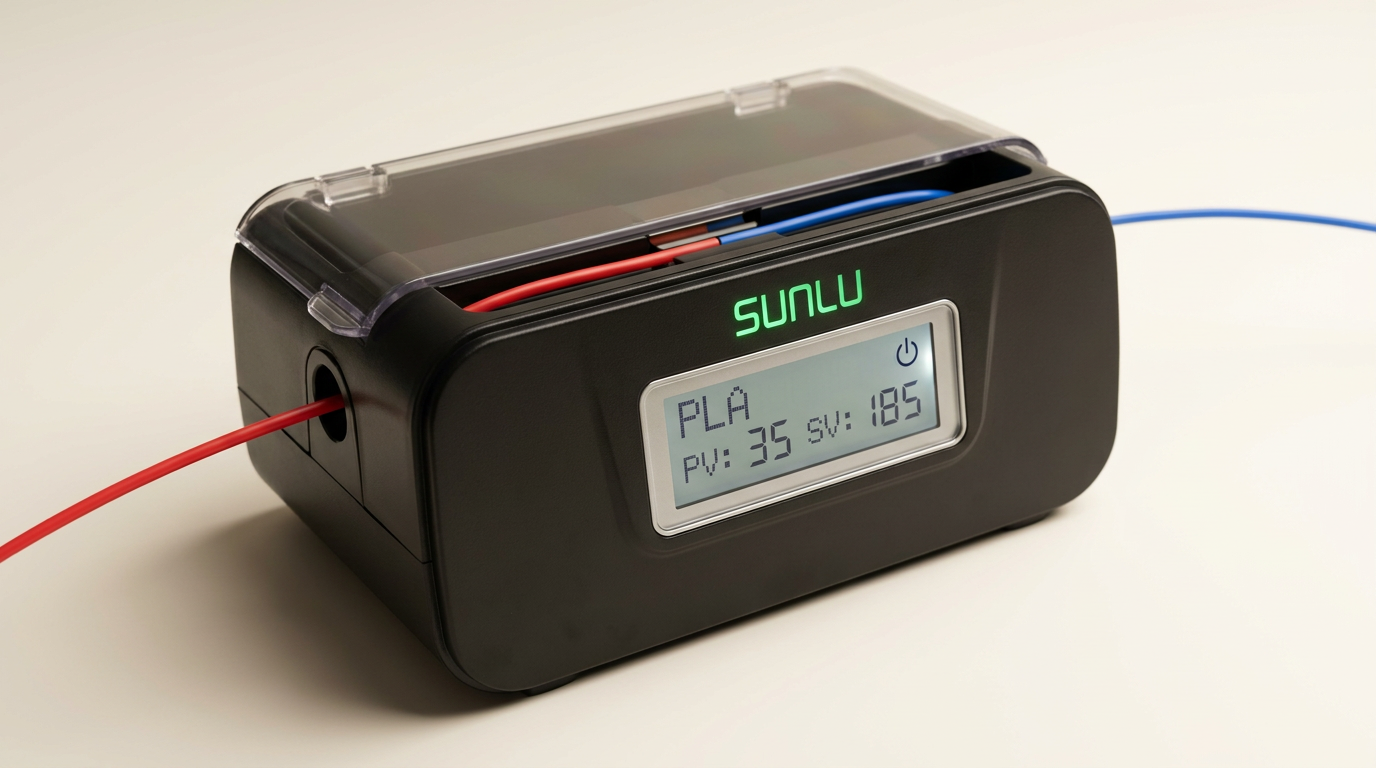
The 3D printing landscape has, for years, grappled with filament waste, a persistent economic and environmental inefficiency. While many users prioritize print quality and speed, the accumulation of short, unusable filament lengths often goes unaddressed until the 'scrap bin' overflows. The SUNLU Filament Connector emerges as a direct response to this often-overlooked problem, not just by facilitating the fusion of nearly depleted spools, but by subtly encouraging a more experimental approach to multi-color printing. This small device positions itself as a tool for practicality and creative liberty, challenging the traditional single-spool workflow.
Unlike sophisticated multi-material extruders or intricate AMS systems, the SUNLU connector offers a low-cost, low-complexity solution for filament utilization. Its design targets the immediate problem of remnant filament, providing a localized thermal splice. What it lacks in direct printer integration, it aims to compensate for in accessibility and immediate impact on material consumption. The true test, however, lies in its ability to consistently produce strong, dimensionally stable joins that do not compromise subsequent print processes.
This review evaluates whether the SUNLU Filament Connector delivers on its promise of waste reduction and creative potential, or if its simplicity introduces a new set of usage hurdles. We examine its build, operational workflow, and real-world performance, focusing on the practical implications for hobbyists and makers seeking to optimize their material efficiency.
What owners love
- + Significantly reduces filament waste by joining remnant spools
- + Allows for multi-color prints by splicing different filaments
- + Heats up quickly, facilitating rapid splicing operations
- + Compact and easily portable, even supporting battery pack use
- + Works effectively with common filament types like PLA, PETG, and ABS
- + Includes a large supply of PTFE sleeves for many connections
Common complaints
- − Requires a learning curve and practice for consistent, reliable joins
- − Manual handling during splicing can be awkward, often requiring multiple hands
- − Splices may create bulges if not handled carefully, potentially hindering printer feeding
- − Some users report instructions are unclear or incomplete, particularly regarding timing
- − The supplied PTFE sleeves are short, increasing distortion risk during cooling
Design & Build
The SUNLU Filament Connector presents as a compact, card-deck sized device, suggesting a priority on portability and minimal footprint. Owners consistently describe its physical presence as smaller than anticipated, reinforcing its design as a peripheral tool rather than a bulky workbench fixture. The unit arrives with a USB cable and PTFE sleeves, but notably omits a power adapter, necessitating a 5V 2A supply from the user. While the build quality is generally regarded as robust enough for its intended light-duty use, the core design revolves around a heated splicing chamber and a mechanism for pressing filament ends together. The visual window and display screen are appreciated additions, providing feedback on the splicing process. The inclusion of 200 PTFE sleeves acknowledges the potential for trial and error, particularly during the initial learning phase, suggesting the manufacturer anticipates a certain rate of imperfect joins.
Setup & Ease of Use
Setting up the SUNLU connector is straightforward from a power perspective, requiring only a compatible USB power source. However, the operational setup and achieving successful splices introduce a notable 'practice tax.' Many users report an initial period of trial and error before consistently strong, clean joins are achieved. Key to success involves cutting filament ends at a 45-degree angle, aligning them within the thin PTFE sleeve, and carefully managing pressure during the heating and bonding stages. Owners frequently mention the difficulty of holding two filament ends and the device simultaneously, often wishing for a 'third hand' or a dedicated jig. This user-interface friction is a common theme, indicating that while the concept is simple, the execution requires focused manual dexterity and a refinement of technique. The instructions are occasionally cited as incomplete or misleading, compounding the learning curve.
Performance in Real Use
When used correctly, the SUNLU Filament Connector excels at its primary function: melting and joining 1.75mm filament. Owners report strong bonds that hold up during subsequent printing, effectively merging partial spools into usable lengths. PLA, PETG, and ABS are frequently mentioned as successfully spliced, with some caveats for specific materials like PET which may not fuse as cleanly. The device heats rapidly, taking approximately three minutes to reach target temperatures. The "filament consolidation" is its core strength, empowering users to extract maximum utility from every roll. However, the consistency of the splice remains critical. Misaligned or overly-pressed joins can create bulges that obstruct filament pathing within a printer, particularly in sensitive direct drive or AMS systems. This often necessitates either careful post-processing or re-splicing, introducing an element of design for printability that is not immediately obvious.
Software & Ecosystem
The SUNLU Filament Connector operates as a standalone, purpose-built heating tool with no software component or broader digital ecosystem. Its functionality is entirely manual, relying on user input for temperature selection and physical manipulation during the splicing process. The absence of integrated automation means the user is responsible for managing filament alignment, pressure, and removal timing. While this simplicity avoids software complexities, it places the entire burden of precise execution on the operator. Owners occasionally wish for features like an integrated filament holder or a more robust cooling jig, suggesting opportunities for aftermarket or manufacturer-provided physical accessories to enhance usability and reduce the 'three-hand' problem. The included PTFE sleeves are consumable, making them a recurring expense for heavy users, though their quantity makes this less of an immediate concern.
Value & Reliability
Priced around $40, the SUNLU Filament Connector is generally regarded as a valuable tool, offering significant returns in avoided filament waste. Many consider it an indispensable item for a 3D printing hobbyist, particularly those with a collection of partial spools. The device's reliability hinges on consistent user technique; the tool itself is robust, but the quality of the splice depends almost entirely on the operator's skill. The high number of included PTFE sleeves also adds to its initial value proposition, extending the period before consumable replenishment is necessary. While the learning curve is real, owners confirm that with practice, the device consistently produces usable joins. Its ability to create multi-color filaments from scraps also adds an element of creative value beyond simple waste reduction. For the investment, the return on filament utilization makes it a compelling purchase for many.
Verdict
Buy - This tool effectively repurposes filament waste, offering substantial material savings over time.
The SUNLU Filament Connector is an excellent purchase for any 3D printer owner who frequently finds themselves with small, unusable lengths of filament. If you prioritize material efficiency, enjoy experimenting with multi-color prints without a multi-material system, and are willing to invest a small amount of time to master its manual operation, this device merits its cost, which is under $50. Those who frequently print delicate models or demand absolute dimensional precision from their filament without any manual intervention might find the initial learning curve frustrating. It is less suitable for users with minimal filament waste or those exclusively printing with very expensive, specialized materials where any splice imperfection could be catastrophic.
The SUNLU Filament Connector represents a micro-innovation in an accessory market often dominated by iterative printer upgrades. It addresses the 'fragmented filament problem' directly, a common pain point few other affordable solutions target with such focused design. This device highlights a growing trend towards granular optimization in 3D printing, where efficiency is not just about faster print speeds, but about extracting every last gram of utility from every consumable, ushering in an era of practical sustainability for the home maker.
FAQ
More 3D Printing Supplies reviews
Kretrum Silk Dual Color PLA Filament Review: Vibrant Aesthetics for 3D Printing
eSUN High Speed PLA+ Filament Review: The Workhorse for Fast Printers
SUNLU PETG Filament 4kg Review: The Bulk Workhorse for High-Volume Prints
Deeplee PLA+ 2.0 Filament Review: A Workhorse Material for 3D Printing
FLASHFORGE Rapid PLA: The 'Stealth Performance' Filament
RAMBERY Silk Dual Color PLA Filament Review: Aesthetic Impact for Small Prints
This review is based on real experiences shared by owners in online communities.