
Polymaker PolyLite ABS Filament Review: The Printer's Choice ABS
This review is based on real experiences shared by owners in online communities.
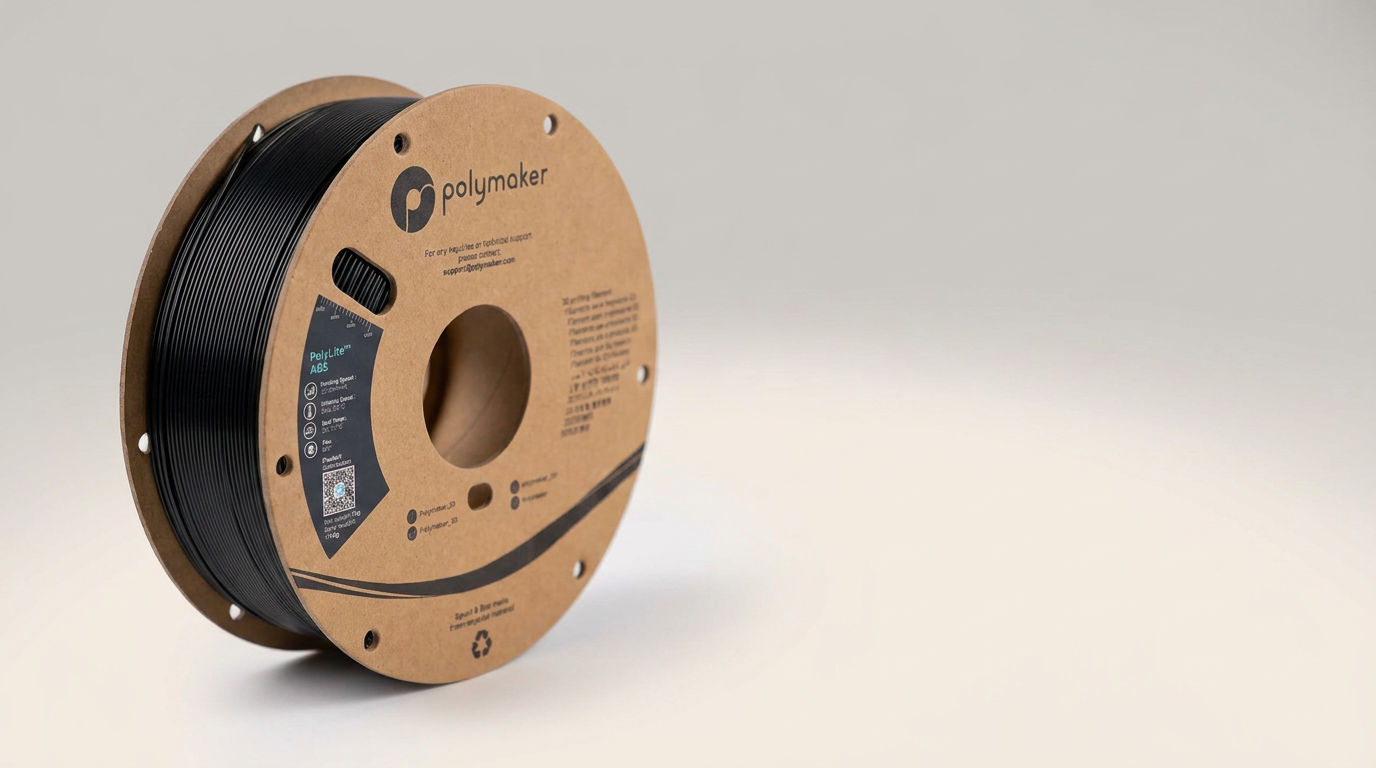
In a 3D printing landscape increasingly dominated by PLA's user-friendliness, ABS filament often presents a "printer's choice" dilemma. Its superior mechanical properties and heat resistance come with known printing challenges like warping and strong odors, frequently leading enthusiasts to avoid it. Polymaker's PolyLite ABS seeks to bridge this gap, promising enhanced stability and a more manageable printing experience without sacrificing ABS's inherent strengths.
Historically, achieving consistent results with ABS required specific hardware and advanced user knowledge. Polymaker aims to simplify this, leveraging a specialized bulk-polymerized resin to reduce volatile content. This review examines how well PolyLite ABS lives up to its promise, evaluating its real-world performance against the common frustrations of ABS printing, and determining if it truly offers a more accessible pathway to durable, functional parts.
Our analysis reveals a filament that performs reliably within its intended parameters, demonstrating what we term the "enclosure economy." This concept highlights how the true value of PolyLite ABS becomes evident when paired with the proper printing environment, transforming a challenging material into a dependable workhorse for functional applications.
What owners love
- + Consistent print quality with reliable layer adhesion
- + Noted for significantly lower odor compared to other ABS filaments
- + Minimal warping when printed with appropriate settings and enclosure
- + Good dimensional accuracy, facilitating functional part assembly
- + Durable and strong, suitable for high-stress applications
- + Offered in a range of consistent, rich colors
Common complaints
- − Still requires a heated bed and enclosure to prevent warping
- − Cardboard spools are prone to damage, impacting AMS compatibility
- − Not explicitly a high speed/flow material, limiting some applications
- − Adhesion to print bed can be less forgiving than PLA or PETG
- − Requires proper drying and humidity control for optimal performance
Design & Build
The Polymaker PolyLite ABS filament arrives in vacuum-sealed packaging with desiccant, aimed at ensuring moisture-free material. Owners frequently commend the consistent winding of the filament onto the spool, noting a lack of tangles or snags, which is crucial for uninterrupted printing. The spools themselves are cardboard, a design choice intended for sustainability. While the filament quality within is consistently praised, the cardboard spools represent a "materiality paradox." This is the tension between an eco-conscious material choice and its practical fragility in shipping, with multiple users reporting damaged spools that prevent use in automated material systems (AMS).
Setup & Ease of Use
Setting up Polymaker PolyLite ABS for successful printing involves adherence to standard ABS best practices, which is typical for the material class. Users consistently report that an enclosure and a heated bed capable of reaching at least 100°C are necessary to mitigate warping, particularly for larger parts. Initial adhesion issues are sometimes encountered, suggesting a slightly steeper learning curve compared to more forgiving materials like PLA. However, once settings are dialed in for a specific printer and environment, the filament is described as relatively easy to print. The lower odor profile, a significant design feature, contributes positively to the user experience, making ABS printing more tolerable in shared spaces.
Performance in Real Use
In day-to-day operation, the PolyLite ABS exhibits strong performance characteristics. Owners frequently highlight its excellent layer adhesion and minimal stringing, resulting in robust, functional prints. The material's durability and heat resistance are consistently validated through applications ranging from speaker adapters to full-scale 3D printer components. While some report exceptional warp resistance even without an enclosure, the consensus emphasizes that a controlled thermal environment is key to unlocking its full potential. The material readily accepts post-processing like sanding and acetone smoothing, enhancing its versatility for finished parts. This consistent performance, particularly its resistance to common ABS pitfalls, defines Polymaker's "reliability premium," where the product consistently delivers on its core promise despite the inherent challenges of the material type.
Software & Ecosystem
Polymaker PolyLite ABS does not rely on proprietary software or a closed ecosystem, integrating seamlessly with standard slicer profiles and a wide array of 3D printers. Users across various printer brands, including Bambu Lab P1S, Qidi i-fast, and Flashforge Creator Pro, report successful outcomes using either stock ABS settings or Polymaker's recommended profiles. This brand agnosticism is a significant advantage, allowing it to be a flexible choice for users who operate diverse hardware. The availability of consistent material specifications further aids users in calibrating their machines and profiles, reinforcing its role as a reliable, open-system filament.
Value & Reliability
Polymaker PolyLite ABS commands a price point that places it in the mid-range of ABS filaments, generally around the upper teens per kilogram. Owners largely consider this a worthwhile investment, citing the consistent quality, reliable performance, and reduced printing frustrations. The filament's dimensional accuracy contributes to functional parts fitting together precisely, adding to its overall utility and perceived value. The high praise for its low odor and consistent printing behavior, even compared to more expensive or brand-specific alternatives, underscores its strong value proposition. The frequent mention of it becoming a 'go-to' or 'default' ABS filament for many users indicates a high level of earned trust and long-term reliability.
Verdict
Buy - Polymaker PolyLite ABS offers a consistently reliable and more manageable ABS printing experience for functional parts.
This filament is a strong choice for users who require the mechanical properties of ABS, such as impact and heat resistance, but seek to minimize typical printing difficulties. It is particularly well-suited for owners of enclosed 3D printers or those willing to invest in a controlled printing environment. Users upgrading from PLA or PETG to ABS for the first time will find its lower odor and reduced warping more forgiving than many alternatives. Those printing critical functional components or enclosures where dimensional accuracy and durability are paramount will find the price, which is typically under $20, justified by the consistent results.
Conversely, users who print exclusively with open-frame printers without effective enclosures, or those unwilling to fine-tune settings for an ABS material, should consider other options. The "enclosure economy" principle means that without proper thermal management, the benefits of this filament are significantly diminished. This PolyLite ABS is not a casual, plug-and-play material for all printers. It requires a commitment to its specific environmental demands, but for those who meet it, Polymaker has engineered an ABS that elevates the material from a niche challenge to a mainstream workhorse for the hobbyist and professional alike.
FAQ
More 3D Printing Supplies reviews
SUNLU Matte Bone White PLA Filament Review: A Budget Workhorse
Fuitnerd Filament Storage Box: An Accessible Dry Storage Solution
SUNLU PLA+2.0 Filament Refill: An Unspooled Advantage for 3D Printing
Polymaker Panchroma PLA Filament Review: Consistent Prints, Vivid Colors
Kretrum Silk Dual Color PLA Filament Review: Vibrant Aesthetics for 3D Printing
eSUN High Speed PLA+ Filament Review: The Workhorse for Fast Printers
This review is based on real experiences shared by owners in online communities.