
Polymaker ASA Filament Review: Durable Outdoor Prints, Low Hassle
This review is based on real experiences shared by owners in online communities.
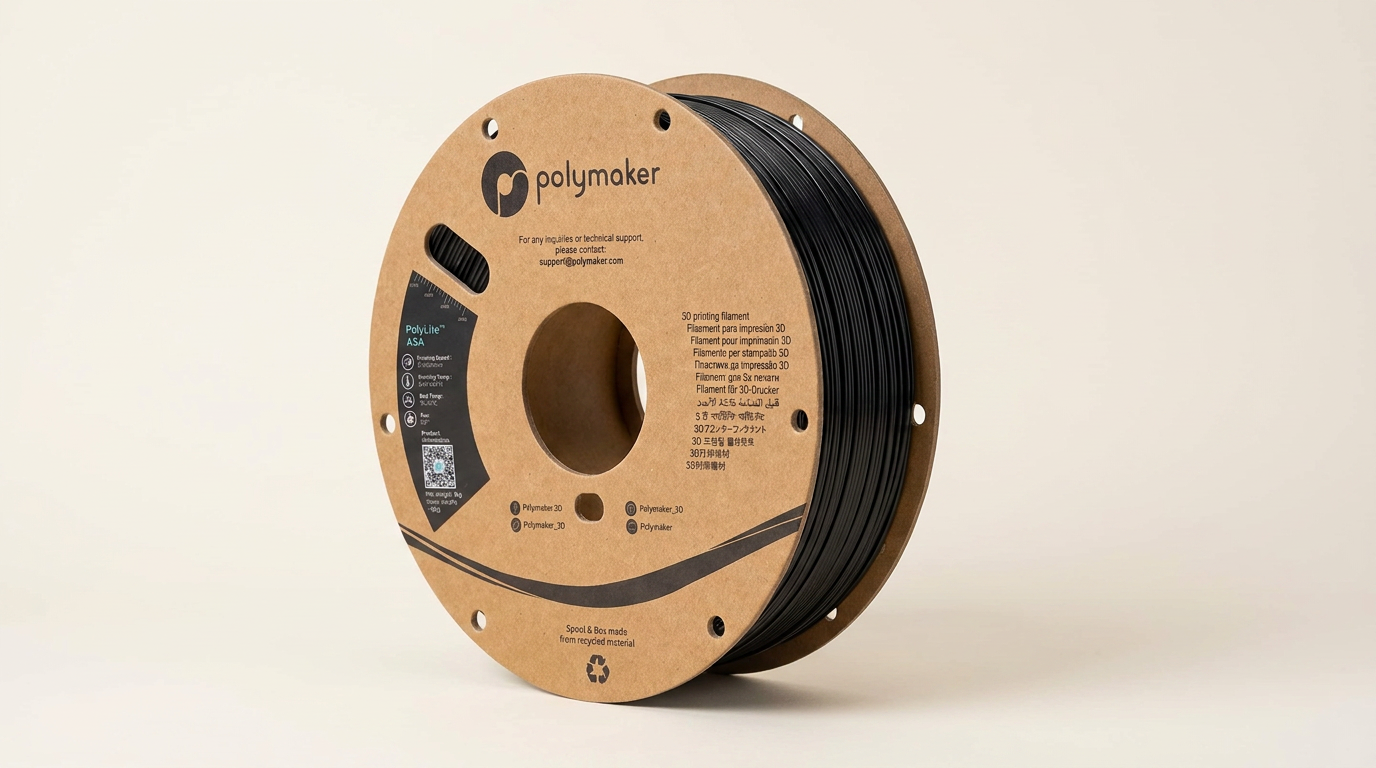
In a 3D printing landscape increasingly dominated by ease-of-use plastics like PLA and PETG, high-performance materials often require a significant commitment from the user, demanding specialized hardware and extensive tuning. ASA, a styrene-based polymer known for its UV and heat resistance, has historically belonged to this challenging category. Polymaker's ASA filament, however, carves out a niche by offering the material's core benefits without the customary deep dive into troubleshooting. This positions it not just as another ASA option, but as a gateway material for users seeking to expand their functional printing capabilities beyond standard plastics.
Most buyers approach ASA with a degree of trepidation, anticipating difficult adhesion, significant warping, and noxious fumes. What Polymaker delivers instead is a surprisingly approachable experience, reducing the typical 'ASA learning curve' to a series of minor adjustments for many. This makes it a compelling choice for those ready to move past prototyping into durable, end-use parts, particularly for outdoor applications, without needing to become an expert in advanced material science.
What owners love
- + Prints consistently with minimal warping or adhesion issues
- + Excellent UV and heat resistance for outdoor functional parts
- + Good layer adhesion and impact resistance for durable prints
- + Generally less odorous than other ABS-like filaments
- + Compatible with Bambu Lab printer profiles for easy setup
- + Well-wound cardboard spools prevent tangling
Common complaints
- − Requires an enclosed printer and heated bed for best results
- − Residual styrene fumes necessitate proper ventilation
- − Limited color options compared to other filament types
- − Prints slower than PLA or PETG for optimal quality
- − Cost is higher than common PLA or PETG filaments
Design & Build
Polymaker ASA filament consistently receives praise for its quality and physical consistency. Owners report neatly wound spools that prevent tangling, a common frustration with lesser filaments. The shift to a fully recycled cardboard spool and box is noted, aligning with sustainable packaging trends. The material itself offers a matte finish, which many users find desirable for functional parts. While specific dimensional tolerances are not universally quantified by owners, the recurring theme is a filament that feeds smoothly and consistently, contributing to reliable extrusion. This attention to mechanical consistency in the manufacturing process is a foundational element for reproducible prints, especially with more demanding materials.
Setup & Ease of Use
The general consensus among owners is that Polymaker ASA mitigates many of the difficulties typically associated with printing ASA. While it is not a 'plug and play' material like PLA, it notably reduces the advanced filament entry barrier. Most users report a manageable learning curve, often requiring only minor adjustments to bed temperature, nozzle temperature, and print speed. Enclosure is a recurring requirement, with some users even pre-heating chambers to 40°C or 45°C. Bed adhesion is frequently cited as strong, particularly on textured PEI plates, with parts often self-releasing upon cooling. For many, simply applying standard ABS settings or utilizing pre-configured profiles for advanced printers, such as those from Bambu Lab, provides immediate, successful results. This 'profile-driven printability' is a significant factor in its ease of adoption.
Performance in Real Use
In functional applications, Polymaker ASA performs reliably. Its primary benefit, excellent weather resistance, is frequently confirmed, with prints enduring outdoor exposure for months without significant degradation, warping, or cracking. High heat resistance is also validated, making it suitable for parts exposed to elevated temperatures. Mechanical properties such as toughness, impact resistance, and strong layer adhesion contribute to durable, robust parts. Many owners use it for demanding applications like custom Starlink mounts, car accessories, or even critical components for other 3D printers. The 'functional stability threshold' of this material is high, meaning it maintains its integrity and dimensions under stresses that would compromise less robust plastics. The print quality itself, including surface finish, bridging, and overhangs, often exceeds user expectations for an ASA.
However, it's important to acknowledge what can be termed as the 'enclosed environment tax.' While easier to print than many ASAs, it still unequivocally demands an enclosed print volume to control ambient temperatures and minimize warping, especially for larger parts. This is not a suggestion but a prerequisite for consistent success. Furthermore, the styrene off-gassing, although described as less pungent than some ABS, is still present and requires adequate ventilation. This is a fundamental characteristic of the material class, and active management of fumes is non-negotiable for user safety.
Software & Ecosystem
Polymaker ASA benefits from strong compatibility across leading 3D printing platforms. Many users of Bambu Lab printers, for example, report excellent results using the manufacturer's own generic ASA profiles, sometimes even preferring Polymaker over Bambu's proprietary filament. This suggests a filament formulation that closely adheres to common material property assumptions made by leading slicer software. The use of standard ABS-like settings is a reliable starting point for tuning, even without direct software profiles. This broad compatibility reduces the 'ecosystem lock-in' that can deter users from experimenting with advanced filaments, as it does not demand specialized, brand-specific settings to perform well.
Value & Reliability
Polymaker ASA is consistently cited as a strong value within its material category. While it commands a higher price than common PLA or PETG, owners routinely describe it as 'worth every penny' due to its reliability and the superior properties it offers for specific applications. The 'cost of tuning' for this filament is notably low, meaning users spend less time and wasted material on failed prints or extensive calibration. For those producing functional parts where failure is not an option, this reliability translates directly into efficiency and reduced total project cost. Long-term users who have processed many kilograms of this filament often highlight its spool-to-spool consistency, confirming that its quality is maintained across batches. This consistency is a hallmark of a mature manufacturing process.
Verdict
Buy - Polymaker ASA filament delivers a surprisingly accessible entry point to high-performance outdoor 3D printing.
This filament is an excellent choice for users who require durable, heat, and UV-resistant parts for outdoor applications, and who already possess an enclosed 3D printer. Those looking to bridge the gap from PETG to more robust engineering plastics will find its printability forgiving and its performance consistent. While its price point is above typical consumer filaments, its reliability and reduced tuning time make it a sound investment for serious makers and small-scale producers. Conversely, beginners without an enclosed printer or those primarily printing decorative items will find this material overly demanding and expensive.
Polymaker ASA represents the 'democratization of durability' in 3D printing. It takes a material traditionally reserved for experienced users with highly optimized setups and makes it broadly achievable for a wider base, particularly with the proliferation of enclosed consumer printers. This filament suggests a future where high-performance materials are not just for specialists but become a standard option, lowering the barrier to entry for truly functional additive manufacturing.
FAQ
More 3D Printing Supplies reviews
FLASHFORGE Rapid PLA: The 'Stealth Performance' Filament
RAMBERY Silk Dual Color PLA Filament Review: Aesthetic Impact for Small Prints
eSUN PLA+ Filament: The Go-To Choice for High-Speed 3D Printers
SUNLU High Speed PETG Filament Review: The 'Dry-First Economy' Advantage
ERYONE Silk Filament PLA+ Review: The Glossy Aesthetic Standard
ELEGOO Matte PLA Filament Bundle Review: A Premium Material on a Budget
This review is based on real experiences shared by owners in online communities.