
OVERTURE Rapid PETG Filament: A New Baseline for High-Speed 3D Printing
This review is based on real experiences shared by owners in online communities.
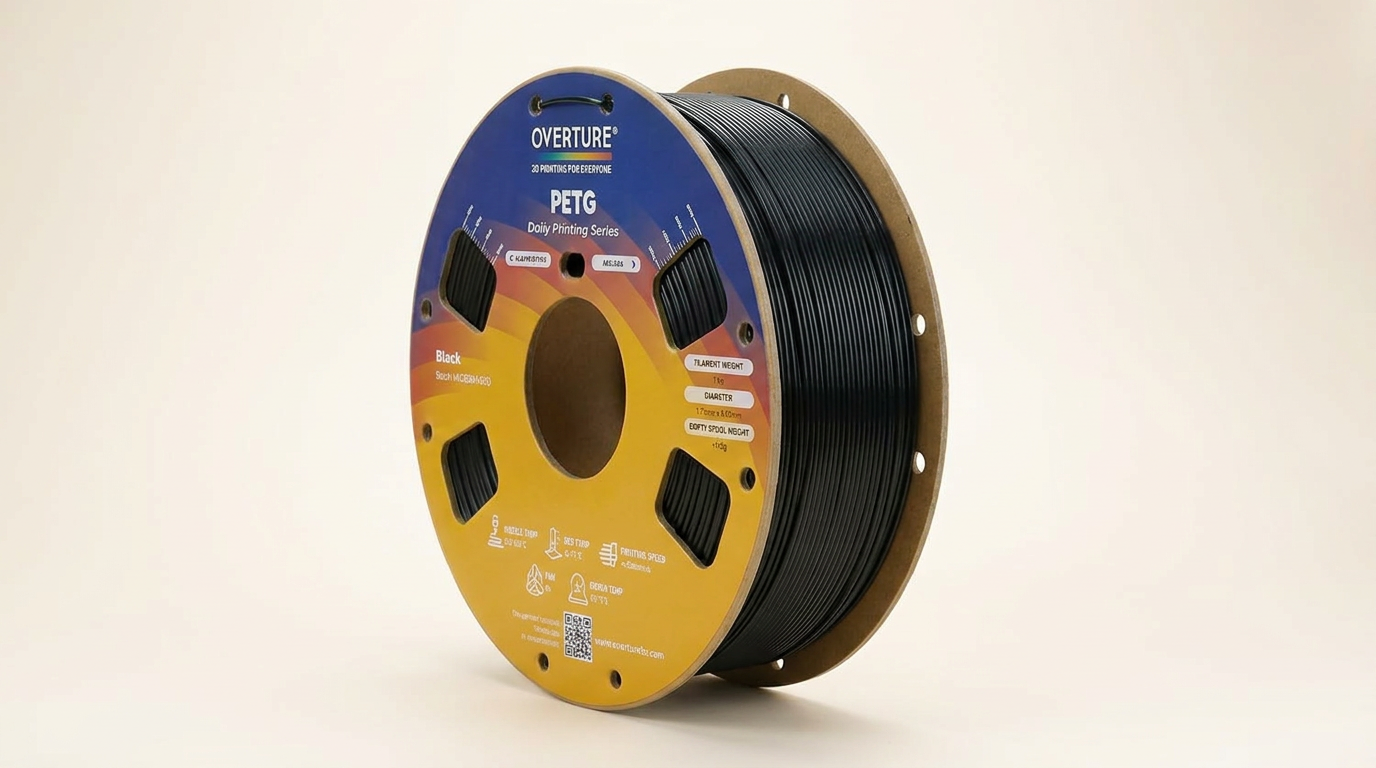
The modern 3D printing landscape, particularly with the advent of high-speed machines, often highlights a performance gap in traditional filaments. While printers accelerate, many materials struggle to keep pace, leading to print failures or compromised quality. OVERTURE's Rapid PETG filament enters this environment with a declared focus on flow consistency at elevated speeds, aiming to address what we call the "speed-tolerance paradox" that plagues many general-purpose filaments.
This review evaluates whether OVERTURE's High Speed PETG lives up to its claim of bridging that gap. We examine how it performs under high flow rates, its usability across various FDM printers, and its overall reliability, drawing from extensive user feedback.
Our assessment reveals a filament that often redefines expectations for PETG's printability, particularly for functional applications where speed and material properties intersect. It suggests a potential shift in what users can expect from this material category when paired with capable hardware.
What owners love
- + Consistent high-flow melt dynamics reported by users with rapid printers.
- + Excellent layer bonding and reduced delamination at higher speeds.
- + AMS friendly and consistently tangle-free winding for multi-material systems.
- + Reliable bed adhesion that facilitates easy removal post-print.
- + Strong, functional prints suitable for mechanical and structural parts.
- + New formula offers improved melt characteristics and flow rates.
Common complaints
- − Some users report moisture issues straight out of the vacuum-sealed package.
- − Can be more brittle than some comparable PETG filaments, affecting part durability.
- − Achieving optimal transparency with clear variants requires significant tuning and slower speeds.
- − Color variations exist, with some metallics being unexpected or deviating from imagery.
- − Requires proper calibration and settings adjustments, especially among newer users or varied machines.
Design & Build
The OVERTURE Rapid PETG filament focuses on a revised chemical formulation designed for high-speed extrusion. This is not merely about physical dimensions but about molecular flow under rapid melt conditions, aiming for a consistent volumetric output. Owners of high-velocity printers specifically highlight the "flawless high-flow melt dynamics" and absence of "speed gaps." This suggests the material itself is engineered to reduce internal friction and viscosity changes that typically cause underextrusion or poor layer adhesion at speed. The neat winding is a consistent point of praise, with several users reporting it prevents tangles and jams, especially critical for multi-material systems. This attention to spooling detail represents a practical consideration often overlooked, yet it directly impacts print success and user frustration, particularly for long or overnight print jobs.
Setup & Ease of Use
Despite its "rapid" designation, setting up and achieving optimal prints with OVERTURE Rapid PETG requires calibration. While some experienced users found it "easy to print," particularly on newer machines like Bambu Lab A1s or P2Ss with generic PETG profiles, others noted a "learning curve." The filament generally responds well to nozzle temperatures between 230-260°C and bed temperatures around 65-70°C. A recurring theme, however, is the need to address moisture. Several owners, even those familiar with filament handling, found the material to be "wet" straight out of the vacuum package, necessitating drying for 8 hours or more to eliminate stringing and improve print quality. This pre-print conditioning adds an initial step that can surprise users accustomed to ready-to-print filaments, highlighting a potential "first-layer tax" where initial setup time is disproportionately higher to get reliable results.
Performance in Real Use
This PETG excels in producing strong, functional parts. Owners consistently report excellent layer adhesion and overall print integrity, making it suitable for structural brackets, machine parts, and other components requiring durability. The material's ability to maintain a consistent gloss at higher temperatures is also noted. While marketed for high-speed, a nuanced picture emerges regarding actual print speeds: some users push it effectively to 300mm/s, while others found their "sweet spot" closer to 38mm/sec for walls to avoid stringing, suggesting machine and specific print geometry play a significant role. The transparent variants, while visually appealing, face the common PETG challenge of achieving true clarity, often requiring significantly slower speeds and 100% infill. This indicates a "clarity ceiling" where material properties impose practical limits on aesthetic outcomes, even with advanced tuning. The filament also performs well as a support interface, detaching cleanly from PLA and ABS.
Software & Ecosystem
OVERTURE Rapid PETG does not rely on a proprietary software ecosystem, functioning with standard slicers like Cura and Bambu Handy. Users recommend creating custom filament profiles within these slicers, particularly for specific machines or desired aesthetic outcomes, such as achieving maximum clarity with transparent variants. The manufacturer provides recommended parameters, but user feedback confirms that fine-tuning is often necessary to optimize outcomes. The filament's compatibility with AMS (Automatic Material System) units is frequently praised, with users reporting smooth loading and tangle-free operation, which enhances the reliability of multi-material prints and automated production workflows. The open compatibility model allows users flexibility, but also places the burden of granular calibration on them.
Value & Reliability
Priced around $15 per kilogram, OVERTURE Rapid PETG is positioned as a competitive option for its performance characteristics. Its reliability in terms of consistent extrusion and tangle-free winding are frequently cited as strong points, contributing to successful long prints and reducing material waste. Many consider it a "good buy" and "excellent quality" for its price range. However, reliability is sometimes contingent on initial conditioning. The presence of moisture in newly opened spools, while not universal, is a recurring enough complaint to warrant attention. While often easily remedied with drying, it represents an inconsistency in out-of-the-box readiness. For many, the high print quality for functional parts outweighs this occasional inconvenience, solidifying its reputation as a dependable workhorse once dialed in.
Verdict
Buy - This filament effectively delivers on its promise of high-speed PETG performance, offering consistent results for functional prints.
This is an excellent choice for users with high-speed FDM printers seeking a reliable PETG for functional parts and structural components. Those who perform multi-material prints will appreciate its AMS friendliness and consistent winding. Users should be prepared for initial calibration and potential filament drying, especially if they prioritize optimal print quality from the first print. Those seeking extreme transparency without extensive tuning or a PETG with superior impact resistance might consider other options.
OVERTURE's Rapid PETG represents a significant step in material development aligning with faster printer kinematics. It quietly establishes a new benchmark for what general-purpose PETG can achieve. This filament doesn't just print faster; it challenges the perception that PETG must inherently be a slow or finicky material, pushing the entire category toward a future where material properties consistently keep pace with hardware advancements.
FAQ
More 3D Printing Supplies reviews
ELEGOO Rapid PETG Filament Review: High-Speed Printing Achieved
ARKA 3D Printing Super Glue Gel Review: Bonds PLA, ABS, PETG, TPU
ELEGOO Rapid PLA Plus Filament Review: Speed Without Compromise
DIYSELF 16-Piece Exacto Knife Set Review: Precision for the Practical Crafter
Miailuy Silk PLA Filament Review: Visual Appeal Over Speed
ELEGOO Water Washable 2.0 Resin Review: Convenience vs. Durability
This review is based on real experiences shared by owners in online communities.