
OVERTURE PLA Plus Filament Review: The Workhorse of Modern 3D Printing
This review is based on real experiences shared by owners in online communities.
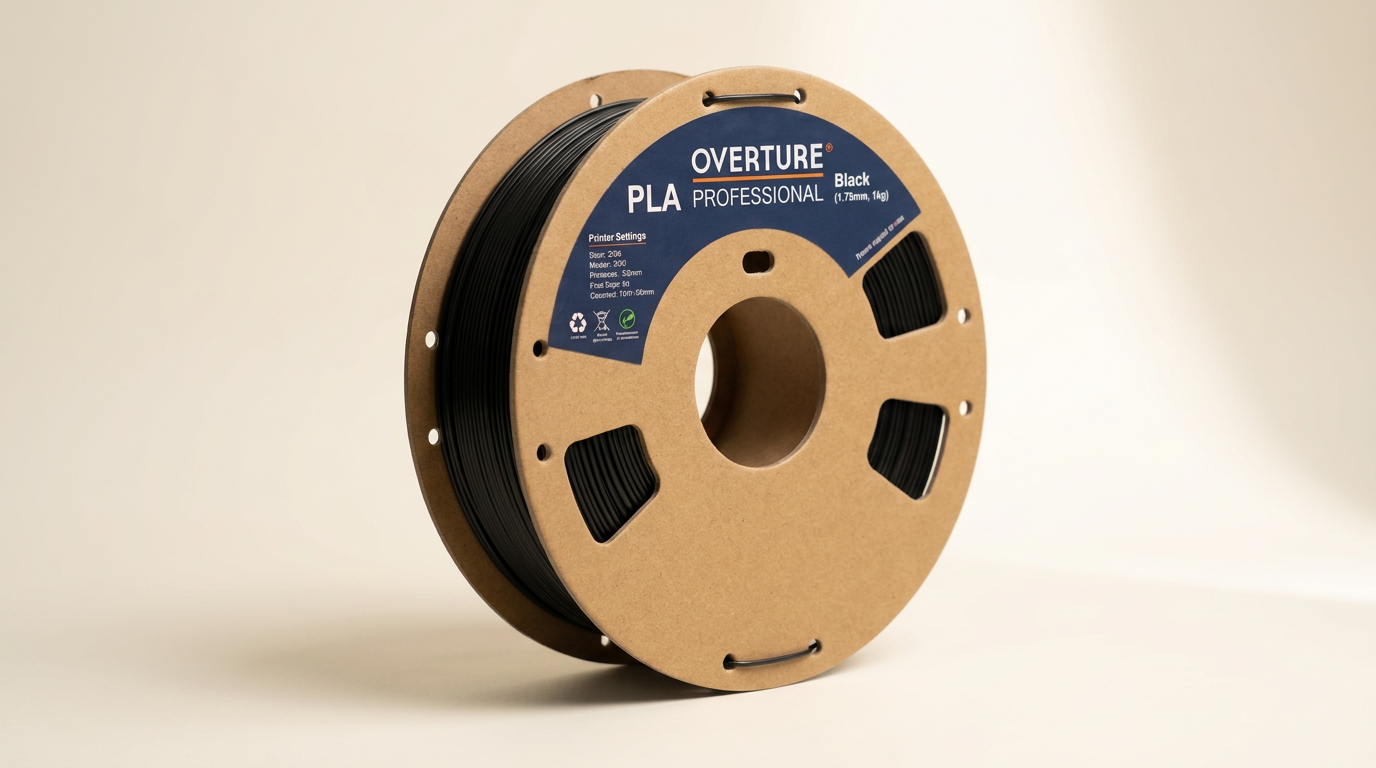
Standard PLA plastic has long been the entry point for 3D printing enthusiasts, balancing ease of use with acceptable mechanical properties. However, as the demands on FDM prints grow, the category quietly bifurcates. OVERTURE PLA Plus represents a mature evolution of this workhorse material, blurring the lines between beginner-friendly filaments and those previously reserved for more industrial applications. This isn't just PLA with a marketing suffix; it's a recalibrated formulation designed to meet the growing mid-tier needs of functional prototyping and durable part creation.
Most buyers approach PLA Plus looking for marginal improvements. What they find in OVERTURE's offering is a significant jump in utilitarian performance, challenging the perception that strength must come with a steep learning curve or a prohibitive price tag. This filament positions itself as a new baseline, effectively making standard PLA a niche choice for purely aesthetic or low-stress models. It caters to a generation of printers that offer higher speeds and greater precision, demanding a material that can keep pace.
What owners love
- + Significantly stronger and less brittle than standard PLA
- + Excellent layer adhesion and minimal warping
- + Wide printing temperature range, accommodating various setups
- + Consistently good print quality with high precision
- + Reliable and tangle-free spooling according to owners
- + Competitive pricing for its enhanced quality
Common complaints
- − Can be highly hygroscopic, requiring careful moisture control
- − Some spools may not fit certain automated material systems (AMS)
- − May require bed adhesion aids like rafts for some prints
- − Color consistency between batches can vary slightly (e.g. Space Gray vs. Black)
Design & Build
OVERTURE PLA Plus is engineered for enhanced durability, marketed with up to five times the impact toughness of standard PLA. Owners consistently report that this claim holds true, noting a noticeable reduction in brittleness compared to conventional PLA. Prints exhibit strong interlayer adhesion, a critical factor for functional parts. The filament maintains high dimensional accuracy, with a specified tolerance of +/- 0.02mm, a figure that appears reflected in precision prints. While most filaments focus on basic strength, OVERTURE prioritizes a balance of impact resistance and structural integrity, reflecting a 'structural PLA' design philosophy that extends its utility beyond mere display pieces into more rigorous applications like tools and enclosures. The black variant reviewed offers a solid, non-transparent finish, contributing to a professional appearance.
Setup & Ease of Use
A hallmark of the OVERTURE PLA Plus is its printability. Many owners, ranging from novices to experienced users, describe it as easy to dial in, often performing well with generic PLA profiles or slight adjustments. A recurring theme is its forgiving nature, with one user noting its ability to print flawlessly even when not fully dried. Standard settings like 205-220°C nozzle temperature and a 60°C bed temperature are commonly cited as effective. However, owners do advise that the filament can be hygroscopic, meaning it absorbs moisture from the air, which can lead to printing issues if not stored properly or dried before use. While generally hassle-free, this material still demands basic moisture hygiene, a reminder of the 'moisture budget' all filaments necessitate for optimal performance.
Performance in Real Use
The true measure of a filament lies in its day-to-day performance. Owners consistently praise the strength and resilience of OVERTURE PLA Plus. Reports detail successful printing of structurally demanding objects, from tool brackets to mechanical parts, that would typically shatter if attempted with standard PLA. Features like minimal stringing and reduced warping are frequently highlighted, allowing for complex geometries and overhangs. One user successfully used it for print-in-place hinged designs, a testament to its blend of flexibility and strength. While generally adhering well to various build plates, a few instances suggest a raft might be beneficial for very large prints to prevent curling. The material's consistent performance across different nozzle sizes (0.4mm to 1.0mm) further underscores its versatility for diverse printing tasks.
Software & Ecosystem
OVERTURE PLA Plus integrates smoothly into existing 3D printing workflows. While specific manufacturer profiles for this exact filament might not always be available, owners report successful printing using generic PLA or PLA Plus settings from other brands. Compatibility with popular printers like Bambu Lab P1S, Elegoo Neptune 3, and Ender 3 V2 is well-documented. A notable point of contention, however, is its relationship with automated material systems (AMS). Some owners experience issues with certain OVERTURE spools being slightly wider than standard, preventing them from rotating freely within AMS units, though this can often be mitigated with adapter rings. This highlights a subtle compatibility friction point, where physical spool dimensions can create an ecosystem lock-out for an otherwise high-performing filament.
Value & Reliability
At its price point, generally under $20 per kilogram spool, OVERTURE PLA Plus delivers significant perceived value. Owners frequently cite it as a 'go-to' choice due to its balance of quality and cost. Reliability is a strong selling point; users report zero tangles and consistent extrusion, leading to high success rates. The material allows for creating durable, functional parts where standard PLA would fail, effectively extending the utility of FDM printing without requiring a significant investment in more exotic materials. This represents a long-term cost-effectiveness, as it reduces failed prints and produces more robust end products. The reliability forms a kind of 'hidden uptime' premium, where fewer print regressions and consistent outputs save time and material that might otherwise be spent troubleshooting or reprinting.
Verdict
Buy - This filament provides a robust performance upgrade over standard PLA without sacrificing printability.
OVERTURE PLA Plus is ideal for any 3D printer owner seeking to produce more durable, functional parts than traditional PLA allows, without the added complexity or cost of materials like PETG. It serves both beginners looking for forgiving ease of use and experienced users needing reliable, strong prints for prototypes, tools, or everyday functional items. Those who frequently print aesthetic models or who require very specific material properties for edge cases might find standard PLA or more specialized filaments more appropriate. However, for a general-purpose, strong-performing PLA, this is a solid choice at a competitive price, hovering well under $20 per spool.
The OVERTURE PLA Plus exemplifies the 'utility horizon' of FDM printing's most accessible material. It's not a revolutionary plastic, but rather an optimization that expands PLA's practical application, addressing the quiet frustration of brittle prints. This evolution subtly redefines the baseline for what a 'default' 3D printing filament should be, pushing standard PLA into an increasingly limited, decorative niche. It reflects a market maturity where reliability and enhanced mechanical properties are now expected, not just desired, even at entry-level pricing.
FAQ
More 3D Printing Supplies reviews
ELEGOO Silk PLA Filament Review: A Budget Silk Filament Leader
ELEGOO Matte PLA Filament: A Premium Finish for Everyday Prints
ELEGOO PLA Filament Bundle Review: The Daily Driver Standard
eSUN PLA Basic Filament Review: A High-Speed Performer
SUNLU Silk PLA Filament Review: The Aesthetic Play in 3D Printing
ELEGOO Rapid PETG Filament Review: High-Speed Printing Achieved
This review is based on real experiences shared by owners in online communities.