
LANDU Silk Tri-Color PLA Filament Review: Visual Impact, Low Fuss
This review is based on real experiences shared by owners in online communities.
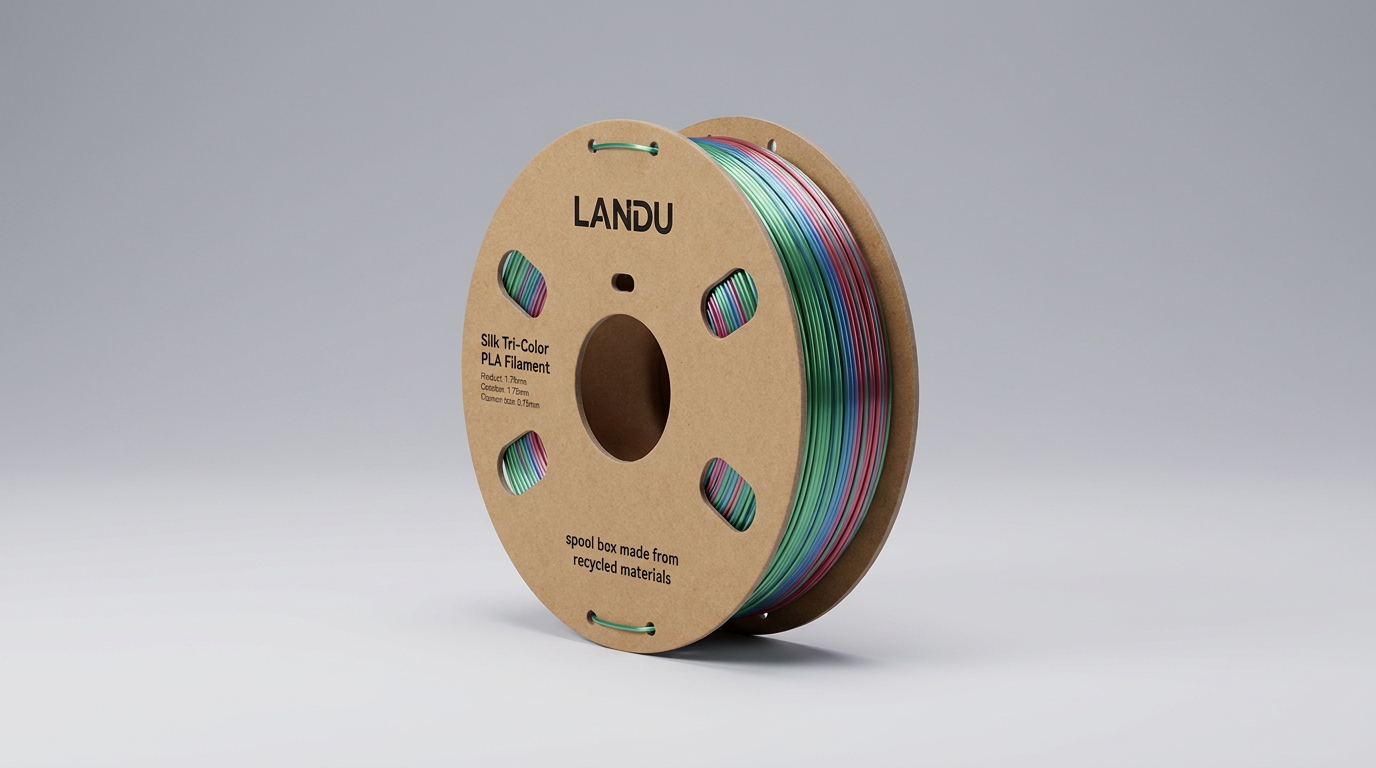
3D printer users often chase the elusive combination of visual impact and reliable performance from their materials. The LANDU Silk Tri-Color PLA Filament, with its distinctive red, blue, and green blend, attempts to address both. While many multi-color filaments promise vibrant results, they frequently introduce new challenges in print consistency or post-processing.
This filament distinguishes itself by delivering on its aesthetic claims without burdening the user with common material frustrations. It presents a low-friction pathway to visually striking prints, positioning it not as a specialist material requiring specific expertise, but rather as an accessible option for adding complexity to decorative projects. The key insight here is the 'Decorative Reliability Quotient' - the ability of a filament to consistently produce attractive, multi-colored prints without demanding excessive calibration or troubleshooting from the user.
Our evaluation focuses on whether the LANDU Silk Tri-Color PLA lives up to this promise, examining its performance across various printers and user scenarios. We assess its print quality, ease of use, and overall value, contrasting its real-world application against its advertised attributes to understand its true place in the competitive filament market.
What owners love
- + Vibrant, eye-catching tri-color effect that changes with viewing angle
- + Consistently smooth, glossy silk finish requiring no post-processing
- + Reliable feeding and minimal issues with clogging or stringing
- + Strong layer adhesion and print integrity reported by many users
- + Works well across a range of popular 3D printers with generic profiles
- + Good value proposition for its consistent quality and aesthetic output
Common complaints
- − One report of a spool tangle early in the roll, though isolated
- − Slightly more brittle than standard PLA in some circumstances
- − Cardboard reel noted by one user as a minor drawback
- − Color combination is fixed; not as versatile as single-color options
Design & Build
The LANDU Silk Tri-Color PLA is designed around a three-color extrusion process, blending red, blue, and green into a single strand. This design yields a shifting color profile as an object is rotated, a visual effect consistently praised by owners. The silk finish provides an inherent gloss, eliminating the need for sanding or polishing to achieve a smooth, reflective surface. This visual characteristic is a primary draw for users creating decorative items, sculptures, or display pieces.
Precision in filament diameter, stated at +/-0.02mm, underpins the consistent flow and reliable extrusion observed by users. The 'Visual Stability Factor' of this filament-the dependable appearance of the tri-color blend across different print orientations and sizes-is high. This suggests effective manufacturing controls for the multi-color blend, a common challenge for similar products. While one user noted a cardboard reel as a 'downfall,' it appears to be a minor aesthetic concern rather than a functional impediment to printing.
Setup & Ease of Use
A recurring theme among owners is the straightforward setup and general ease of use for this filament. Many report successful prints using standard or generic PLA silk profiles on a variety of popular machines, including Bambu Lab A1, K2 Plus, Prusa Mini, Ender 3 V3 KE, P1S, and X1 Carbon. This broad compatibility indicates a forgiving material that does not demand extensive calibration or specialized profiles, reducing the 'filament anxiety' often associated with novel materials.
Users specifically highlight the absence of common issues like clogging, stringing, or bed adhesion problems when adhering to recommended temperature settings, typically around 210C for the hotend and 70C for the bed. The filament arrives neatly wound, minimizing snags and tangles during automated feeding, a crucial factor for long-duration prints. This 'plug-and-print' behavior lowers the barrier to entry for achieving complex visual effects, a significant advantage for both novice and experienced users.
Performance in Real Use
The LANDU Silk Tri-Color PLA performs reliably across diverse printing scenarios. Owners consistently report strong layer adhesion, leading to robust and durable printed objects. The filament's ability to maintain its vibrant tri-color effect and smooth, glossy finish on functional items like succulent holders and intricate models such as dragons speaks to its versatility. Users note the colors are bright and visually impactful, closely matching product photos.
Performance metrics like clog-free operation and minimal stringing are frequently cited, contributing to a stress-free printing experience. One user observed that prints emerged with great integrity and that the color 'appears to change with the light,' highlighting the dynamic visual properties. While one comment mentioned the filament being 'a little brittle,' this appears to be an isolated observation and not a widespread issue. The overarching sentiment is one of consistent, high-quality output, even on long prints, fulfilling the promise of a 'smooth printing' experience.
Software & Ecosystem
The filament's compatibility with generic PLA silk settings across various slicer software and printer ecosystems is a significant advantage. Owners successfully used it with Creality Slicer on an Ender 3 V3 KE, as well as on Bambu Lab machines (A1, P1S, X1 Carbon) with their respective generic profiles. This broad integration suggests the filament's material properties align closely with established industry standards for PLA, minimizing the need for bespoke software adjustments or proprietary ecosystems.
This 'Universal Profile Adaptability' means users are not locked into specific printer brands or software versions to achieve optimal results. The filament's performance relies more on its inherent material quality and manufacturing precision than on specialized software compensation. The absence of specific software-related complaints underscores its seamless integration into existing 3D printing workflows.
Value & Reliability
Considering its price band, the LANDU Silk Tri-Color PLA offers compelling value. Users frequently express surprise at the quality given the cost, often noting it performs comparably to, or even surpasses, more expensive brands of multi-color silk PLA. The sentiment 'For the price, you really can’t beat this stuff' is common, particularly from those who initially approached it with skepticism due to its affordability.
Reliability is a cornerstone of its appeal; multiple buyers have made repeat purchases, indicating consistent satisfaction and trust in the brand's quality control. The filament's ability to print without drying straight out of the vacuum-sealed bag further enhances its convenience and perceived value. The long-term reliability for decorative pieces, combined with its strong performance in avoiding common printing failures, positions it as a 'Cost-Effective Aesthetic Driver' - a material that reliably delivers high visual appeal without the hidden costs of failed prints or extensive troubleshooting.
Verdict
Buy - This filament delivers exceptional visual appeal and print reliability for decorative 3D printing projects.
This LANDU filament is ideal for makers prioritizing aesthetic impact with minimal setup fuss. Those creating decorative objects, gifts, or models that benefit from dynamic, shifting colors will find it an excellent choice. Its broad compatibility with various printers and generic PLA silk profiles makes it suitable for users across all experience levels, particularly those new to multi-color or silk finishes. Hobbyists looking for consistent, visually striking results without spending well above $20 per spool should consider it.
Conversely, users requiring precise, static color separation for functional parts or engineering prototypes should look elsewhere, as the tri-color blend is inherently dynamic. Those exclusively printing highly brittle structures might also consider alternatives if maximum impact resistance is paramount, though this is a minor concern. The LANDU Silk Tri-Color PLA ultimately redefines the 'visual utility' segment of 3D printing, demonstrating that captivating aesthetics and reliable performance need not reside in separate, high-cost offerings, but can be effectively merged into an accessible, everyday filament.
FAQ
More 3D Printing Supplies reviews
ELEGOO Rapid PETG Filament Review: High-Speed Printing Achieved
ARKA 3D Printing Super Glue Gel Review: Bonds PLA, ABS, PETG, TPU
ELEGOO Rapid PLA Plus Filament Review: Speed Without Compromise
DIYSELF 16-Piece Exacto Knife Set Review: Precision for the Practical Crafter
Miailuy Silk PLA Filament Review: Visual Appeal Over Speed
ELEGOO Water Washable 2.0 Resin Review: Convenience vs. Durability
This review is based on real experiences shared by owners in online communities.