
Kingdder 500 Pcs 3D Magnetic Tracking Dots Review: Practical Scanning?
This review is based on real experiences shared by owners in online communities.
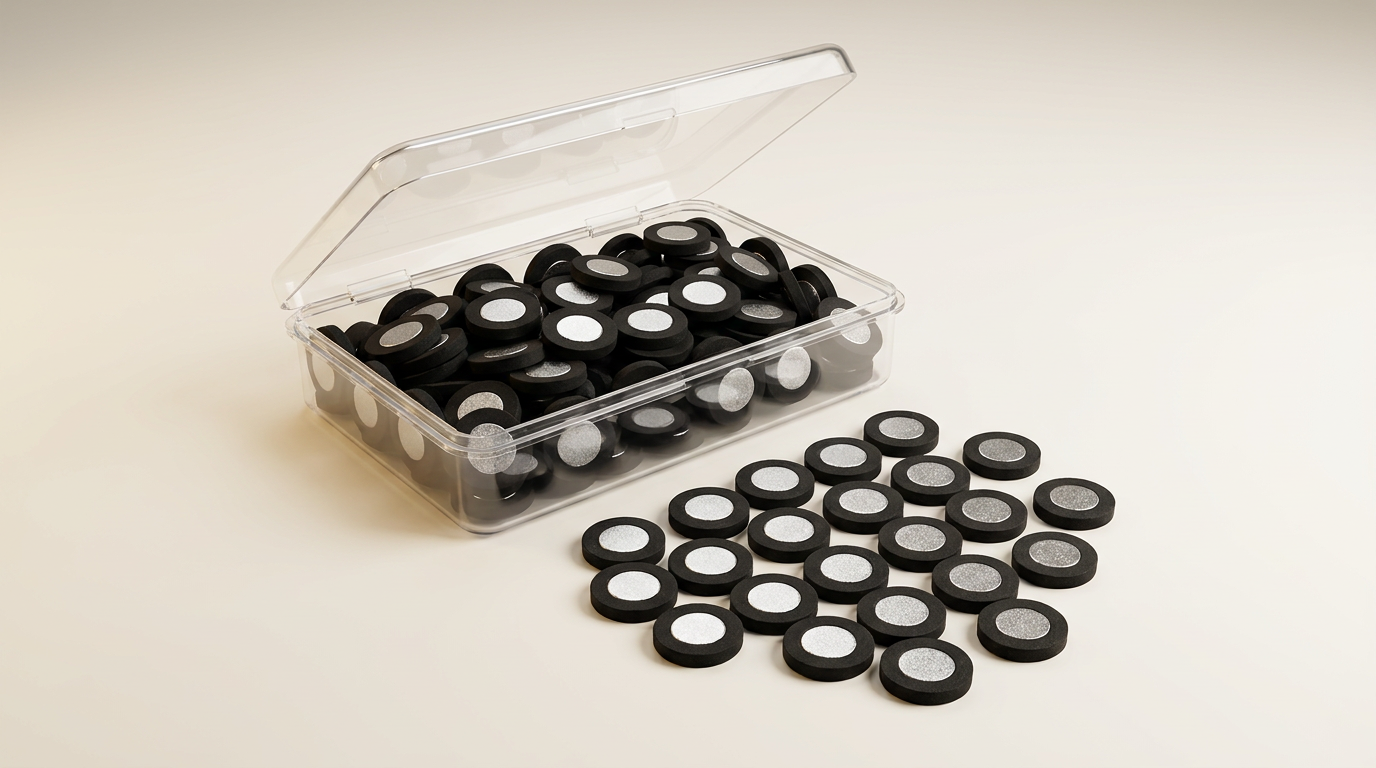
3D scanning relies on consistent tracking markers to achieve accurate data acquisition, especially for large, featureless, or reflective surfaces. Traditional adhesive dots are effective but create waste and consume significant time during application and removal. To address these inefficiencies, Kingdder offers a solution in the form of 500 reusable magnetic tracking dots.
These magnetic markers aim to streamline the scanning workflow by providing a temporary, repositionable reference point. Designed for compatibility with various 3D scanners, the dots promise high reflectivity and reusability. This review evaluates their performance, build quality, and overall utility based on owner experiences, assessing if they present a viable alternative to adhesive markers for professionals and hobbyists alike.
What owners love
- + Significantly reduces setup and teardown time compared to adhesive markers
- + Reusable nature saves costs and minimizes waste over time
- + Improves scanner tracking on large, smooth, or featureless surfaces
- + High reflectivity aids in scan registration accuracy
- + Easy to apply and remove without leaving residue
Common complaints
- − Magnetic strength is often reported as weak, leading to detachment
- − Limited to ferrous metal surfaces; unsuitable for non-magnetic materials
- − May not adhere well to painted or very smooth metal surfaces
- − Can slide or fall off angled surfaces easily
- − Thicker paint or coatings can further reduce magnetic grip
Design & Build
Kingdder's 3D magnetic tracking dots feature an inner diameter of 6mm and an outer diameter of 10mm, a size optimized for detail capture during scanning. Constructed from soft magnetic material, they are designed to be thin and light enough to prevent surface damage while providing a strong enough magnetic force for adherence. Owners consistently praise their reusability and ease of handling. The black and white coloration is intended to facilitate quick identification and visibility for various scanner types, including white light scanners. Despite the intended strong magnetic force, a recurring comment among owners concerns the actual strength, often describing it as adequate but not robust. This compromise in magnetic power is frequently attributed to their thin profile, which most users accept for optimal scanning.
Setup & Ease of Use
The primary advantage of these magnetic dots lies in their ease of setup and removal. Users report a drastic reduction in workflow time, with application and disposal taking a fraction of the time compared to adhesive markers. The dots simply stick to ferrous metal surfaces and peel off without effort, leaving no residue. This reusability is a significant factor in their appeal, eliminating the need to constantly purchase and apply disposable markers. However, the ease of use is entirely dependent on the surface. They perform best on raw or lightly painted metals and flat surfaces. Angled or heavily painted surfaces, as well as non-ferrous materials, negate this advantage, requiring alternative methods or posing tracking challenges.
Performance in Real Use
When used on appropriate surfaces, these magnetic dots significantly enhance 3D scanner tracking. Owners successfully deploy them on large, smooth items like car panels and fuel tanks, where objects lack sufficient features for consistent tracking. The high reflectivity of the markers is effective for accurate scan registration, with users commenting on improved scanner performance. While the magnetic hold is often described as moderate, it is generally sufficient for flat, ferrous surfaces. The markers' thickness also offers an unexpected benefit, helping scanners maintain tracking on flat planes where traditional decal dots might struggle. However, their performance drops sharply on non-magnetic materials or surfaces with weak ferromagnetic properties, such as thicker paint layers.
Software & Ecosystem
These magnetic tracking dots are passive reference points; they do not integrate with software or have an ecosystem in the traditional sense. Their functionality is entirely dependent on the 3D scanner's ability to detect and utilize reflective markers for registration. The high reflectivity is an inherent design feature that makes them compatible with a wide range of industrial and consumer-grade 3D scanners, including those using optical mapping and machine vision. They serve as an essential calibration tool alongside 3D scanning sprays, providing reliable targets for precise data capture. The lack of software means universal compatibility across various scanning platforms, as long as the scanner supports marker-based tracking.
Value & Reliability
Priced around $30-$40 for a pack of 500, the Kingdder magnetic dots offer substantial value, particularly given their reusability. Compared to the ongoing cost of disposable adhesive markers, these present a cost-effective alternative over time. Owners frequently mention the financial savings and reduced waste as key benefits. While the magnetic strength is a point of contention, most users find it acceptable for their intended applications on metal surfaces. The dots are durable enough for repeated use, standing up to the rigors of frequent application and removal. Their reliability, however, is conditional on the scanned object's material and surface characteristics. For specific use cases involving ferrous metals, they prove highly reliable and efficient. For applications beyond this scope, their utility diminishes.
Verdict
Consider - These magnetic tracking dots offer a compelling alternative to adhesive markers for specific 3D scanning scenarios.
They are a strong choice for users regularly scanning large, smooth, ferrous metal objects such as automotive parts, industrial machinery, or metal prototypes. The reusability, reduced setup time, and cost savings make them a practical investment for workflows where traditional markers are a constant consumable. Expect to pay in the $30-$40 range for a substantial quantity. Those who scan predominantly non-magnetic materials, heavily painted surfaces, or intricate objects with steep angles should exercise caution. Their limited magnetic strength and inability to adhere to non-ferrous surfaces will restrict their utility, necessitating alternative tracking methods.
FAQ
More 3D Scanners reviews
EinScan SE V2 Review: Precision for Dedicated 3D Modelers
Honeywell Voyager 1452g Review: A Kit That Falls Short
Matter and Form Three Review: Precision 3D Scanning Reimagined
3DMakerpro Scanner Tripod Holder Review: A Micro-Tripod for Macro Precision
TOSUKKI 3mm Reflective 3D Scanning Targets Review
EinScan Rigil Lite 3D Scanner Review: Unchained Scanning Power
This review is based on real experiences shared by owners in online communities.