
IEMAI PETG 1.75mm Dual Color Gradient Filament Review
This review is based on real experiences shared by owners in online communities.
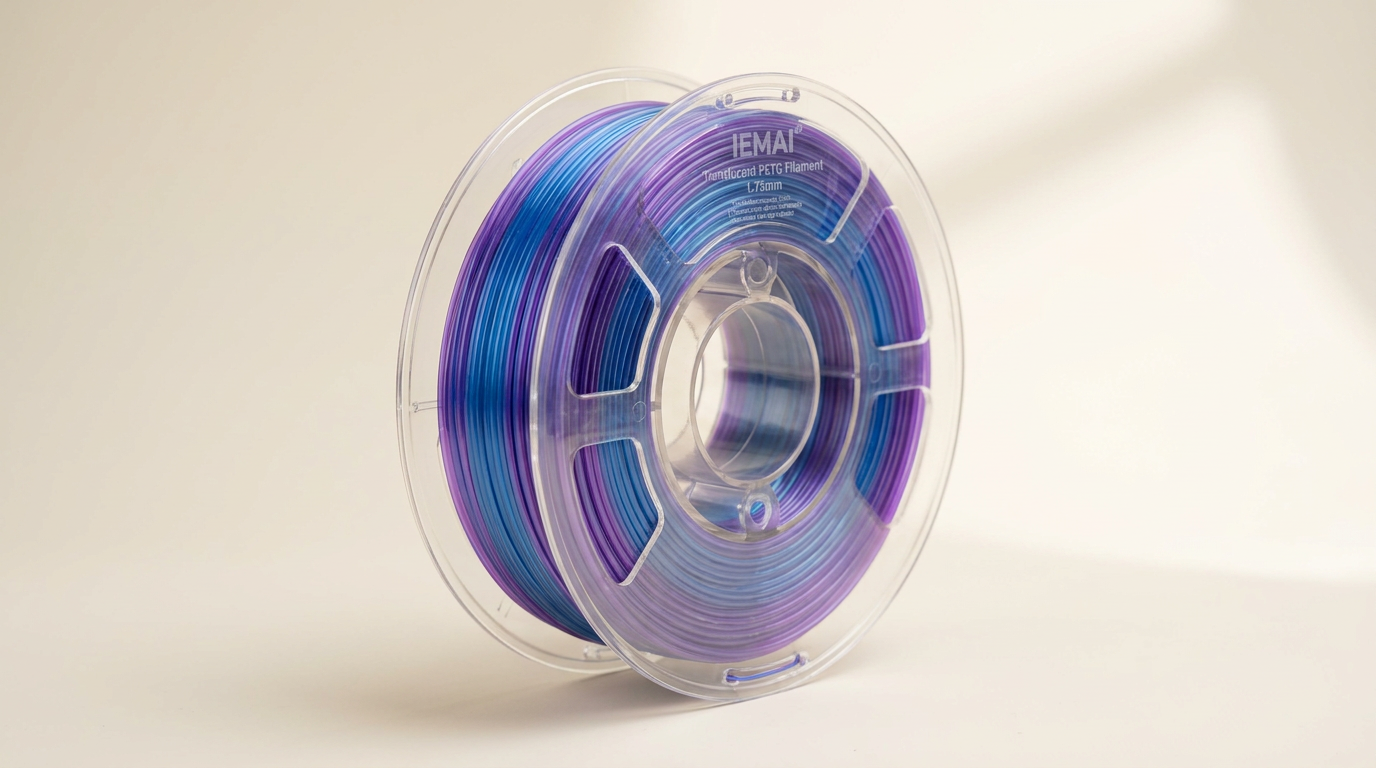
IEMAI offers a 1.75mm PETG filament designed for 3D printing applications requiring both aesthetic appeal and material toughness. This review examines its dual-color gradient effect and performance characteristics, specifically a translucent blue-to-purple variant, based on direct user experiences.
Targeting artistic creations, home decor, and functional parts, IEMAI promotes its PETG as an alternative combining PLA's ease of use with ABS's durability. The filament is engineered for consistent extrusion and supports printing speeds up to 600mm/s. This assessment evaluates how these claims hold up in practice, focusing on print quality, material properties, and user experience across various 3D printer setups.
What owners love
- + Vibrant, consistent dual-color gradient and translucency
- + Excellent light diffusion for illuminated projects
- + Prints consistently with minimal clogging or stringing
- + Strong bed and layer adhesion reported
- + Compatible with high-speed printers like Bambu P1S/X1C
- + Good value for quality, with increased toughness over PLA
Common complaints
- − Some users initially struggle with PETG settings if new to the material
- − Achieving optimal transparency requires specific print settings
- − Smaller prints may not fully showcase the gradient effect
- − Requires proper drying before use, like most PETG filaments
- − Requires proper ventilation due to PETG fumes
Design & Build
The IEMAI PETG filament is manufactured to a stated 1.75mm diameter with a +/- 0.02mm tolerance, prioritizing consistent extrusion. Owners confirm smooth feeding and reliable adherence to both the print bed and subsequent layers. The material's dual-color gradient, such as blue-to-purple, is a primary design feature, offering a distinct aesthetic that transitions along the print. Its translucent property is favored for projects requiring light diffusion, with users reporting excellent results in applications like lampshades and LED enclosures. The material feels robust, enhancing its suitability for both decorative and functional parts where durability is a factor.
Setup & Ease of Use
Initial setup with this PETG filament generally proceeds smoothly for experienced users. However, individuals new to PETG might encounter a learning curve, as reports indicate a need for fine-tuning nozzle and bed temperatures, along with Z-offset adjustments. A common suggestion involves using a smooth plate with gluestick for optimal adhesion on printers like the Bambu P1S. Drying the filament at 70°C for 8-12 hours prior to printing is recommended, and owners confirm this practice contributes to better print quality. Once settings are dialed in, users describe the filament as reliable, with minimal issues like stringing or warping.
Performance in Real Use
This IEMAI PETG filament performs effectively across a range of 3D printers, including high-speed models like the Bambu Lab P1S and X1C. Owners report consistent extrusion and reliable print quality, even at speeds up to 600mm/s. The gradient effect is well-received, producing visually striking objects. For applications involving light, the translucency diffuses illumination effectively, making it suitable for LED-lit projects. While achieving a super-transparent, glass-like finish can be challenging and may increase stringing with higher temperatures, the filament consistently produces a clear, glossy surface regardless. Its enhanced toughness and durability compared to standard PLA are frequently noted as benefits.
Software & Ecosystem
The filament integrates well with standard slicing software and printer ecosystems. Users report success using generic PETG settings in applications like Bambu Studio, often requiring only minor adjustments for optimal results. Its compatibility with high-speed printers like the Bambu P1S and X1C is a notable advantage, allowing users to leverage advanced printer capabilities without compromising print quality. No specific proprietary software or ecosystem restrictions are mentioned, simplifying its adoption into existing 3D printing workflows.
Value & Reliability
This IEMAI PETG filament offers good value. Owners consider the quality to be high, with many expressing intent to repurchase. Its reliability is consistently praised, with multiple users completing entire spools without print failures due to the filament itself. The material's balanced properties-combining ease of printing with enhanced toughness and heat resistance-contribute to its overall appeal. While some filaments in this category can be priced significantly higher, this offering generally resides in a competitive mid-range, often under $20 per spool, making it an accessible option for its performance.
Verdict
Buy - This filament consistently delivers reliable prints with striking visual effects, especially for translucent and gradient projects.
This filament is an excellent choice for 3D printing enthusiasts and makers who prioritize aesthetic appeal, particularly those working on artistic prints, home decor, or LED-lit projects. Its high-speed compatibility appeals to owners of modern printers capable of fast printing. Individuals new to PETG should be prepared to fine-tune settings. Those primarily printing small, single-color functional parts where the gradient effect would be lost may find other options more suitable.
FAQ
More 3D Printing Supplies reviews
ELEGOO Water Washable 2.0 Resin Review: Convenience vs. Durability
EONO3D PETG Filament Review: The Low-Friction PETG for Modern Printers
Creality Ender PETG Filament Review: Value for the Volume Printer
Bambu Lab PLA Filament Review: The Smart Choice for Bambu Printers
ANYCUBIC PLA Filament Bundle Review: The Workhorse Default
YOUSU Matte PLA Filament Review: A New Standard for Finish
This review is based on real experiences shared by owners in online communities.