
HzdaDeve Bambu P1S Hotend 3-Pack Review: Value Meets Risk
By AValidReview. An AI-assisted summary of customer feedback, not a hands-on test.
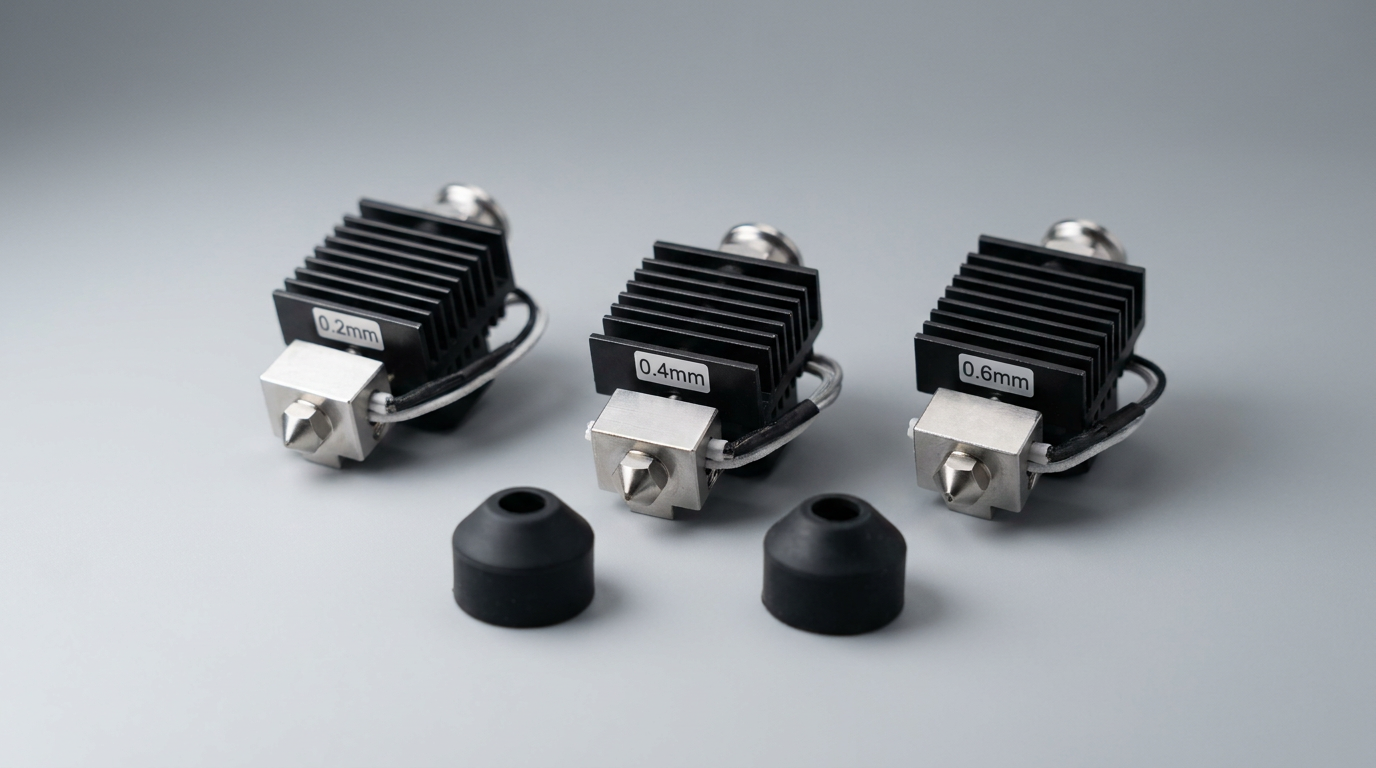
Bambu Lab earned its dominance by transforming desktop 3D printing from a finicky kit hobby into a reliable appliance. That closed ecosystem, however, left an opening for third-party manufacturers to undercut official replacement costs. The HzdaDeve 3-Pack Hotend Kit (0.2mm, 0.4mm, and 0.6mm) targets owners looking to avoid the first-party price premium, offering three fully assembled toolhead modules for less than the cost of a single OEM complete hotend.
This setup introduces what we call the clone convenience paradox. The appeal of a complete assembly is eliminating the tedious work of moving ceramic heaters and fragile thermistors between heat sinks. Yet, by inviting budget third-party assemblies into a machine that runs at aggressive acceleration speeds, you reintroduce the exact hardware lottery that Bambu Lab printers were engineered to avoid.
While hundreds of hours of flawless extrusion are entirely possible with this kit, the margin for error is razor-thin. When a cheap aftermarket nozzle fails at 500 millimeters per second, it does not just ruin a plastic model; it risks mechanical damage to the machine itself.
What owners love
- + Complete drop-in assemblies with pre-wired thermistors and ceramic heaters
- + Provides 0.2mm, 0.4mm, and 0.6mm bore sizes in a single budget package
- + Costs significantly less than official Bambu Lab complete hotends
- + Clean extrusion and smooth surface finishes when tolerances are correct
Common complaints
- − Nozzles appear to be stainless steel rather than true hardened steel
- − Risk of structural nozzle failure that can gouge build plates
- − Loose-fitting silicone socks require careful positioning
- − Inconsistent quality control across different nozzle sizes in the same box
Design & Build
Each unit in the HzdaDeve kit comes pre-assembled with a heat sink, heat break, heater block, ceramic heating element, thermistor, and silicone sock. The design mimics the original Bambu Lab all-in-one geometry, bypassing the frustrating assembly process required by bare heat breaks. However, a close inspection reveals a critical material discrepancy. While promotional materials label these as hardened steel, the shiny metallic finish indicates they are stainless steel. True hardened steel nozzles undergo heat treatments that leave a characteristic dark, matte surface. For users printing standard PLA or PETG, stainless steel suffices, but running abrasive carbon-fiber or glow-in-the-dark filaments through these tips will wear the orifice out much faster than advertised. Additionally, the included silicone socks fit looser than OEM covers, which can lead to filament snagging during high-speed travel moves.
Setup & Ease of Use
Installation follows the standard Bambu Lab maintenance workflow: remove the front toolhead cover, detach the two JST connectors for the thermistor and heater, undo two mounting screws, and drop the new unit into place. Because HzdaDeve includes pre-soldered wiring harnesses, swap time takes under five minutes. The challenge lies in what we term the Toolhead Lottery. While many units drop straight into the toolhead bracket without friction, slight machining variances on the heat sink mount mean certain units bind during insertion. In some cases, owners find that two of the three hotends mount effortlessly, while the third requires force or fails to seat entirely. Before securing the retention screws, users must carefully inspect whether the heat sink sits flush against the extruder assembly.
Performance in Real Use
When a properly machined unit is installed, print results are difficult to distinguish from first-party hardware. The 0.2mm nozzle delivers clean detail on miniatures, while the 0.4mm unit handles standard prototyping with consistent layer lines and dependable extrusion. The high-speed ceramic heater keeps pace with volumetric flow demands up to normal print thresholds. However, the kit suffers from catastrophic failure risks. Several owners report what we call the Bed-Strike Hazard: structural failure where the nozzle tip separates or shears off the assembly mid-print. In a high-speed motion system, a broken tip leaves a jagged heat block dragging across the build surface, permanently gouging textured PEI plates. Thermal sensor drift is another documented failure mode, where the 0.2mm unit fails to register correct temperatures, triggering constant cooling fan activation and thermal runaway warnings.
Software & Ecosystem
Bambu Studio interacts with the HzdaDeve assemblies without protest, treating them as stock components once the corresponding nozzle diameter is selected in the slicer. Because the thermistor resistance curve closely tracks standard Bambu Lab specifications, basic PID auto-tuning or standard thermal calibration is typically sufficient. That said, the automated platform expects tight mechanical tolerances. If a third-party heat break sits a fraction of a millimeter lower than stock, the printer's automated z-offset routine must absorb the variance through bed-tapping calibration. Any failure in the thermistor circuit will immediately halt the print sequence, meaning firmware error handling is your only safety net if an element arrives with poor internal soldering.
Value & Reliability
Priced in the budget range under $40 for three complete units, the financial argument is undeniably tempting. Getting a 0.2mm detail hotend, a standard 0.4mm workhorse, and a 0.6mm high-flow module for less than the price of a single Bambu Lab OEM assembly looks like exceptional utility on paper. Many users log over 500 hours of printing without a single clog. But the math changes the moment a single failure occurs. If an unevenly pressed nozzle tip separates and tears through an expensive magnetic build sheet, the initial savings vanish instantly. This product exists in an asymmetric risk profile: it offers small, incremental cost savings balanced against the low-probability, high-consequence destruction of secondary components.
Verdict
Consider - An economical shortcut to multiple nozzle sizes, but one that carries real quality-control variance and mechanical risk.
This 3-pack makes sense for hobbyists on a strict budget who want quick nozzle flexibility and possess the technical discipline to inspect each unit before installation. If you regularly switch between fine-scale miniatures with a 0.2mm nozzle and rapid drafts with a 0.6mm unit, the convenience of fully wired drop-in modules is hard to beat for under $40.
Print farm operators, commercial makers, and hands-off users should skip this set entirely. The time lost troubleshooting thermal errors, clearing extruder gear clogs, or replacing a gouged build plate outweighs any upfront hardware savings.
The real issue with budget clone assemblies is that they treat the hotend as an isolated consumable rather than a high-speed kinetic tool. Bambu printers depend on absolute mechanical integrity under brutal acceleration; saving cash on an unverified joint at the very tip of that motion system turns every high-speed print into an uncalculated gamble.
FAQ
More 3D Printer Parts & Accessories reviews
Fannova 23.6" Large Printer Stand Review
Ultrafashs 3D Printer Cleaning Rope Review

ELEGOO 3D Printer Adhesive Glue Review: Reliable Bed Adhesion
SAHVAIM AMS Lite Filament Hub Review: Quick Fix for Bambu A1
IdeaFormer-3D Bambu Lab Textured PEI Plate Review
Wefuit 0.2mm Hardened Steel Hotend Review: Budget Precision
This review is based on real experiences shared by owners in online communities.