
HysiPrui P1S/P1P Integrated Hotend Review: Cheap Spares, Real Trade-Offs
By AValidReview. An AI-assisted summary of customer feedback, not a hands-on test.
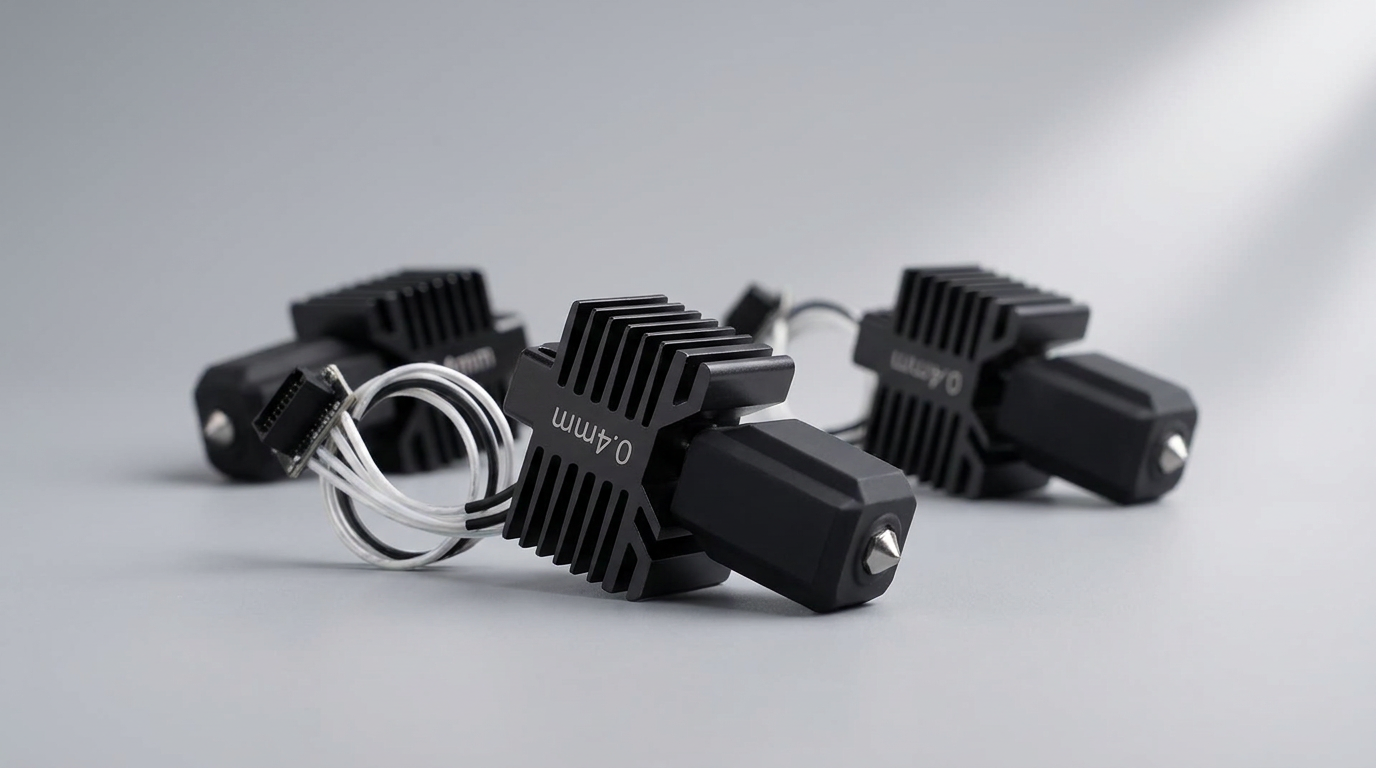
The Bambu Lab ecosystem conditioned makers to treat 3D printing like high-speed appliance operation, but hotends remain mechanical consumables subject to wear, clogs, and thermal fatigue. Buying first-party replacements adds up quickly, especially when running abrasive filaments like carbon fiber, glow-in-the-dark blends, or filled wood polymers. Third-party vendors have stepped into the breach, pitching multi-packs that promise factory tolerances at a fraction of the cost.
The HysiPrui 3-Piece Integrated Hotend Kit occupies a distinct niche in this landscape: what we call the hot-swap safety net. Selling in the under $40 range for a three-pack of hardened steel assemblies, it offers insurance against catastrophic downtime rather than a true engineering upgrade. Many owners buy these units to sit on a pegboard, ready to deploy the second a stubborn clog stalls a multi-hour project.
Yet running budget hardware in a tightly tuned motion system introduces hidden friction. While HysiPrui delivers functional hardened nozzles that withstand rough materials, minor manufacturing variances force owners to navigate subtle flow discrepancies and inconsistent durability. Understanding whether this kit solves your printing woes comes down to whether you prioritize raw per-unit cost over factory-calibrated predictability.
What owners love
- + Significantly lower cost per unit than factory replacements
- + Hardened steel nozzle handles abrasive carbon fiber and glow filaments
- + Integrated design avoids traditional nozzle-to-heatbreak thread leaks
- + Direct drop-in form factor with pre-terminated thermistor and heater connectors
- + Provides immediate spare parts for print farms running continuous workloads
Common complaints
- − Variable tolerances require manual flow rate and K-value recalibrations
- − Does not include cooling fans, requiring component harvesting from old hotends
- − Fragile electrical connectors prone to damage during repeated swaps
- − Uneven quality control across units, leading to occasional early failures
Design & Build
HysiPrui builds these units around an integrated all-metal throat and nozzle assembly designed to bypass the traditional leak paths of standard threaded nozzles. Machined from hardened steel, the nozzle tip is built to withstand abrasive materials that quickly erode stock brass or standard stainless steel. However, manufacturing execution shows clear gaps compared to first-party hardware. Critical dimensions vary slightly between production runs. Several owners report marginal length discrepancies compared to stock components, which can compromise the bottom seal against the silicone sock and trigger filament pooling. The electrical leads feature modular plugs for rapid installation, but the plastic housings and crimps are delicate. Applying excess force while routing the heater or thermistor wires can shear the pins or crack the retaining clips, exposing the design trade-off between aggressive unit pricing and rugged material selection.
Setup & Ease of Use
Swapping the HysiPrui assembly into a P1S or P1P toolhead follows standard Bambu maintenance procedures, but it is not completely plug-and-play out of the box. Buyers must harvest their existing cooling fans and mounting screws from a retired hotend, as this kit ships strictly with the core block, cartridge heater, thermistor, and silicone sock. Before installation, users must verify that the heat sink mounting screws are fully tightened; shipping vibrations frequently loosen these factory fasteners. Once physically seated, bed leveling is mandatory. Because physical nozzle height can sit a fraction of a millimeter off OEM spec, skipping manual recalibration risks nozzle scraping or poor initial layer adhesion. Owners who take the time to inspect physical tolerances before torquing the retention screws encounter minimal physical friction during setup.
Performance in Real Use
Once dialed in, the hardened nozzle handles standard PLA, PETG, and abrasive blends without premature tip erosion. Extrusion through the 0.4mm bore is clean, producing uniform outer perimeters and dense infill at standard Bambu print profiles. The all-metal design prevents filament back-flow when operating at elevated flow rates. However, thermal conductivity differs from OEM stainless steel. This variance introduces what we term the calibration drift penalty: straight drop-in prints without tuning often display over-extrusion, stringing, or rough top surfaces. Users running technical filaments must run dedicated flow dynamics calibrations, frequently lowering pressure advance K-values and tweaking flow ratios by two to three percent to restore factory-grade fidelity. For standard decorative prints, the output is largely indistinguishable from OEM parts, but achieving dimensional precision requires extra operator involvement.
Software & Ecosystem
Bambu Studio and Bambu Handy accept the HysiPrui assembly without throwing sensor errors, as the thermistor curve closely matches factory resistance ratings up to normal operating temperatures. Temperatures report stably across extended print jobs, and automated vibration resonance calibrations complete without interference. The friction lies entirely in Bambu closed tuning philosophy. Because the printer assumes it is running first-party metal with factory-modeled thermal mass, automated flow compensation cannot correct for third-party fluid dynamics on its own. If you rely solely on stock presets, you will see minor finish flaws on fine perimeters. The machine will not warn you about these minor deviations, placing the responsibility on the user to build custom filament profiles inside the slicer.
Value & Reliability
Selling in the $30 to $40 bracket for three complete assemblies, the kit undercuts first-party replacements dramatically. For print-farm operators managing a fleet of P1P or P1S machines, having three hotends on hand for the price of roughly one OEM assembly is an undeniable operational asset. Yet reliability exhibits a noticeable spread. While many owners run these hotends for dozens of hours without incident, a measurable subset of units experiences early clogging or internal bore imperfections within the first few prints. Clearing stubborn clogs via cold pulls can prove frustrating due to interior machining roughness, and aggressive needle probing risks damaging the internal seat. The value equation rests entirely on your tolerance for hardware variance versus outright procurement costs.
Verdict
Consider - A high-value insurance policy for print farms and high-volume hobbyists willing to trade minor calibration time for significant hardware savings.
If you run abrasive filaments around the clock, rely on rapid hotend swaps to minimize production downtime, and know your way around Bambu Studio flow calibrations, this 3-pack makes strong economic sense. It delivers capable hardened steel performance at an entry-level price point, letting you treat hotends as true disposable consumables.
Skip this kit if you demand pure plug-and-play simplicity, rely strictly on factory default slicer profiles, or lack the patience to salvage fans and recalibrate K-values. What budget hotend buyers frequently miss is that the true cost of third-party hardware is not the purchase price, but the diagnostic labor required to compensate for loose manufacturing tolerances.
FAQ
More 3D Printer Parts & Accessories reviews
HP OfficeJet Pro 8135 Review: The Cloud-Tethered Workhorse
HzdaDeve Bambu P1S Hotend 3-Pack Review: Value Meets Risk
Fannova 23.6" Large Printer Stand Review
Ultrafashs 3D Printer Cleaning Rope Review

ELEGOO 3D Printer Adhesive Glue Review: Reliable Bed Adhesion
SAHVAIM AMS Lite Filament Hub Review: Quick Fix for Bambu A1
This review is based on real experiences shared by owners in online communities.