
EONO3D PETG Filament Review: The Low-Friction PETG for Modern Printers
This review is based on real experiences shared by owners in online communities.
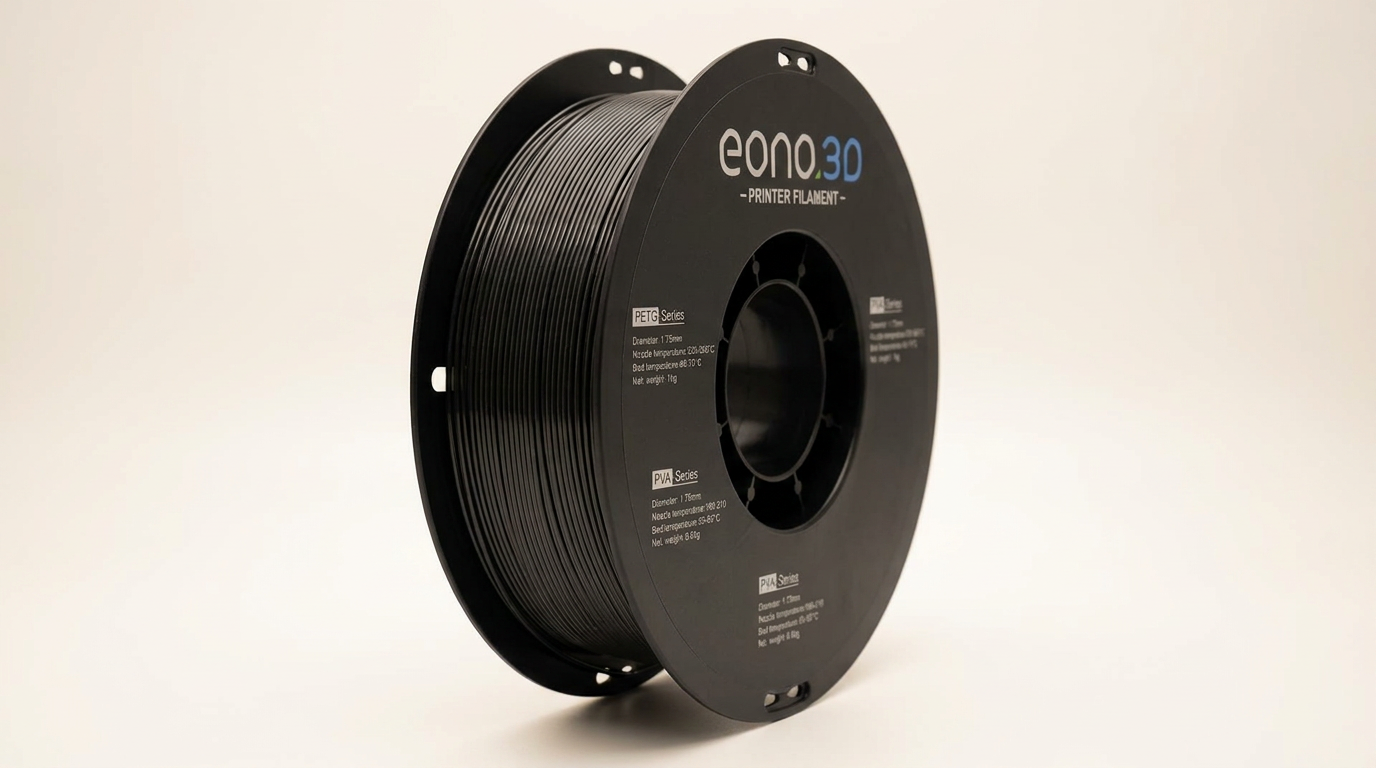
The modern 3D printing landscape, particularly with the proliferation of high-speed CoreXY machines, has shifted expectations for filament. Where once rigorous tuning and drying were prerequisites for PETG, today's users demand a more 'plug-and-play' experience. The EONO3D Black PETG filament emerges as a strong contender in this evolving segment, frequently appearing in discussions as a surprisingly competent option at an accessible price point.
This isn't just another budget PETG. What stands out in owner feedback is a consistent narrative of effortless performance, often without the typical pre-print rituals. It suggests a filament formulation that anticipates the demands of newer, faster printers, offering a reliability factor that distinguishes it from many competitors in its class.
Our assessment delves into whether this EONO3D PETG truly delivers on its promise of low-hassle, high-performance printing, and where its particular strengths lie in a crowded market.
What owners love
- + Prints consistently with minimal stringing
- + Excellent layer adhesion and structural integrity
- + Surprisingly ready to print out of the box for many users
- + Compatible with Bambu Lab and Prusa presets
- + Delivers a deep, consistent black finish
Common complaints
- − Some users still recommend pre-drying for optimal results
- − Specific temperature tuning benefits certain setups
- − Availability in multi-packs is limited
Design & Build
The EONO3D PETG filament arrives vacuum-sealed with desiccant, a standard practice owners appreciate for maintaining dryness. Several users noted the winding quality of the spool as neat and consistent, reducing the risk of tangles during long prints. The black variant produces a deep, uniform hue with a noticeable shine, contributing to a polished final aesthetic. For transparent variants, owners report excellent clarity in single-wall prints and an attractive frosted translucency in multi-layer parts. The consistent ±0.02mm diameter accuracy, cited by the manufacturer, is corroborated by owners who experience smooth extrusion without clogs or under-extrusion, suggesting a robust manufacturing process for filament consistency. This dimensional precision contributes significantly to what we call the 'low-friction PETG' experience-minimal resistance in the filament path and predictable melt flow.
Setup & Ease of Use
A recurring theme among owners is the filament's surprising 'plug-and-play' readiness. Many report printing successfully straight from the vacuum-sealed bag without prior drying, a notable departure from typical PETG behavior. This out-of-box usability is particularly highlighted by Bambu Lab X1C and Prusa MK4S owners, who frequently achieve excellent results using their printer's default 'Generic PETG' or even 'PLA' profiles. While some veteran users still advocate for pre-drying PETG as a best practice, the filament's immediate performance for a significant segment of the user base demonstrates a formulation optimized for convenience. This 'unattended operation' characteristic, where a user can initiate a print with minimal pre-configuration, marks a significant quality-of-life improvement.
Performance in Real Use
The EONO3D PETG consistently delivers strong print performance. Owners report minimal stringing, clean retractions, and excellent layer adhesion, resulting in robust, functional parts. Projects range from tool organizers and clamps to intricate lattice-work laptop stands and large, multi-day scale models. The filament's toughness and impact resistance are frequently praised, making it suitable for mechanical applications that demand durability. Dimensional accuracy is a highlight; custom inserts and functional parts exhibit precise fits. Even complex geometries, such as moving gears, print successfully without issues like oozing or sticking. This consistent performance across diverse applications underscores its reliability as a workhorse filament for demanding projects.
Software & Ecosystem
Compatibility is a key strength. This PETG functions across a wide array of 1.75mm FDM 3D printers, from Prusa MK4S to Bambu Lab X1C and A1, and various Elegoo models. The most compelling aspect is its ability to perform well with standard, generic PETG presets, often requiring minimal to no custom tuning. This 'default profile compatibility' significantly reduces the barrier to entry for users less inclined to spend hours calibrating. While recommended settings are provided (Nozzle 230-260°C, Bed 50-70°C), owners often find success within or even outside these ranges, sometimes even adapting PLA profiles, which speaks to the filament's forgiving nature. This broad-spectrum compatibility means less friction for integrating it into existing workflows.
Value & Reliability
At its accessible price point, often around $10 per kilogram, the EONO3D PETG presents a compelling value proposition. Owners consistently praise its 'quality at low price' and 'rock-solid reliability.' The filament's ability to handle multi-day, continuous prints without warping, clogs, or tangles further reinforces its reliability claims. Many users, including those who print PETG frequently, consider it a default purchase option. The combination of consistent print quality, structural integrity, and ease of use, coupled with its economical cost, positions it as a strong candidate for 'everyday' functional printing, reducing what we call the 'cost-of-failure tax' often associated with cheaper, less consistent filaments.
Verdict
Strong Buy - This EONO3D PETG filament offers exceptional ease of use and consistent performance, especially on modern 3D printers.
This filament is an excellent choice for anyone seeking a reliable, high-performance PETG without the typical pre-print hassles. It particularly shines for owners of newer, high-speed CoreXY printers who desire a 'load and print' experience. Its strong layer adhesion and minimal stringing make it ideal for functional parts, mechanical components, and projects requiring durability. Buyers who prioritize value without sacrificing print quality will find this product highly suitable. Those who are just beginning to explore PETG will also appreciate its forgiving nature.
However, users who prefer to stick strictly to well-established, premium brands regardless of price, or those whose printing workflows are already heavily optimized for very specific, temperamental PETG formulations, might not find a compelling reason to switch. This PETG establishes a new baseline for what a budget-friendly filament can offer: it represents the 'acceleration curve PETG' - a filament designed not just for strength, but for the speed and convenience demanded by the current generation of 3D printing hardware, reducing the traditional 'PETG preparation penalty' to an afterthought for many.
FAQ
More 3D Printing Supplies reviews
ELEGOO Silk PLA Filament Review: A Budget Silk Filament Leader
ELEGOO Matte PLA Filament: A Premium Finish for Everyday Prints
ELEGOO PLA Filament Bundle Review: The Daily Driver Standard
eSUN PLA Basic Filament Review: A High-Speed Performer
SUNLU Silk PLA Filament Review: The Aesthetic Play in 3D Printing
ELEGOO Rapid PETG Filament Review: High-Speed Printing Achieved
This review is based on real experiences shared by owners in online communities.