
ELEGOO Rapid PETG Filament Review: High-Speed Printing Achieved
This review is based on real experiences shared by owners in online communities.
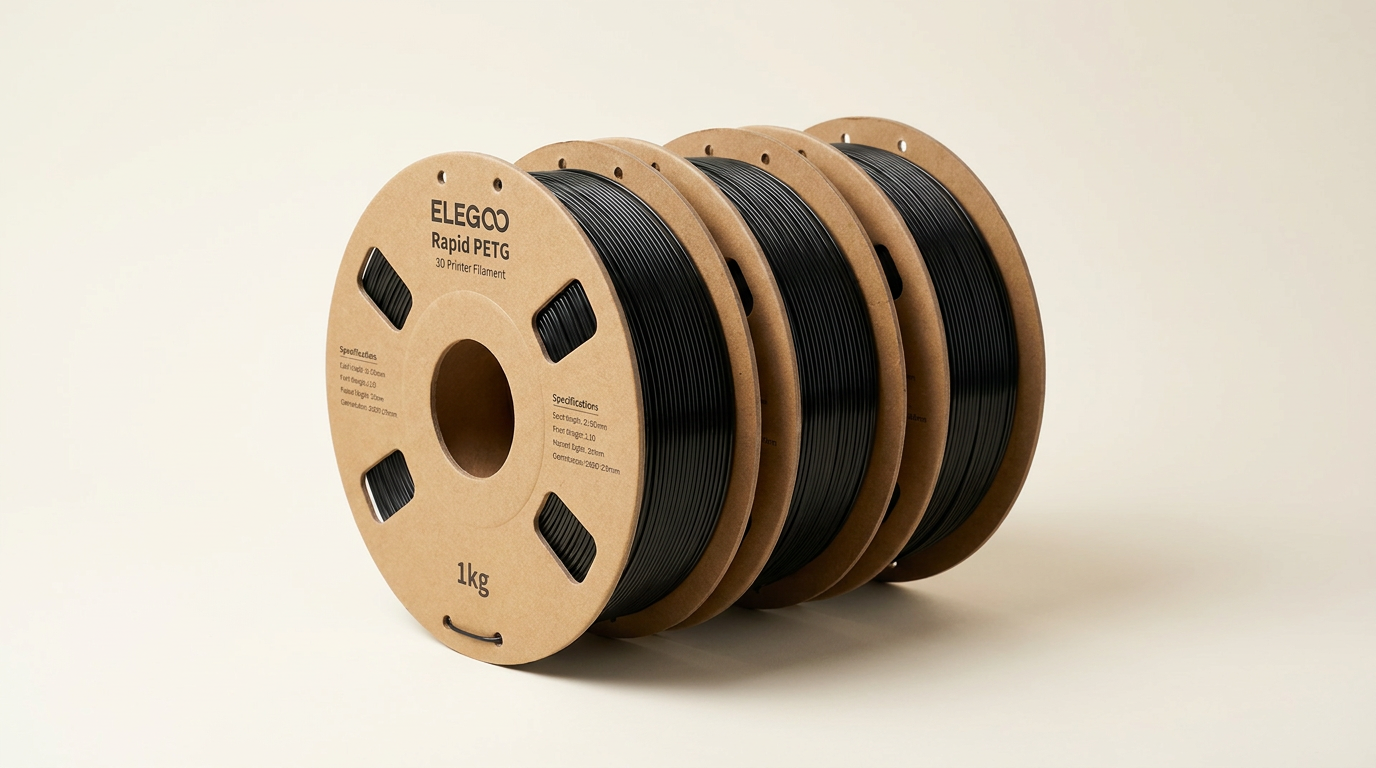
The proliferation of high-speed 3D printers has created a new demand for filaments capable of keeping pace without compromising print quality. Most PETG formulations, while robust, often struggle at elevated speeds, introducing stringing and adhesion issues that require extensive tuning. ELEGOO’s Rapid PETG filament enters this evolving market, positioning itself as a direct response to this challenge.
This filament aims to offer the toughness and thermal resistance characteristic of PETG, but with print characteristics more akin to standard PLA, enabling faster project completion on both conventional and rapid-traverse machines. However, the true test lies in whether it can consistently deliver on this promise across varied printer ecosystems and user skill levels. Many rapid filaments claim high performance, but few balance speed with print reliability without demanding significant user calibration. This review examines how ELEGOO’s offering navigates that critical balance.
What owners love
- + Supports high-speed printing with minimal quality degradation
- + Offers good strength, durability, and impact resistance
- + Demonstrates reliable layer adhesion and finish quality
- + Neatly wound spools reduce tangles and feeding issues
- + Competitively priced for its performance tier
Common complaints
- − Prone to moisture absorption, requiring regular drying
- − May require significant temperature and retraction calibration
- − Finished prints can exhibit a shiny surface finish
- − Cardboard spools may deform, impacting moisture ingress
Design & Build
ELEGOO Rapid PETG filament arrives on cardboard spools, a choice that generates mixed feedback. While cardboard is often favored for its environmental profile, several owners note the spools can arrive with deformation. This physical vulnerability to handling during transit is a minor but recurring observation that can affect the overall out-of-box experience. The winding quality, however, earns consistent praise. Owners report neat, tangle-free spools, preventing the common frustration of filament snags or breaks during long print jobs. This attention to winding precision is critical for high-speed printing, where any inconsistency can lead to catastrophic failures. The filament itself exhibits consistent diameter, minimizing extrusion irregularities that can plague less refined materials.
Setup & Ease of Use
The ease of use for ELEGOO Rapid PETG presents what we term the 'calibration paradox.' While it is marketed as a rapid-printing filament, many users highlight a required dialing-in period, particularly for retraction settings to mitigate stringing, a known PETG characteristic. Temperature adjustments are also frequently necessary, with users reporting optimal print temperatures ranging from 245°C to 260°C depending on the specific printer and desired outcome. This contrasts with the 'print-and-go' expectation often associated with rapid filaments. However, once calibrated, owners report smooth feeding and consistent extrusion across various machines, from an Ender 3 v1 to Bambu Lab P1S and Creality K1 series printers. The filament's compatibility with AMS (Automatic Material System) units, specifically the AMS lite, is a notable upside, addressing a common constraint with certain filament brands.
Performance in Real Use
In operation, ELEGOO Rapid PETG largely lives up to its 'rapid' designation. Owners successfully achieve print speeds of 300mm/s and even 600mm/s without significant degradation in print quality or layer adhesion. This capability makes it suitable for functional parts, prototypes, and miniatures where both speed and structural integrity are priorities. The material's toughness and impact resistance receive positive remarks, with one user noting they could fold a thin sheet without snapping. This confirms its utility for applications demanding more durability than standard PLA. However, the 'moisture tax' is a consistent theme; while some users report good out-of-the-box performance, many emphasize the necessity of thorough drying, even directly after unpacking, to prevent adhesion issues and stringing. This is a common PETG trait, but its impact is amplified in high-speed applications where consistency is paramount.
Software & Ecosystem
The successful deployment of ELEGOO Rapid PETG often relies on compatible slicer profiles. Owners find success leveraging generic PETG High Flow (HF) profiles in software like Orca Slicer or adapting existing profiles for printers such as the Bambu Lab P1S. This indicates the filament benefits from slicer software that can specifically account for its high-flow characteristics. Some users even found success in previously challenging scenarios by switching to alternative slicer software like ideaMaker, which offers targeted PETG profiles. This suggests that while the filament performs well, its optimal use is significantly enhanced by a robust software ecosystem and access to fine-tunable parameters, rather than a purely plug-and-play experience. The presence of such profiles helps to streamline the calibration process, shortening the 'calibration paradox' period.
Value & Reliability
ELEGOO Rapid PETG offers strong value within the high-speed filament segment. Owners frequently cite its affordability, especially for a multi-roll bundle, making it an attractive option for those needing cost-effective, durable prints. The reliability of the filament, once dialed in, is generally high. Many report consistent print quality and successful outcomes for various applications, from D&D miniatures to functional parts. The primary reliability concern centers on its susceptibility to moisture; inconsistent drying practices directly correlate with reduced adhesion and increased stringing. This necessitates a proactive approach to filament storage and pre-print drying. Overall, its consistent performance at higher speeds, combined with its competitive pricing, establishes it as a dependable choice for users who are prepared to manage its moisture requirements.
Verdict
Buy - ELEGOO Rapid PETG delivers on its promise of high-speed printing for durable parts, offering significant value to the prepared user.
This filament is an excellent choice for experienced users who own modern high-speed 3D printers or are willing to invest time in fine-tuning settings on conventional machines. Its strength, layer adhesion, and ability to print at elevated speeds make it ideal for functional prints, prototypes, and any project demanding robust physical properties without the typical speed constraints of PETG. At its price point, typically under $50 for a multi-pack, it presents a compelling option for frequent users. Those new to 3D printing or seeking a purely 'set-it-and-forget-it' experience might find the initial calibration and moisture management demands a barrier.
ELEGOO's Rapid PETG isn't just a faster PETG; it's a testament to the increasing 'material intelligence' of 3D printing, where filaments are engineered not just for properties but for process optimization. This product quietly establishes a new performance baseline for affordable rapid PETG, suggesting that the era of sacrificing speed for material properties is rapidly diminishing, provided users commit to understanding the material's specific needs.
FAQ
More 3D Printing Supplies reviews
ARKA 3D Printing Super Glue Gel Review: Bonds PLA, ABS, PETG, TPU
ELEGOO Rapid PLA Plus Filament Review: Speed Without Compromise
DIYSELF 16-Piece Exacto Knife Set Review: Precision for the Practical Crafter
Miailuy Silk PLA Filament Review: Visual Appeal Over Speed
ELEGOO Water Washable 2.0 Resin Review: Convenience vs. Durability
Frucindra Glow PLA+ Filament Review: Fun in Small Batches
This review is based on real experiences shared by owners in online communities.