
ELEGOO PLA Filament Review: The FDM Workhorse for High-Volume Printing
This review is based on real experiences shared by owners in online communities.
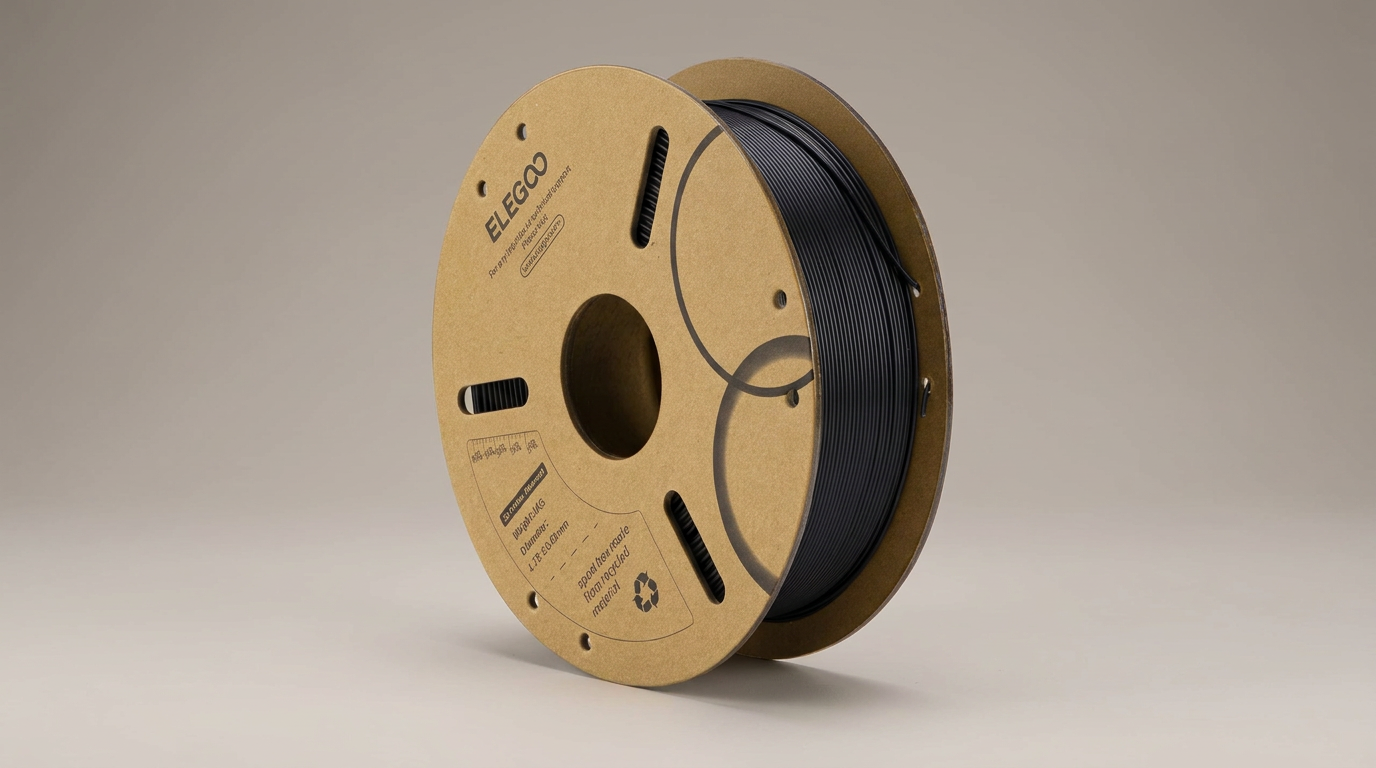
In a 3D printing market often preoccupied with exotic materials and specialized applications, the ELEGOO PLA Filament carves out a niche by expertly fulfilling the needs of high-volume, reliable production. While many brands chase niche improvements, Elegoo doubles down on the foundational demand for consistent, affordable plastic that behaves predictably. This approach positions it not as an innovation leader, but as the quiet bedrock of many makers' workflows.
The real story behind this filament is its role as a "continuity material": the type you can return to repeatedly without recalibrating your entire printing process. For users running multiple machines or tackling large batches of parts, the cost of an inconsistent spool outweighs any marginal performance gains from premium alternatives. Elegoo appears to understand this reality, focusing on the basics that enable uninterrupted output rather than chasing ephemeral benchmarks.
This review dives into how well the ELEGOO PLA Filament executes on its promise of dependable, affordable material, assessing its print quality, handling characteristics, and overall value in the context of an increasingly crowded filament landscape. We explore whether its perceived simplicity masks an underlying design philosophy that prioritizes print farm stability over cutting-edge material science.
What owners love
- + Consistent print quality and reliable layer adhesion
- + Minimal stringing or clogging issues reported
- + Good value, especially during sales
- + Compatible with a wide range of FDM printers
- + Positive experiences with customer support responsiveness
- + Suitable for high-volume or large-part printing needs
Common complaints
- − Requires pre-drying for optimal results
- − Larger spool hole size causes feeding issues on some setups
- − Matte finish may not suit all aesthetic preferences
- − PLA+ version receives mixed reviews, indicating inconsistency
- − Some colors reportedly print smoother than others
Design & Build
The ELEGOO PLA Filament arrives on a cardboard spool, a common choice for cost-effectiveness and increasing environmental consideration. Owners frequently commend the neat winding, noting a "less-tangle" design that prevents snags and breaks during printing. This attention to spooling is crucial for maintaining print consistency, particularly on longer jobs. However, a specific design choice involving the spool's inner diameter presents a unique challenge: several owners mention an oversized center hole. This can lead to feeding issues on certain printer setups, resulting in vibrations and potential print quality degradation if not properly accommodated with a compatible spool holder. This illustrates an interesting "hardware-software friction" where the physical design of the spool can disrupt the mechanical stability of the printer, an often overlooked detail in filament packaging.
Setup & Ease of Use
Initial setup with the ELEGOO PLA is generally straightforward. Owners report that the filament adheres well to print beds, with many noting successful prints using default PLA profiles in popular slicers, even on high-speed machines like the Bambu Lab P1S. This suggests a broad printability window, which is a significant advantage for users seeking a plug-and-play experience. However, a consistent observation is the need for pre-drying. While the filament is advertised as "pre-dried before packaging," many successful users still recommend or find it necessary to dry the filament for at least 30 minutes to an hour prior to use to avoid issues like bubbling or poor layer adhesion. This suggests a "latent moisture tax"; while usable out of box, optimal print quality often requires an additional, proactive step that some users might not anticipate.
Performance in Real Use
When properly dried and fed, the ELEGOO PLA Filament delivers consistent performance. Users frequently describe "clean prints" with "good layer adhesion" and "smooth outer shells." The filament handles well across various printer brands and models, supporting its claim of broad compatibility. Print temperatures around 210°C appear to be a sweet spot for many. While some note a "low gloss black" or matte finish, the overall aesthetic quality is generally well-received for functional parts, cosplay, and other projects where a consistent, unproblematic print is prioritized. The absence of clogging or significant stringing is a recurring positive theme, underscoring its suitability for uninterrupted, long print runs. This reliability is a core tenet of its appeal, particularly for those whose primary concern is throughput.
Software & Ecosystem
Filament does not inherently interact with software in the same way hardware does, but its compatibility with slicer profiles is key to user experience. The ELEGOO PLA thrives here, with multiple users reporting success using default PLA settings in software like Bambu Studio without extensive tweaking. This ease of integration minimizes the "tuning fatigue" often associated with new filament brands, allowing users to focus on design and printing rather than constant profile adjustments. Elegoo offers a range of colors, which expands its utility for diverse projects, though individual colors may exhibit slight performance variations, suggesting minor differences in their formulation. The stated dimensional accuracy of +/- 0.02 mm is also critical for consistent flow rates and reliable extrusion across different software-driven movements.
Value & Reliability
The value proposition of ELEGOO PLA is a major draw. Many owners emphasize its "good for the price" nature, often purchasing it when on sale, positioning it as an economical choice that does not compromise on core print quality. This balance of cost and performance makes it a "go-to" filament for users who frequently require large quantities or for projects where material cost is a factor. Long-term users attest to its consistency, noting prints that "hold strong" over time and a general absence of issues across multiple rolls. Manufacturer support also receives positive mention, with instances of proactive problem resolution, such as offering replacements after a user experienced issues. This combination of affordability, consistent results, and responsive service cultivates strong brand loyalty, fostering a sense of dependable reliability that is highly valued in the 3D printing community.
Verdict
Buy - This filament provides highly consistent and reliable prints at a competitive price point.
This is an excellent choice for anyone needing a dependable, cost-effective PLA for most FDM printing tasks. It is particularly well-suited for users running high-volume production, printing large parts, or those with multiple printers where consistency across spools is critical. If your priority is a material that prints predictably with minimal fuss and good bed adhesion, especially within a limited budget, this filament serves that purpose exceptionally well. However, those seeking specialized finishes, unusual material properties, or who prioritize an absolute 'out-of-the-box' dry experience might consider other options. Users with non-standard spool holders should verify compatibility or be prepared to adapt their setup.
The ELEGOO PLA Filament defines the "baseline excellence" category for 3D printing materials. It eschews material science breakthroughs or hyper-specific applications in favor of mastering the fundamentals: consistent diameter, reliable adhesion, and easy printability. Its true innovation lies not in novelty, but in proving that the most valuable filament for many users is simply the one that prints every time, without exception. This focus on pragmatic reliability, even if it requires a pre-dry, marks it as a workhorse that underpins the real productivity of many FDM users, making it an essential, if unglamorous, component of the modern maker space.
FAQ
More 3D Printing Supplies reviews
Kretrum Silk Dual Color PLA Filament Review: Vibrant Aesthetics for 3D Printing
eSUN High Speed PLA+ Filament Review: The Workhorse for Fast Printers
SUNLU PETG Filament 4kg Review: The Bulk Workhorse for High-Volume Prints
Deeplee PLA+ 2.0 Filament Review: A Workhorse Material for 3D Printing
FLASHFORGE Rapid PLA: The 'Stealth Performance' Filament
RAMBERY Silk Dual Color PLA Filament Review: Aesthetic Impact for Small Prints
This review is based on real experiences shared by owners in online communities.