
ELEGOO PETG Filament: A Workhorse Material for Functional Prints
This review is based on real experiences shared by owners in online communities.
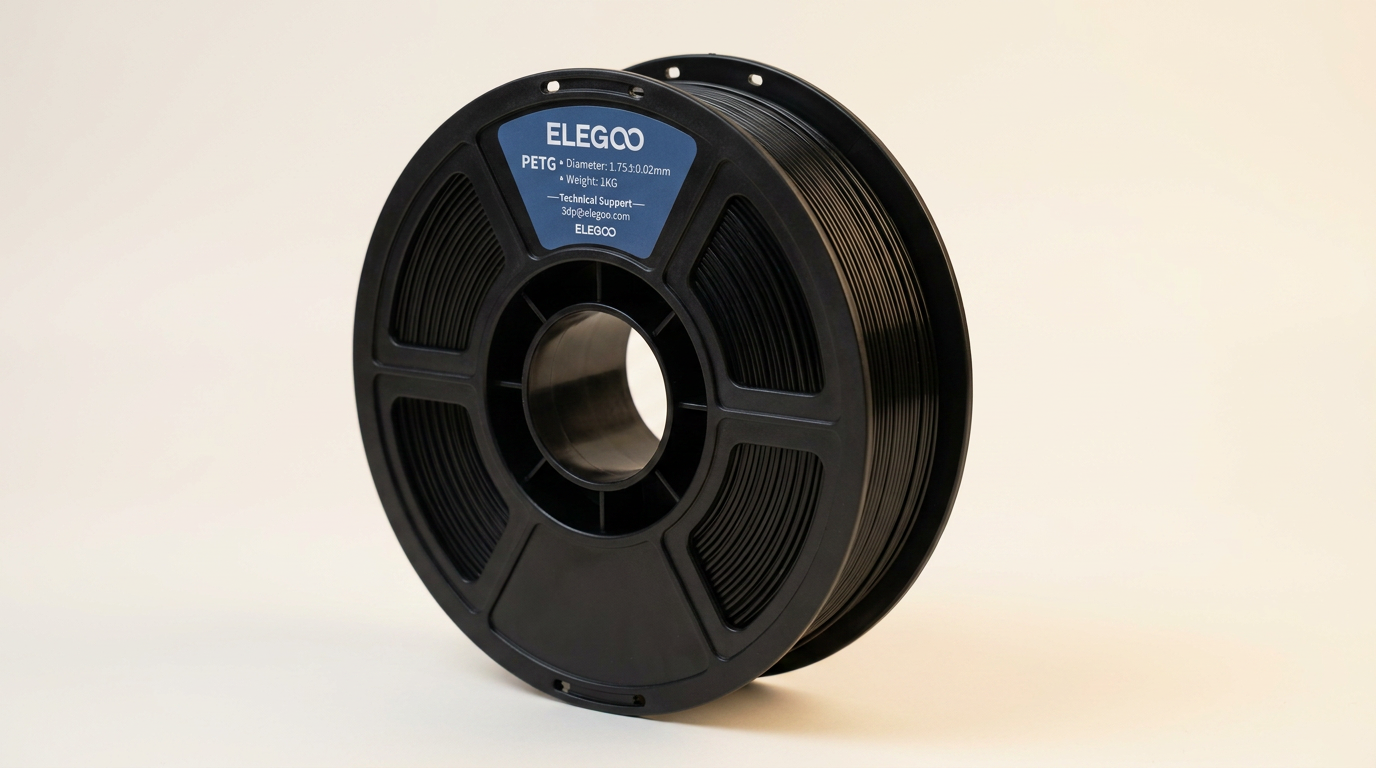
The 3D printing market is saturated with material choices, making the selection of a reliable filament a strategic decision. While PLA remains the entry point for most users, PETG occupies a crucial middle ground, offering enhanced durability and heat resistance without the demanding printing conditions of ABS or ASA. ELEGOO’s PETG filament enters this crowded field claiming a balance of toughness and printability, a combination many filament manufacturers promise but few consistently deliver.
This review dives into ELEGOO's 1.75mm PETG, distinguishing it from competitors and assessing its true standing as a functional printing material. We examine whether its specifications translate into tangible benefits for various print scenarios, and crucially, who stands to gain most from incorporating it into their workflow. The data suggests that while ELEGOO PETG largely lives up to its billing, it also highlights an ongoing conversation around moisture management that is endemic to the material type, regardless of brand affiliation.
What owners love
- + Consistent extrusion and dimensional accuracy reported by owners
- + Excellent layer adhesion for strong, functional prints
- + Good resistance to heat, suitable for outdoor applications
- + Reliable performance across various FDM printers
- + Cost-effective for its quality level
- + Neatly spooled, reducing tangles and jams
Common complaints
- − Often contains significant moisture upon arrival, requiring drying
- − Stringing can occur if retraction settings are not fine-tuned
- − Supports can be challenging to remove cleanly
- − Adhesion to print beds can be overly strong, requiring care
- − Surface finish is inherently shiny, which may not suit all aesthetics
Design & Build
ELEGOO’s PETG filament adheres to the standard 1.75mm diameter, with manufacturers claiming a +/- 0.02mm tolerance. Owners consistently affirm this dimensional accuracy. Owners frequently comment on the filament's neat winding on plastic spools, contrasting favorably with cardboard alternatives which can shed debris and cause feeding issues. This attention to spool quality, what we call 'The Packaging Premium,' minimizes tangling and ensures smooth feeding, a critical factor for print reliability over long durations. While PETG inherently provides specific material properties, the physical presentation and spooling directly impact the user experience, underscoring ELEGOO's focus on foundational reliability.
Setup & Ease of Use
Users describe the ELEGOO PETG as generally straightforward to print, especially for those familiar with PETG's characteristics. However, a near-universal recommendation for new spools is drying. Owners frequently report that the filament arrives 'wetter than a Southeastern swamp,' despite vacuum sealing. This 'humidity tax' requires pre-processing the filament in a dryer, which adds a preparatory step to the workflow. Once dried and with optimized retraction and temperature settings, primarily to manage PETG's tendency to string, users achieve clean prints with strong bed and layer adhesion. Printing temperatures typically range between 240-255 C, aligning with standard PETG profiles.
Performance in Real Use
In operation, the ELEGOO PETG performs as a reliable workhorse. Owners highlight its strong layer bonding and impact resistance, making it suitable for functional parts, mechanical components, and outdoor applications where PLA would deform or degrade. Projects like custom RV mods, car parts, and outdoor tools demonstrate its heat deflection capabilities. Prints exhibit a slightly glossy finish, inherent to PETG. While supports are noted to be tough to remove, this is a common characteristic of PETG across brands, rather than a specific flaw of the ELEGOO offering. The consistent extrusion minimizes clogging and under-extrusion, supporting high print success rates across various printer models, including Bambu Lab and Elegoo Neptune series machines.
Software & Ecosystem
As a filament, ELEGOO PETG integrates directly into existing 3D printing ecosystems without proprietary software dependencies. Its 1.75mm diameter and universal material properties ensure compatibility with the vast majority of FDM 3D printers, from Elegoo's own Neptune series to Creality, Anycubic Kobra, and Bambu Lab machines. Users leverage standard slicer software like Cura or PrusaSlicer, often starting with default PETG profiles and making minor adjustments for retraction to combat stringing. The filament's consistent quality means that once optimal printer settings are identified, they tend to remain stable, reducing the need for constant profile adjustments. This 'profile stability' is a significant, understated benefit for long-term users, reducing friction and troubleshooting during production.
Value & Reliability
ELEGOO PETG positions itself as a high-value option. Priced competitively, typically in the sub-$20 range per kilogram spool, it delivers quality consistent with more expensive brands. Owners frequently cite its affordability as a key purchasing factor, often noting that it performs as well or better than other PETG filaments they have used. The overall reliability stems from its dimensional accuracy, consistent extrusion without clogging, and strong mechanical properties of finished prints. Despite the recurring need for pre-drying, the filament delivers consistent results once properly prepared, making it a dependable choice for those seeking a balance of cost, strength, and printability.
Verdict
Buy - This PETG reliably delivers tough, functional prints across a range of applications, especially after proper drying.
This filament is an excellent choice for users needing durable, heat-resistant parts for outdoor use, mechanical components, or general prototyping where more resilience than PLA is required. Hobbyists and small businesses producing functional prints will find its performance and sub-$20 price point highly attractive. However, those new to PETG or unwilling to incorporate a filament dryer into their workflow should consider other options or be prepared for inconsistent results due to moisture.
ELEGOO PETG exemplifies the 'material commodity paradox' in 3D printing: an otherwise excellent product whose true potential is often obscured by a common, remediable issue like moisture absorption. Its consistent mechanical performance, once dried, reveals a fundamentally solid offering that competes far above its price band, challenging the notion that higher cost inherently equates to superior material. It is a testament to core manufacturing quality despite a ubiquitous environmental vulnerability.
FAQ
More 3D Printing Supplies reviews
Kretrum Silk Dual Color PLA Filament Review: Vibrant Aesthetics for 3D Printing
eSUN High Speed PLA+ Filament Review: The Workhorse for Fast Printers
SUNLU PETG Filament 4kg Review: The Bulk Workhorse for High-Volume Prints
Deeplee PLA+ 2.0 Filament Review: A Workhorse Material for 3D Printing
FLASHFORGE Rapid PLA: The 'Stealth Performance' Filament
RAMBERY Silk Dual Color PLA Filament Review: Aesthetic Impact for Small Prints
This review is based on real experiences shared by owners in online communities.