
Comgrow Filament Dryer Box Review: Essential for Moisture-Free 3D Prints
By AValidReview. An AI-assisted summary of customer feedback, not a hands-on test.
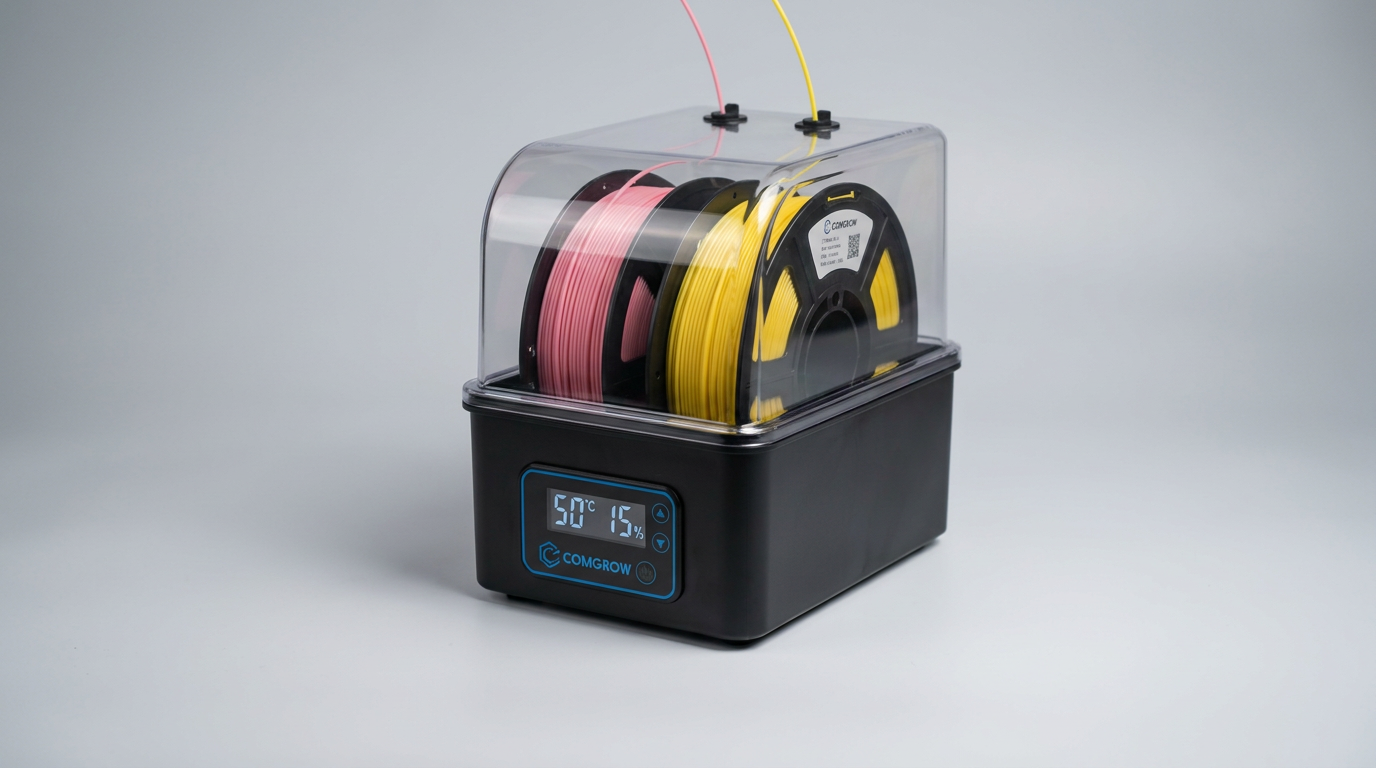
Moisture is a silent killer of 3D print quality, leading to stringing, poor adhesion, and failed prints. Even in moderate humidity environments, filament can absorb enough atmospheric water to degrade its properties. A filament dryer box provides a controlled environment to remove this moisture, ensuring consistent and high-quality results from every spool.
The Comgrow 3D Printer Filament Dryer Box aims to address this common challenge. Designed to both dry and store filament, it promises to revitalize compromised spools and maintain optimal conditions for new ones. This review evaluates its effectiveness, ease of use, and overall value based on extensive user feedback.
What owners love
- + Effectively dries PLA and PETG filament, improving print quality
- + Accommodates two 1kg spools simultaneously
- + Allows direct printing from the dryer box
- + Integrated rollers ensure smooth filament feeding
- + Intuitive controls and clear display for temperature and time
Common complaints
- − Maximum temperature of 50°C may be insufficient for some advanced materials
- − Limited exhaust for humid air requires manual venting
- − Bottom of the unit can get very hot, potentially marking surfaces
- − Initial interface and settings can be confusing
- − Internal fan mortality reported by some users
Design & Build
The Comgrow Filament Dryer Box presents a practical design, allowing it to hold two 1kg filament spools. It includes rollers at the base, facilitating smooth feeding directly to a 3D printer. Owners appreciate this feature, noting it prevents unnecessary handling of freshly dried filament. The unit features built-in silicone-sealed feeding holes, with some newer iterations offering four ports, two on top and two on the front, a reported improvement. The clear casing allows for visual monitoring of spools. While built from lightweight plastic, users generally find it functional, though some note a less premium feel. A recurring caution involves the unit's base, which can reach high temperatures during extended operation, warranting careful placement to avoid surface damage.
Setup & Ease of Use
Initial setup involves loading filament and configuring drying parameters. The dryer features a 2-inch LCD screen displaying temperature and humidity, alongside touch buttons for operation. While the controls allow setting temperatures between 40°C and 50°C and durations from 6 to 48 hours, some users describe the interface as initially unintuitive, occasionally requiring experimentation to master. Instructions are generally clear, but some find the manual less than ideal. A small number of users report initial issues with loose internal cable connections, which are typically easy to resolve by reseating the connections.
Performance in Real Use
The Comgrow dryer consistently delivers on its primary function: removing moisture from PLA and PETG filaments. Users across various humidity levels, including tropical environments, report significant improvements in print quality, citing reduced stringing, better adhesion, and smoother finishes. While the maximum temperature of 50°C is effective for common materials, some advanced filaments might benefit from higher temperatures, a limitation noted by owners. The unit lacks an active exhaust system; condensation often collects inside, requiring users to manually crack the lid or remove silicone plugs to vent humid air effectively. When used for direct printing, the internal rollers generally perform well, though some report instances of filament binding or dislodging if not loaded precisely.
Software & Ecosystem
This product operates as a standalone appliance with no external software or integrated ecosystem beyond its onboard controls. The 2-inch LCD provides real-time temperature and humidity readings, along with countdown timers. Users find this display useful for monitoring the drying process, observing humidity levels decrease over time. The simplicity of operation, once understood, is a strength for many, preferring a dedicated function over complex software integrations.
Value & Reliability
Offered in the under $50 price range, the Comgrow Filament Dryer Box represents strong value. Owners frequently state it rivals more expensive alternatives in core drying performance. Longevity, however, sees mixed reports; one user experienced a fan failure but praised prompt customer service for providing a replacement. The absence of a robust exhaust system is a design oversight that users consistently highlight. Despite these points, its ability to significantly enhance print quality makes it a worthwhile investment for 3D printing enthusiasts operating on a budget. For occasional printers or those living in humid climates, the impact on print reliability can justify the cost within a few uses.
Verdict
Buy - This dryer significantly improves 3D print quality by tackling moisture-related issues effectively.
This Comgrow filament dryer is an excellent choice for mainstream 3D printing hobbyists and occasional users, especially those printing with PLA and PETG. Its ability to dry two spools simultaneously and allow direct printing makes it highly practical. Priced in the under $50 category, it offers substantial value for anyone experiencing print quality degradation due to moist filament.
However, users who frequently print with advanced engineering filaments requiring drying temperatures above 50°C should consider alternatives. Individuals seeking a fully automated system without manual interventions for humidity exhaust might also find its design limitations restrictive.
FAQ
More 3D Printing Supplies reviews
ACESAY Glow in the Dark PLA+ Review: Novelty With Hidden Costs
Kretrum Glow in the Dark PLA Review: Vivid Color, Subdued Glow
MarsWork Pre-Dried PLA Basic 8x250g Bundle Review
Meuymeu 8-Pack Silk and Glow PLA+ Filament Review
SUNLU 16 Color PLA Filament Bundle Review
ANYCUBIC Multicolor PLA 10KG Review: Budget Bulk Reality
This review is based on real experiences shared by owners in online communities.